Spotted Paca

Spotted Paca

Cuniculus paca

Silhouette: Margot Michaud · PhyloPic

LCLeast ConcernNTVUENCR
Daily sighting probability ~10% · With luck
at Manu National Park

In 3 days ~40% in a week ~60%

15 Verified sightings at Manu National Park From 2019 to 2026
67 In all 9 parks
January Best month
🌙 Nocturnal When it's spotted

About the Spotted Paca

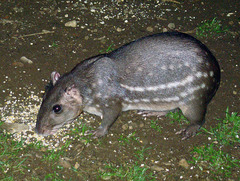
The lowland paca (Cuniculus paca), also known as the spotted paca, is a species of rodent. It has coarse dark brown to black fur, a pale underbelly, and typically 3–5 rows of white spots along its sides. Adults weigh 6 to 12 kilograms (13 to 26 lb). Its zygomatic arch is expanded laterally and dorsally to form a resonating chamber, a feature unique among mammals.

Lowland pacas are primarily nocturnal and solitary. They inhabit forested areas near water, live in burrows, and are strong swimmers that commonly enter the water to escape danger. Their diet consists mainly of plant material, including fruit, seeds, nuts, roots, and tubers, and they act as seed distributors.

Lowland pacas are hunted for their meat and can be agricultural pests, feeding on crops, including yam, cassava, sugar cane, and maize. Their numbers have been reduced by hunting and habitat destruction, although they remain plentiful in protected habitats.

The animal is called paca in most of its range, but tepezcuintle (original Aztec language name) in most of Mexico and Central America, tepesquintle in Guatemala, guardatinaja in Nicaragua, pisquinte in northern Costa Rica, tepezcuinte in... Wikipedia →

Sounds

Call0:24

Ecuador · 2025

© Marc Anderson · XC978268 · CC BY-NC-ND 4.0

Recording0:10

Colombia · 2022

© Ben (Tremarctos Photography) · XC1041238 · CC BY-NC-SA 4.0

Global Distribution

Parks Where Found

# Park Country Daily sighting probability
1 Darién National Park 🇵🇦 Panama
~20%
2 Manu National Park 🇵🇪 Peru
~10%
3 Yasuní National Park 🇪🇨 Ecuador
~10%
4 Arrecifes de Cozumel National Park 🇲🇽 Mexico
~10%
5 Tambopata National Reserve 🇵🇪 Peru
~10%
6 Tijuca National Park 🇧🇷 Brazil
~10%
7 Soberanía National Park 🇵🇦 Panama
~10%
8 Arenal Volcano National Park 🇨🇷 Costa Rica
~10%
9 La Amistad International Park (Panama) 🇵🇦 Panama
<5%

Cities Where Found

# City Country Daily sighting probability
1 Rio de Janeiro 🇧🇷 Brazil
~10%
2 San José 🇨🇷 Costa Rica
<5%

Zoos & Centres Where Found

# Zoo / Centre Country
1 Beijing Zoo 🇨🇳 China In captivity
2 Yaroslavl Zoo 🇷🇺 Russia In captivity
3 Bioparque Municipal Vesty Pakos 🇧🇴 Bolivia In captivity
4 Amaru 🇪🇨 Ecuador In captivity
5 Parque de las Leyendas 🇵🇪 Peru In captivity
6 Zoopark Limpopo 🇷🇺 Russia In captivity
7 Zoológico de Fauna Sudamericana 🇧🇴 Bolivia In captivity
8 Elmwood Park Zoo 🇺🇸 United States In captivity
9 Papiliorama 🇨🇭 Switzerland In captivity
10 Buenaventura Zoo 🇵🇦 Panama In captivity
11 El Nispero Zoo 🇵🇦 Panama In captivity
12 蘭陽動植物王國 🇹🇼 Taiwan In captivity
13 Тульский экзотариум (новая экспозиция) 🇷🇺 Russia In captivity

Before you go

What are the chances of seeing a Spotted Paca in Manu National Park?

With luck

About 10% of wildlife watchers report a Spotted Paca sighting in Manu National Park on a given day, based on 15 verified sightings from GBIF citizen-science data from 2019 to 2026. It is the 20th most-seen of the 42 mammals we can rate there. Over three days the chance rises to about 40%, and over a week to about 60%, if each day is a fresh chance.

When is the best time to see a Spotted Paca in Manu National Park?

January

In that month about 30% of wildlife watchers report a Spotted Paca in Manu National Park on a given day, against under 5% in February, April–May, July and November, the lowest months.

What time of day is best to see a Spotted Paca?

Between 7 and 10 pm

Across all the parks we cover, that three-hour window holds the most Spotted Paca sightings with a recorded time, and about 9 in 10 of them come between 6 pm and 6 am: it is mostly seen at night.

Is Manu National Park the best place to see a Spotted Paca?

2nd of 9

Of the 9 parks where we can rate Spotted Paca sightings, Manu National Park ranks 2nd at about 10%. The best odds are in Darién National Park (Panama, about 20%).

Which relatives of the Spotted Paca live in Manu National Park?

Same order: Rodentia

The closest relatives of the Spotted Paca that you can see in Manu National Park (order Rodentia, Rodents) are Capybara (about 40%), Brown Agouti (about 20%) and Bolivian Squirrel (about 10%), with each one's daily chance of a sighting.

Where does the Spotted Paca sighting chance come from?

GBIF citizen-science records

It is estimated from how often the Spotted Paca is recorded against all the mammals logged in Manu National Park (15 verified sightings from 2019 to 2026), calibrated against known sighting rates. Figures are rounded to the nearest 10% because citizen-science data supports honest approximations, not decimals, and months with records from fewer than five people show "—". How it works.

← Back to Manu National Park