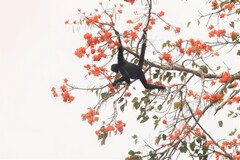
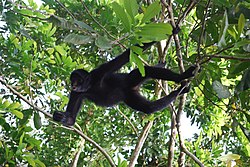
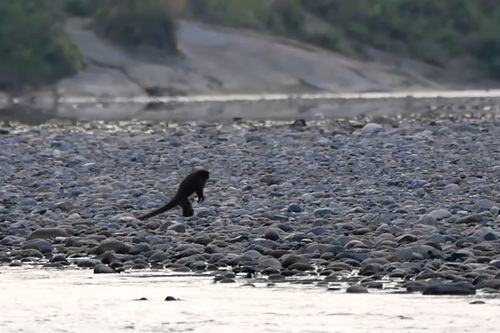
Black-faced Black Spider Monkey

Black-faced Black Spider Monkey

Ateles chamek

Silhouette: Steven Traver · PhyloPic

LCNTVUENEndangeredCR
Daily sighting probability ~30% · Possible
at Manu National Park

In 3 days ~70% in a week ~90%

115 Verified sightings at Manu National Park From 2019 to 2026
150 In all 2 parks
August Best month
☀️ Diurnal When it's spotted

About the Black-faced Black Spider Monkey

The Peruvian spider monkey (Ateles chamek), also known as the black-faced black spider monkey, is a species of spider monkey that lives in Peru, as well as in Brazil and in Bolivia. At 60 centimetres (2 feet) long, they are relatively large among species of monkey, and their strong, prehensile tails can be up to 1 m (3 ft) long. Unlike many species of monkey, they have only a vestigial thumb, an adaptation which enables them to travel using brachiation. Peruvian spider monkeys live in groups of 20–30 individuals, but these groups are rarely all together simultaneously. The size and dynamics of the resulting subgroups vary with food availability and sociobehavioral activity. They prefer to eat fleshy fruit, but will change their diet in response to scarcity of ripe fruit. Individuals of this species also eat small animals, insects and leaves based on availability. Females separate from the band to give birth, typically in the fall. These females inhabit a group of core areas where resources are abundant in certain seasons. Typically, males exhibit ranging over longer distances than females, with movement of individuals enhancing the fluidity of subgroup size. Peruvian spider monkey are independent at about 10 months, with a lifespan of about 20 years. Wikipedia →

Sounds

Recording0:48

Peru · 2024

© Sylvia Billingsley · iNaturalist · CC BY-NC 4.0

Recording0:20

Peru · 2026

© rvanloon · iNaturalist · CC BY-NC 4.0

Global Distribution

Parks Where Found

# Park Country Daily sighting probability
1 Manu National Park 🇵🇪 Peru
~30%
2 Tambopata National Reserve 🇵🇪 Peru
~20%

Zoos & Centres Where Found

# Zoo / Centre Country
1 Fota Wildlife Park 🇮🇪 Ireland In captivity
2 Parque Zoobotânico de Teresina 🇧🇷 Brazil In captivity
3 Ecological Center of Sonora 🇲🇽 Mexico In captivity
4 Curitiba Zoo 🇧🇷 Brazil In captivity
5 Wildlife World Zoo 🇺🇸 United States In captivity
6 Parque Natural de Pucallpa 🇵🇪 Peru In captivity
7 Zoológico de Goiânia 🇧🇷 Brazil In captivity
8 Biocentro Güembé 🇧🇴 Bolivia In captivity
9 Dickerson Park Zoo 🇺🇸 United States In captivity
10 Zoológico Dois Irmãos 🇧🇷 Brazil In captivity
11 Bioparque Municipal Vesty Pakos 🇧🇴 Bolivia In captivity
12 Senda Verde (Wildlife Sanctuary) 🇧🇴 Bolivia In captivity
13 The Wild Safari 🇺🇸 United States In captivity
14 Zoo Santo Inácio 🇵🇹 Portugal In captivity
15 Parque Ecológico de São Carlos 🇧🇷 Brazil In captivity
16 Amaru 🇪🇨 Ecuador In captivity
17 John Ball Zoo 🇺🇸 United States In captivity
18 Buin Zoo 🇨🇱 Chile In captivity
19 Bioparque Wakatá 🇨🇴 Colombia In captivity
20 Yaguar Xoo 🇲🇽 Mexico In captivity
21 Zoo Park da Montanha 🇧🇷 Brazil In captivity
22 Zoológico de Fauna Sudamericana 🇧🇴 Bolivia In captivity
23 Greenville Zoo 🇺🇸 United States In captivity
24 El Nispero Zoo 🇵🇦 Panama In captivity
25 Zoologico Mundo Andino - Tipon 🇵🇪 Peru In captivity
26 Arequipa zoo 🇵🇪 Peru In captivity
27 Guadeloupe zoo 🇫🇷 France In captivity
28 Agroflori Parque de las Aves 🇧🇴 Bolivia In captivity
29 Zoológico do Acre 🇧🇷 Brazil In captivity
30 Cóndor 🇧🇴 Bolivia In captivity
31 Great National Aquarium 🇵🇪 Peru In captivity
32 Huachipa Zoo Park 🇵🇪 Peru In captivity
33 Municipal Aquarium of Cuiabá 🇧🇷 Brazil In captivity
34 Wiwa Quito 🇪🇨 Ecuador In captivity

Before you go

What are the chances of seeing a Black-faced Black Spider Monkey in Manu National Park?

Possible

About 30% of wildlife watchers report a Black-faced Black Spider Monkey sighting in Manu National Park on a given day, based on 115 verified sightings from GBIF citizen-science data from 2019 to 2026. It is the 6th most-seen of the 42 mammals we can rate there. Over three days the chance rises to about 70%, and over a week to about 90%, if each day is a fresh chance.

When is the best time to see a Black-faced Black Spider Monkey in Manu National Park?

January–February, July–August and November

In those months about 40% of wildlife watchers report a Black-faced Black Spider Monkey in Manu National Park on a given day, against about 20% in April–May, October and December, the lowest months.

What time of day is best to see a Black-faced Black Spider Monkey?

Between 3 and 6 pm

Across all the parks we cover, that three-hour window holds the most Black-faced Black Spider Monkey sightings with a recorded time, and about 9 in 10 of them come between 6 am and 6 pm: it is a daytime animal.

Is Manu National Park the best place to see a Black-faced Black Spider Monkey?

Yes

Of the 2 parks where we can rate Black-faced Black Spider Monkey sightings, Manu National Park has the highest daily chance: about 30%. Next come Tambopata National Reserve (Peru, about 20%).

Which relatives of the Black-faced Black Spider Monkey live in Manu National Park?

Same family: Atelidae

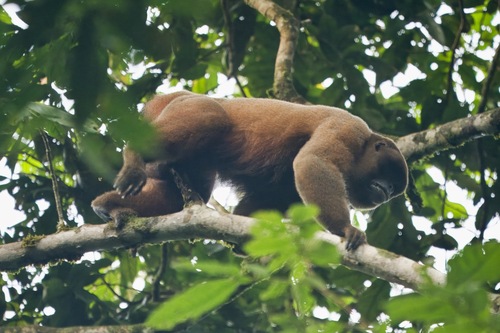
The closest relatives of the Black-faced Black Spider Monkey that you can see in Manu National Park (family Atelidae, Spider, Howler, and Woolly Monkeys) are Bolivian Red Howler Monkey (about 20%), Common Woolly Monkey (about 20%) and Colombian Red Howler Monkey (about 20%), with each one's daily chance of a sighting.

Where does the Black-faced Black Spider Monkey sighting chance come from?

GBIF citizen-science records

It is estimated from how often the Black-faced Black Spider Monkey is recorded against all the mammals logged in Manu National Park (115 verified sightings from 2019 to 2026), calibrated against known sighting rates. Figures are rounded to the nearest 10% because citizen-science data supports honest approximations, not decimals, and months with records from fewer than five people show "—". How it works.

← Back to Manu National Park