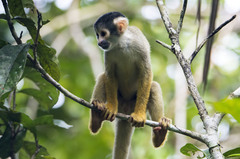
Black-capped Squirrel Monkey

Black-capped Squirrel Monkey

Saimiri boliviensis

Silhouette: PhyloPic

LCLeast ConcernNTVUENCR
Daily sighting probability ~50% · Likely
at Manu National Park

In 3 days ~90% in a week >90%

184 Verified sightings at Manu National Park From 2019 to 2026
330 In all 2 parks
March Best month
☀️ Diurnal When it's spotted

About the Black-capped Squirrel Monkey

The black-capped squirrel monkey (Saimiri boliviensis) is a species of New-World monkey native to the upper Amazon basin in Bolivia, western Brazil and eastern Peru. They weigh between 365 and 1,135 g (13 and 40 oz) and measure, from the head to the base of the tail, between 225 and 370 mm (9 and 15 in). The black-capped squirrel monkey is primarily tree-dwelling and is found in both native and plantation forests as well as some farmed areas near running water. Its diet is omnivorous and mostly consists of flowers, fruit, leaves, nuts, seeds, insects, arachnids, eggs and small vertebrates. It mostly lives in female-dominated troops of around 40 to 75 monkeys, with males having been observed to disperse to live in all-male troops after reaching sexual maturation.

The black-capped squirrel monkey displays sexual dimorphism, with males normally weighing between 550 and 1,135 g (19... Wikipedia →

Sounds

Call1:12

Peru · 2024

© Richard E. Webster · XC963913 · CC BY-NC-SA 4.0

Recording0:14

Bolivia · 2022

© jgaglione · iNaturalist · CC BY-NC 4.0

Global Distribution

Parks Where Found

# Park Country Daily sighting probability
1 Tambopata National Reserve 🇵🇪 Peru
~50%
2 Manu National Park 🇵🇪 Peru
~50%

Cities Where Found

# City Country Daily sighting probability
1 Santa Cruz de la Sierra 🇧🇴 Bolivia
~20%

Zoos & Centres Where Found

# Zoo / Centre Country
1 Pairi Daiza 🇧🇪 Belgium In captivity
2 Basel Zoo 🇨🇭 Switzerland In captivity
3 ZooParc de Beauval 🇫🇷 France In captivity
4 Copenhagen Zoo 🇩🇰 Denmark In captivity
5 Dublin Zoo 🇮🇪 Ireland In captivity
6 Réserve africaine de Sigean 🇫🇷 France In captivity
7 Uminonakamichi Seaside Park 🇯🇵 Japan In captivity
8 Taipei Zoo 🇹🇼 Taiwan In captivity
9 Port Lympne Wild Animal Park 🇬🇧 United Kingdom In captivity
10 Kyushu African Safari 🇯🇵 Japan In captivity
11 Parc zoologique de Montpellier 🇫🇷 France In captivity
12 Wow Safari Thoiry 🇫🇷 France In captivity
13 Ree Park – Ebeltoft Safari 🇩🇰 Denmark In captivity
14 Zoo and Botanical Garden of Branféré 🇫🇷 France In captivity
15 Novosibirsk Zoo 🇷🇺 Russia In captivity
16 Szeged Zoo 🇭🇺 Hungary In captivity
17 Zoo La Barben 🇫🇷 France In captivity
18 Burgers' Ocean 🇳🇱 Netherlands In captivity
19 Chessington World of Adventures 🇬🇧 United Kingdom In captivity
20 Royal Burgers' Zoo 🇳🇱 Netherlands In captivity
21 Terra Natura Benidorm 🇪🇸 Spain In captivity
22 Darling Downs Zoo 🇦🇺 Australia In captivity
23 Hobart Zoo and Aquarium 🇦🇺 Australia In captivity
24 National Zoo & Aquarium 🇦🇺 Australia In captivity
25 Lisbon Zoo 🇵🇹 Portugal In captivity
26 Tierwelt Herberstein 🇦🇹 Austria In captivity
27 Taronga Zoo 🇦🇺 Australia In captivity
28 Bioparque Municipal Vesty Pakos 🇧🇴 Bolivia In captivity
29 Melbourne Zoo 🇦🇺 Australia In captivity
30 Ljubljana Zoo 🇸🇮 Slovenia In captivity
31 Perth Zoo 🇦🇺 Australia In captivity
32 Zoo d'Amnéville 🇫🇷 France In captivity
33 Auckland Zoo 🇳🇿 New Zealand In captivity
34 London Zoo 🇬🇧 United Kingdom In captivity
35 Ouwehands Dierenpark 🇳🇱 Netherlands In captivity
36 Apenheul Primate Park 🇳🇱 Netherlands In captivity
37 Miyazaki City Phoenix Zoo 🇯🇵 Japan In captivity
38 Salzburg Zoo 🇦🇹 Austria In captivity
39 Affen- und Vogelpark Eckenhagen 🇩🇪 Germany In captivity
40 Buffalo Zoo 🇺🇸 United States In captivity
41 Monkeyland 🇿🇦 South Africa In captivity
42 Sydney Zoo 🇦🇺 Australia In captivity
43 Adelaide Zoo 🇦🇺 Australia In captivity
44 Pyrénées Animal Park 🇫🇷 France In captivity
45 Parco Zoo 🇮🇹 Italy In captivity
46 Ichikawa Zoological & Botanical Garden 🇯🇵 Japan In captivity
47 World of Birds Wildlife Sanctuary and Monkey Park 🇿🇦 South Africa In captivity
48 Parc zoologique des Sables d'Olonnes 🇫🇷 France In captivity
49 Zoo de Martinique 🇫🇷 France In captivity
50 Zoo Lagos 🇵🇹 Portugal In captivity

Before you go

What are the chances of seeing a Black-capped Squirrel Monkey in Manu National Park?

Likely

About 50% of wildlife watchers report a Black-capped Squirrel Monkey sighting in Manu National Park on a given day, based on 184 verified sightings from GBIF citizen-science data from 2019 to 2026. It is the most-seen of the 42 mammals we can rate there. Over three days the chance rises to about 90%, and over a week to over 90%, if each day is a fresh chance.

When is the best time to see a Black-capped Squirrel Monkey in Manu National Park?

March and September

In those months about 60% of wildlife watchers report a Black-capped Squirrel Monkey in Manu National Park on a given day, against about 30% in April, the lowest month.

What time of day is best to see a Black-capped Squirrel Monkey?

Between 9 am and noon

Across all the parks we cover, that three-hour window holds the most Black-capped Squirrel Monkey sightings with a recorded time, and about 9 in 10 of them come between 6 am and 6 pm: it is a daytime animal.

Is Manu National Park the best place to see a Black-capped Squirrel Monkey?

Among the best

Of the 2 parks where we can rate Black-capped Squirrel Monkey sightings, Manu National Park ranks 2nd at about 50%, level with the leaders once rounded. The best odds are in Tambopata National Reserve (Peru, about 50%).

Which relatives of the Black-capped Squirrel Monkey live in Manu National Park?

Same family: Cebidae

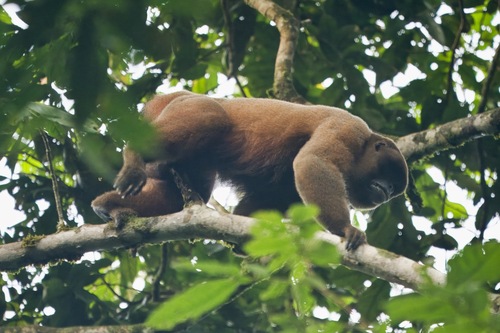
The closest relatives of the Black-capped Squirrel Monkey that you can see in Manu National Park (family Cebidae, Cebid Monkeys) are Brown Capuchin (about 50%) and Shock-headed Capuchin (about 20%), with each one's daily chance of a sighting.

Where does the Black-capped Squirrel Monkey sighting chance come from?

GBIF citizen-science records

It is estimated from how often the Black-capped Squirrel Monkey is recorded against all the mammals logged in Manu National Park (184 verified sightings from 2019 to 2026), calibrated against known sighting rates. Figures are rounded to the nearest 10% because citizen-science data supports honest approximations, not decimals, and months with records from fewer than five people show "—". How it works.

← Back to Manu National Park