Chestnut-capped Puffbird

Chestnut-capped Puffbird

Bucco macrodactylus

Silhouette: Matt Wilkins (Photo by Len Blumin) · PhyloPic

Daily sighting probability ~10% · With luck
at Manu National Park

In 3 days ~20% in a week ~30%

211 Verified sightings at Manu National Park From 2019 to 2026
448 In all 5 parks
May Best month
☀️ Diurnal When it's spotted

About the Chestnut-capped Puffbird

The chestnut-capped puffbird (Bucco macrodactylus) is a species of bird in the family Bucconidae, the puffbirds, nunlets, and nunbirds. It is found in Bolivia, Brazil, Colombia, Ecuador, Peru, and Venezuela. The chestnut-capped puffbird has variously been placed in genera Bucco, Argicus, and Cyphos. As of 2021, the International Ornithological Committee (IOC) and the Clements taxonomy place it in Bucco, while BirdLife International's Handbook of the Birds of the World (HBW) place it by itself in Cyphos. All three treat it as monotypic, though part of the Venezuelan population has sometimes been separated as B. m. caurensis.

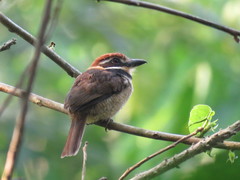
The chestnut-capped puffbird is 14 to 16.5 cm (5.5 to 6.5 in) long and weighs about 25 g (0.88 oz). Its plumage is unique among puffbirds. Its crown is chestnut, its nape a bright reddish orange, and the rest of the upperparts brown with a few lighter bars on the back and many on the rump. The tail is long, narrow, and warm dark brown. It has a thin white supercilium, black cheeks and lower throat with a white line between them, and a reddish white chin and upper throat. The chin feathers curl up over the base of the... Wikipedia →

Sounds

Song0:29

Colombia · 2022

© Mauricio Cuellar Ramirez (@Birding.travel) · XC697655 · CC BY-NC-SA 4.0

Call0:44

Peru · 2009

© Andrew Spencer · XC40312 · CC BY-NC-ND 2.5

Song?0:16

Peru · 2009

© David Geale · XC39706 · CC BY-NC-ND 2.5

Global Distribution

Parks Where Found

# Park Country Daily sighting probability
1 Manu National Park 🇵🇪 Peru
~10%
2 Tambopata National Reserve 🇵🇪 Peru
<5%
3 Yasuní National Park 🇪🇨 Ecuador
<5%
4 Amacayacu National Natural Park 🇨🇴 Colombia
<5%
5 Cuyabeno Wildlife Reserve 🇪🇨 Ecuador
<5%

Before you go

What are the chances of seeing a Chestnut-capped Puffbird in Manu National Park?

With luck

About 10% of wildlife watchers report a Chestnut-capped Puffbird sighting in Manu National Park on a given day, based on 211 verified sightings from GBIF citizen-science data from 2019 to 2026. It is the 268th most-seen of the 641 birds we can rate there. Over three days the chance rises to about 20%, and over a week to about 30%, if each day is a fresh chance.

When is the best time to see a Chestnut-capped Puffbird in Manu National Park?

March–July, September and November

In those months about 10% of wildlife watchers report a Chestnut-capped Puffbird in Manu National Park on a given day, against under 5% in August, October and December–February, the lowest months.

What time of day is best to see a Chestnut-capped Puffbird?

Between 8 and 11 am

Across all the parks we cover, that three-hour window holds the most Chestnut-capped Puffbird sightings with a recorded time, and about 8 in 10 of them come between 6 am and 6 pm: it is a daytime animal.

Is Manu National Park the best place to see a Chestnut-capped Puffbird?

Yes

Of the 5 parks where we can rate Chestnut-capped Puffbird sightings, Manu National Park has the highest daily chance: about 10%. Next come Tambopata National Reserve (Peru, under 5%) and Yasuní National Park (Ecuador, under 5%).

Where does the Chestnut-capped Puffbird sighting chance come from?

GBIF citizen-science records

It is estimated from how often the Chestnut-capped Puffbird is recorded against all the birds logged in Manu National Park (211 verified sightings from 2019 to 2026), calibrated against known sighting rates. Figures are rounded to the nearest 10% because citizen-science data supports honest approximations, not decimals, and months with records from fewer than five people show "—". How it works.

← Back to Manu National Park
