Convict Tree Frog

Convict Tree Frog

Boana calcarata

Silhouette: Andy Wilson · PhyloPic

LCLeast ConcernNTVUENCR
Daily sighting probability ~20% · Possible
at Manu National Park

In 3 days ~50% in a week ~80%

28 Verified sightings at Manu National Park From 2019 to 2026
52 In all 3 parks
December Best month
🌙 Nocturnal When it's spotted

About the Convict Tree Frog

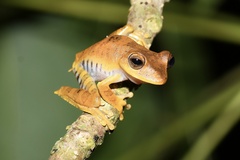
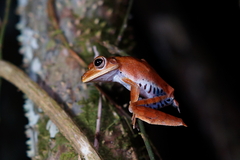
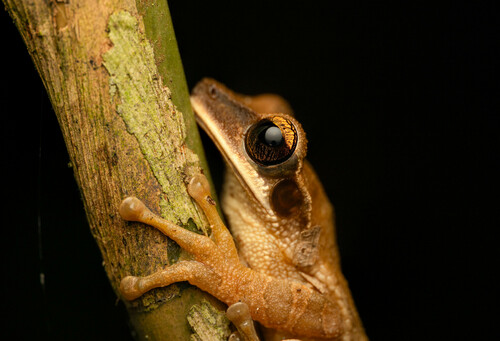
Troschel's treefrog (Boana calcarata), also known as the blue-flanked treefrog or the convict treefrog, is a species of frog in the family Hylidae. It is found in most parts of the Amazon Basin including Suriname. Colombian, Guianan and Venezuelan records need confirmation.

This species was originally described by Franz Hermann Troschel as Hyla calcarata in 1848. After Edward Drinker Cope transferred it to the genus Hypsiboas as Hypsiboas calcaratus in 1867, it was variously recognized with either name until Faivovich and colleagues validated Hypsiboas in 2005. However, in 2017 Alain Dubois showed that Hypsiboas was a junior synonym of Boana, the latter then being the valid name. Many sources, however, still use the old name.

Adult males measure 28–43 mm (1.1–1.7 in) and adult females 46–56 mm (1.8–2.2 in) in snout–vent length. The fingers have only basal webbing while the toes are webbed. Males have pre-pollical spines. The dorsal coloration varies from light brown to reddish brown or brown. There is a dark brown middorsal line, and some specimens have brown diffuse transversal bands. The limbs bear pale brown transversal bars dorsally. Scattered minute... Wikipedia →

Sounds

Recording0:06

Ecuador · 2026

© henryedelman · iNaturalist · CC BY-NC 4.0

Global Distribution

Parks Where Found

# Park Country Daily sighting probability
1 Manu National Park 🇵🇪 Peru
~20%
2 Cuyabeno Wildlife Reserve 🇪🇨 Ecuador
~20%
3 Yasuní National Park 🇪🇨 Ecuador
~10%

Before you go

What are the chances of seeing a Convict Tree Frog in Manu National Park?

Possible

About 20% of wildlife watchers report a Convict Tree Frog sighting in Manu National Park on a given day, based on 28 verified sightings from GBIF citizen-science data from 2019 to 2026. It is the 22nd most-seen of the 67 amphibians we can rate there. Over three days the chance rises to about 50%, and over a week to about 80%, if each day is a fresh chance.

When is the best time to see a Convict Tree Frog in Manu National Park?

October to January

In those months about 30% of wildlife watchers report a Convict Tree Frog in Manu National Park on a given day, against under 5% in February, April, July and September, the lowest months.

What time of day is best to see a Convict Tree Frog?

Between 7 and 10 pm

Across all the parks we cover, that three-hour window holds the most Convict Tree Frog sightings with a recorded time, and about 9 in 10 of them come between 6 pm and 6 am: it is mostly seen at night.

Is Manu National Park the best place to see a Convict Tree Frog?

Yes

Of the 3 parks where we can rate Convict Tree Frog sightings, Manu National Park has the highest daily chance: about 20%. Next come Cuyabeno Wildlife Reserve (Ecuador, about 20%) and Yasuní National Park (Ecuador, about 10%).

Which relatives of the Convict Tree Frog live in Manu National Park?

Same genus: Boana

The closest relatives of the Convict Tree Frog that you can see in Manu National Park (genus Boana, Gladiator Tree Frogs) are Map Tree Frog (about 30%), Rocket Tree Frog (about 30%) and Polka-dot Tree Frog (about 20%), with each one's daily chance of a sighting.

Where does the Convict Tree Frog sighting chance come from?

GBIF citizen-science records

It is estimated from how often the Convict Tree Frog is recorded against all the amphibians logged in Manu National Park (28 verified sightings from 2019 to 2026), calibrated against known sighting rates. Figures are rounded to the nearest 10% because citizen-science data supports honest approximations, not decimals, and months with records from fewer than five people show "—". How it works.

← Back to Manu National Park