Forest Giant Owl

Forest Giant Owl

Caligo eurilochus

Daily sighting probability ~10% · With luck
at Manu National Park

In 3 days ~20% in a week ~40%

6 Verified sightings at Manu National Park From 2019 to 2026
11 In all 2 parks
December Best month
☀️🌙 Day & Night When it's spotted

About the Forest Giant Owl

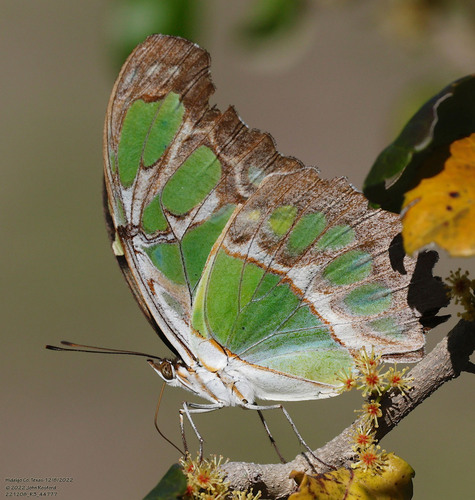
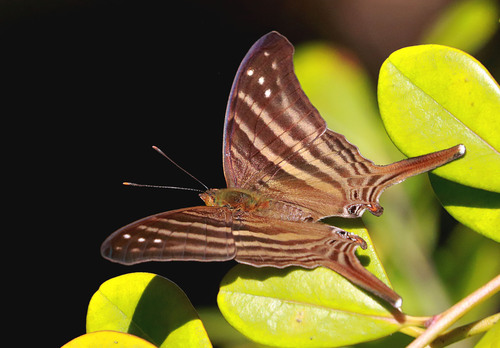
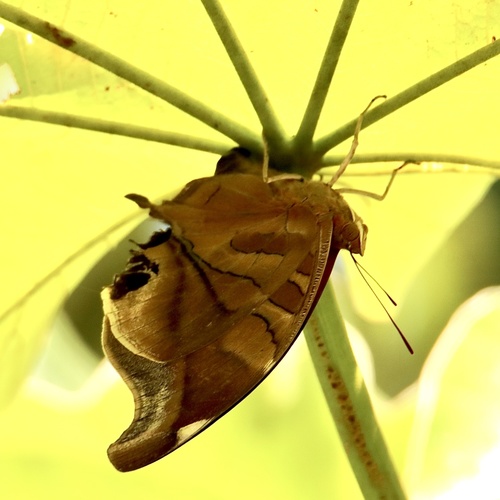
Caligo eurilochus, the forest giant owl, is an owl butterfly (tribe Brassolini of nymphalid subfamily Morphinae) ranging from Mexico, through Central America, to the Amazon River basin in South America. It is a very large butterfly, among the largest in its family, with a wingspan up to 17 centimetres. The type locality is Suriname.

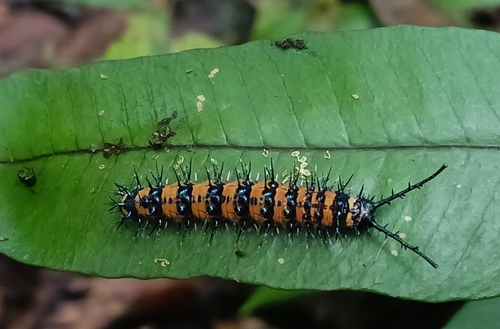
Several subspecies are recognized, but many more have been proposed. The larvae feed on several host plants, including Calathea latifolia (Marantaceae), Heychium sp. (Zingiberaceae), Heliconia latispatha (Heliconiaceae), and Musa spp. (Musaceae). The larva also feed on the fruit of most Musa species. The female lays a large number of eggs of one of the host plants and the small larvae hatch after about 3 to 5 days. Fertile eggs develop a grey ring just above the center. Infertile eggs collapse. The first instar of the larvae are white with two orange/brown stripes down the length of their body leading to two little spindles at the end. Later on in life the larvae develop hairs mimicking spines and a crown made of four horns at the back of their head. The larvae then find a high enough spot to pupate and begin the change of metamorphosis. The large owl butterfly emerges and begins to pump out its wings, later searching for food. the butterflies drink the juices of fermenting fruits and a wide variety of nectar plants. Wikipedia →

Global Distribution

Parks Where Found

# Park Country Daily sighting probability
1 Yasuní National Park 🇪🇨 Ecuador
~10%
2 Manu National Park 🇵🇪 Peru
~10%

Before you go

What are the chances of seeing a Forest Giant Owl in Manu National Park?

With luck

About 10% of wildlife watchers report a Forest Giant Owl sighting in Manu National Park on a given day, based on 6 verified sightings from GBIF citizen-science data from 2019 to 2026. It is the 246th most-seen of the 366 insects we can rate there. Over three days the chance rises to about 20%, and over a week to about 40%, if each day is a fresh chance.

When is the best time to see a Forest Giant Owl in Manu National Park?

February–March, June and October–December

In those months about 10% of wildlife watchers report a Forest Giant Owl in Manu National Park on a given day, against under 5% in January, April–May and July–September, the lowest months.

What time of day is best to see a Forest Giant Owl?

Between 8 and 11 am

Across all the parks we cover, that three-hour window holds the most Forest Giant Owl sightings with a recorded time, and about half of them come between 6 am and 6 pm: it is seen both by day and at night.

Is Manu National Park the best place to see a Forest Giant Owl?

Among the best

Of the 2 parks where we can rate Forest Giant Owl sightings, Manu National Park ranks 2nd at about 10%, level with the leaders once rounded. The best odds are in Yasuní National Park (Ecuador, about 10%).

Where does the Forest Giant Owl sighting chance come from?

GBIF citizen-science records

It is estimated from how often the Forest Giant Owl is recorded against all the insects logged in Manu National Park (6 verified sightings from 2019 to 2026), calibrated against known sighting rates. Figures are rounded to the nearest 10% because citizen-science data supports honest approximations, not decimals, and months with records from fewer than five people show "—". How it works.

← Back to Manu National Park