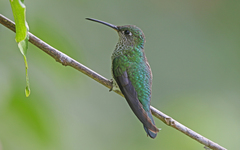

Many-spotted Hummingbird

Many-spotted Hummingbird

Taphrospilus hypostictus

Silhouette: Ferran Sayol · PhyloPic

LCLeast ConcernNTVUENCR
Daily sighting probability ~10% · With luck
at Manu National Park

In 3 days ~30% in a week ~60%

448 Verified sightings at Manu National Park From 2019 to 2026
963 In all 3 parks
January Best month
☀️ Diurnal When it's spotted

About the Many-spotted Hummingbird

The many-spotted hummingbird (Taphrospilus hypostictus) is a species of hummingbird in the "emeralds", tribe Trochilini of subfamily Trochilinae. It is found in Bolivia, Colombia, Ecuador, Peru, and possibly Argentina. The many-spotted hummingbird is the only member of genus Taphrospilus and has no subspecies. However, some authors have placed it in genus Talaphorus which others merged into Leucippus.

The many-spotted hummingbird is 10.5 to 11.4 cm (4.1 to 4.5 in) long and weighs 6.7 to 9 g (0.24 to 0.32 oz). Both sexes have a slightly decurved black bill about 2.3 cm (0.91 in) long, and their plumage is very similar. Adults' upperparts are grass green to coppery bronze and the underparts white. The underparts except the central belly are thickly spotted with green, the female's somewhat less heavily. Their tail is blue-green with dusky gray tips to the feathers. Juveniles are the same with the addition of buffy fringes on the head feathers.

The many-spotted hummingbird's primary range is the eastern slope of the Andes from Ecuador's Napo Province through eastern Peru into central Bolivia. It has also been... Wikipedia →

Sounds

Call0:14

Ecuador · 2004

© Jonas Nilsson · XC262880 · CC BY-NC-SA 4.0

Flight call0:12

Ecuador · 2008

© Charlie Vogt · XC21061 · CC BY-NC-ND 2.5

Call0:08

Ecuador · 2024

© Paul Driver · XC978301 · CC BY-NC-SA 4.0

Global Distribution

Parks Where Found

# Park Country Daily sighting probability
1 Podocarpus National Park 🇪🇨 Ecuador
~30%
2 Manu National Park 🇵🇪 Peru
~10%
3 Yasuní National Park 🇪🇨 Ecuador
<5%

Before you go

What are the chances of seeing a Many-spotted Hummingbird in Manu National Park?

With luck

About 10% of wildlife watchers report a Many-spotted Hummingbird sighting in Manu National Park on a given day, based on 448 verified sightings from GBIF citizen-science data from 2019 to 2026. It is the 141st most-seen of the 641 birds we can rate there. Over three days the chance rises to about 30%, and over a week to about 60%, if each day is a fresh chance.

When is the best time to see a Many-spotted Hummingbird in Manu National Park?

January and April–May

In those months about 20% of wildlife watchers report a Many-spotted Hummingbird in Manu National Park on a given day, against about 10% in February–March and June–December, the lowest months.

What time of day is best to see a Many-spotted Hummingbird?

Between 1 and 4 pm

Across all the parks we cover, that three-hour window holds the most Many-spotted Hummingbird sightings with a recorded time, and about 9 in 10 of them come between 6 am and 6 pm: it is a daytime animal.

Is Manu National Park the best place to see a Many-spotted Hummingbird?

2nd of 3

Of the 3 parks where we can rate Many-spotted Hummingbird sightings, Manu National Park ranks 2nd at about 10%. The best odds are in Podocarpus National Park (Ecuador, about 30%).

Which relatives of the Many-spotted Hummingbird live in Manu National Park?

Same family: Trochilidae

The closest relatives of the Many-spotted Hummingbird that you can see in Manu National Park (family Trochilidae, Hummingbirds) are Golden-tailed Sapphire (about 30%), White-necked Jacobin (about 30%) and Gray-breasted Sabrewing (about 30%), with each one's daily chance of a sighting.

Where does the Many-spotted Hummingbird sighting chance come from?

GBIF citizen-science records

It is estimated from how often the Many-spotted Hummingbird is recorded against all the birds logged in Manu National Park (448 verified sightings from 2019 to 2026), calibrated against known sighting rates. Figures are rounded to the nearest 10% because citizen-science data supports honest approximations, not decimals, and months with records from fewer than five people show "—". How it works.

← Back to Manu National Park