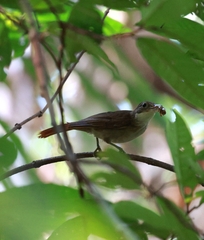
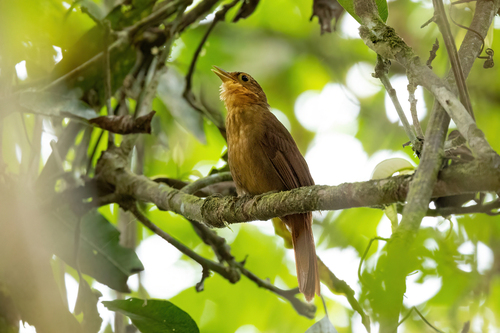
Olive-backed Foliage-gleaner

Olive-backed Foliage-gleaner

Automolus infuscatus

Silhouette: Sheatherius · PhyloPic

LCLeast ConcernNTVUENCR
Daily sighting probability <5% · Rare
at Manu National Park

In 3 days ~10% in a week ~20%

116 Verified sightings at Manu National Park From 2019 to 2026
572 In all 5 parks
September Best month
☀️ Diurnal When it's spotted

About the Olive-backed Foliage-gleaner

The olive-backed foliage-gleaner (Automolus infuscatus) is a species of bird in the Furnariinae subfamily of the ovenbird family Furnariidae. It is found in every mainland South American country except Argentina, Chile, Paraguay, and Uruguay.

The olive-backed foliage-gleaner has these four subspecies: Automolus infuscatus infuscatus (Sclater, PL, 1856) Automolus infuscatus badius Zimmer, JT, 1935 Automolus infuscatus cervicalis (Sclater, PL, 1889) Automolus infuscatus purusianus Todd, 1948

What is now the Para foliage-gleaner (A. paraensis) was a fifth subspecies. Following a 2002 publication, major taxonomic systems elevated it to species rank. The olive-backed foliage-gleaner, Para foliage-gleaner, Pernambuco foliage-gleaner (A. lammi), and white-eyed foliage-gleaner (A. leucophthalmus) form a superspecies.

The olive-backed foliage-gleaner is 18 to 19 cm (7.1 to 7.5 in) long and weighs about 27 to 40 g (0.95 to 1.4 oz). It is a fairly large member of its genus and has a heavy bill. The sexes have the same plumage. Adults of the nominate subspecies A. i. infuscatus have a mostly blackish brown face with faint reddish streaks on the... Wikipedia →

Sounds

Call0:17

Brazil · 2026

© JAYRSON ARAUJO DE OLIVEIRA · XC1186145 · CC BY-NC-SA 4.0

Song0:20

Brazil · 2021

© Matheus Fernandes Moraes Silva · XC658836 · CC BY-NC-ND 4.0

Call0:08

Bolivia · 2021

© Jacob Wijpkema · XC685687 · CC BY-NC-SA 4.0

Global Distribution

Parks Where Found

# Park Country Daily sighting probability
1 Tambopata National Reserve 🇵🇪 Peru
~10%
2 Manu National Park 🇵🇪 Peru
<5%
3 Amacayacu National Natural Park 🇨🇴 Colombia
<5%
4 Brownsberg Nature Park 🇸🇷 Suriname
<5%
5 Yasuní National Park 🇪🇨 Ecuador
<5%

Before you go

What are the chances of seeing an Olive-backed Foliage-gleaner in Manu National Park?

Rare

Under 5% of wildlife watchers report an Olive-backed Foliage-gleaner sighting in Manu National Park on a given day, based on 116 verified sightings from GBIF citizen-science data from 2019 to 2026. It is the 360th most-seen of the 641 birds we can rate there. Over three days the chance rises to about 10%, and over a week to about 20%, if each day is a fresh chance.

When is the best time to see an Olive-backed Foliage-gleaner in Manu National Park?

September and December

In those months about 10% of wildlife watchers report an Olive-backed Foliage-gleaner in Manu National Park on a given day, against under 5% in January–August and October–November, the lowest months.

What time of day is best to see an Olive-backed Foliage-gleaner?

Between 8 and 11 am

Across all the parks we cover, that three-hour window holds the most Olive-backed Foliage-gleaner sightings with a recorded time, and nearly all of them come between 6 am and 6 pm: it is a daytime animal.

Is Manu National Park the best place to see an Olive-backed Foliage-gleaner?

2nd of 5

Of the 5 parks where we can rate Olive-backed Foliage-gleaner sightings, Manu National Park ranks 2nd at under 5%. The best odds are in Tambopata National Reserve (Peru, about 10%).

Which relatives of the Olive-backed Foliage-gleaner live in Manu National Park?

Same genus: Automolus

The closest relatives of the Olive-backed Foliage-gleaner that you can see in Manu National Park (genus Automolus, Automolus Foliage-gleaners) are Chestnut-crowned Foliage-gleaner (about 10%) and Ochre-throated Foliage-gleaner (about 10%), with each one's daily chance of a sighting.

Where does the Olive-backed Foliage-gleaner sighting chance come from?

GBIF citizen-science records

It is estimated from how often the Olive-backed Foliage-gleaner is recorded against all the birds logged in Manu National Park (116 verified sightings from 2019 to 2026), calibrated against known sighting rates. Figures are rounded to the nearest 10% because citizen-science data supports honest approximations, not decimals, and months with records from fewer than five people show "—". How it works.

← Back to Manu National Park