Pale-winged Trumpeter

Pale-winged Trumpeter

Psophia leucoptera

Silhouette: Kai Caspar · PhyloPic

LCLeast ConcernNTVUENCR
Daily sighting probability <5% · Rare
at Manu National Park

In 3 days ~10% in a week ~30%

226 Verified sightings at Manu National Park From 2019 to 2026
509 In all 2 parks
December Best month
☀️ Diurnal When it's spotted

About the Pale-winged Trumpeter

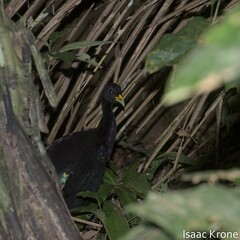
The pale-winged trumpeter (Psophia leucoptera), also known as the white-winged trumpeter, is a species of bird in the family Psophiidae. It is found in the western Amazon rainforest of Bolivia, Brazil, and Peru. The "ochre-winged" trumpeter is now considered a subspecies of the grey-winged trumpeter (P. crepitans).

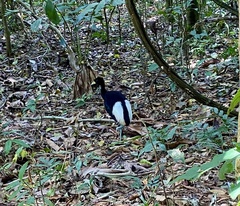
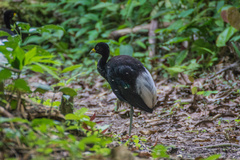
The pale-winged trumpeter is a chicken-like bird with a long neck and legs and a hump-backed profile. It is 45 to 52 centimetres (18 to 20 in) long. Males weigh 1.28 to 1.44 kg (2.8 to 3.2 lb) and females 1.18 to 1.32 kg (2.6 to 2.9 lb). The sexes are similar in appearance. Their stout, slightly decurved, bill is grayish with a yellow base and their legs and feet are pale grayish. They are almost entirely black, with a white hindwing and purple, green, and bronze iridescence on the outer wing coverts.

The pale-winged trumpeter is found in the upper Amazon Basin of eastern Peru, northern and central Bolivia, and central-western Brazil south of the Amazon and west of the Rio Madeira. A single record in extreme southeastern Colombia has not been accepted by the South American Classification Committee... Wikipedia →

Sounds

Call0:49

Brazil · 2026

© JAYRSON ARAUJO DE OLIVEIRA · XC1186201 · CC BY-NC-SA 4.0

Song0:51

Brazil · 2018

© Jerome Fischer · XC435881 · CC BY-NC-SA 4.0

?0:37

Peru · 2008

© F. Schmitt · XC33914 · CC BY-NC-ND 2.5

Global Distribution

Parks Where Found

# Park Country Daily sighting probability
1 Tambopata National Reserve 🇵🇪 Peru
~10%
2 Manu National Park 🇵🇪 Peru
<5%

Zoos & Centres Where Found

# Zoo / Centre Country
1 Great National Aquarium 🇵🇪 Peru In captivity

Before you go

What are the chances of seeing a Pale-winged Trumpeter in Manu National Park?

Rare

Under 5% of wildlife watchers report a Pale-winged Trumpeter sighting in Manu National Park on a given day, based on 226 verified sightings from GBIF citizen-science data from 2019 to 2026. It is the 296th most-seen of the 641 birds we can rate there. Over three days the chance rises to about 10%, and over a week to about 30%, if each day is a fresh chance.

When is the best time to see a Pale-winged Trumpeter in Manu National Park?

May, September and November–March

In those months about 10% of wildlife watchers report a Pale-winged Trumpeter in Manu National Park on a given day, against under 5% in April, June–August and October, the lowest months.

What time of day is best to see a Pale-winged Trumpeter?

Between 2 and 5 pm

Across all the parks we cover, that three-hour window holds the most Pale-winged Trumpeter sightings with a recorded time, and about 8 in 10 of them come between 6 am and 6 pm: it is a daytime animal.

Is Manu National Park the best place to see a Pale-winged Trumpeter?

2nd of 2

Of the 2 parks where we can rate Pale-winged Trumpeter sightings, Manu National Park ranks 2nd at under 5%. The best odds are in Tambopata National Reserve (Peru, about 10%).

Which relatives of the Pale-winged Trumpeter live in Manu National Park?

Same order: Gruiformes

The closest relatives of the Pale-winged Trumpeter that you can see in Manu National Park (order Gruiformes, Cranes, Rails, and Allies) are American Purple Gallinule (about 20%), Limpkin (about 20%) and Gray-cowled Wood-Rail (about 20%), with each one's daily chance of a sighting.

Where does the Pale-winged Trumpeter sighting chance come from?

GBIF citizen-science records

It is estimated from how often the Pale-winged Trumpeter is recorded against all the birds logged in Manu National Park (226 verified sightings from 2019 to 2026), calibrated against known sighting rates. Figures are rounded to the nearest 10% because citizen-science data supports honest approximations, not decimals, and months with records from fewer than five people show "—". How it works.

← Back to Manu National Park