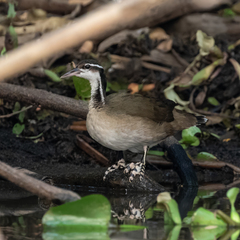
Sungrebe

Sungrebe

Heliornis fulica

Silhouette: Sheatherius · PhyloPic

LCLeast ConcernNTVUENCR
Daily sighting probability ~10% · With luck
at Manu National Park

In 3 days ~10% in a week ~30%

211 Verified sightings at Manu National Park From 2019 to 2026
1,951 In all 14 parks
November Best month
☀️ Diurnal When it's spotted

About the Sungrebe

The sungrebe or American finfoot (Heliornis fulica) is a small aquatic gruiform found in the tropical and subtropical Americas from northeastern Mexico to central Ecuador and southern Brazil. The sungrebe is now the only species placed in the genus Heliornis that was erected by the French naturalist Pierre Bonnaterre in 1791 with the sungrebe as the type species. The name of the genus combines the Ancient Greek hēlios meaning "sun" and ornis meaning "bird". The specific epithet fulica is Latin for "coot".

These waterfowl have broad lobes on their feet, convergent to that of grebes or coots, that they use to propel themselves in the water. They are reclusive birds, preferring well-covered slow-flowing streams and secluded waterways, sometimes swimming partly submerged, like an anhinga.

Sungrebes are unique among birds in that males have "pouches", folds of skin under their wings in which they carry their young from hatching until the chicks are able to swim for themselves. This has led to them being called "Marsupial Birds"; certain feathers, with their own musculature, serve as "guard rails" to prevent the baby from falling out.

Sungrebes, when perching or on land... Wikipedia →

Sounds

Song0:05

Brazil · 2023

© JAYRSON ARAUJO DE OLIVEIRA · XC790481 · CC BY-NC-SA 4.0

Alarm call0:11

Colombia · 2022

© Frank Lambert · XC777212 · CC BY-NC-ND 4.0

Call0:25

Brazil · 2021

© João Vitor Oliveira de Souza · XC744427 · CC BY-NC-SA 4.0

Global Distribution

Parks Where Found

# Park Country Daily sighting probability
1 Cuyabeno Wildlife Reserve 🇪🇨 Ecuador
~30%
2 Yasuní National Park 🇪🇨 Ecuador
~20%
3 Anavilhanas National Park 🇧🇷 Brazil
~20%
4 Tortuguero National Park 🇨🇷 Costa Rica
~10%
5 Montes Azules Biosphere Reserve 🇲🇽 Mexico
~10%
6 Amacayacu National Natural Park 🇨🇴 Colombia
~10%
7 Tambopata National Reserve 🇵🇪 Peru
~10%
8 Manu National Park 🇵🇪 Peru
~10%
9 Parque Estadual Encontro das Águas 🇧🇷 Brazil
<5%
10 Tikal National Park 🇬🇹 Guatemala
<5%
11 Calakmul Biosphere Reserve 🇲🇽 Mexico
<5%
12 Braulio Carrillo National Park 🇨🇷 Costa Rica
<5%
13 Arenal Volcano National Park 🇨🇷 Costa Rica
<5%
14 Iguaçu National Park 🇧🇷 Brazil
<5%

Before you go

What are the chances of seeing a Sungrebe in Manu National Park?

With luck

About 10% of wildlife watchers report a Sungrebe sighting in Manu National Park on a given day, based on 211 verified sightings from GBIF citizen-science data from 2019 to 2026. It is the 280th most-seen of the 641 birds we can rate there. Over three days the chance rises to about 10%, and over a week to about 30%, if each day is a fresh chance.

When is the best time to see a Sungrebe in Manu National Park?

September to December

In those months about 10% of wildlife watchers report a Sungrebe in Manu National Park on a given day, against under 5% in January to August, the lowest months.

What time of day is best to see a Sungrebe?

Between 8 and 11 am

Across all the parks we cover, that three-hour window holds the most Sungrebe sightings with a recorded time, and about 9 in 10 of them come between 6 am and 6 pm: it is a daytime animal.

Which relatives of the Sungrebe live in Manu National Park?

Same order: Gruiformes

The closest relatives of the Sungrebe that you can see in Manu National Park (order Gruiformes, Cranes, Rails, and Allies) are American Purple Gallinule (about 20%), Limpkin (about 20%) and Gray-cowled Wood-Rail (about 20%), with each one's daily chance of a sighting.

Where does the Sungrebe sighting chance come from?

GBIF citizen-science records

It is estimated from how often the Sungrebe is recorded against all the birds logged in Manu National Park (211 verified sightings from 2019 to 2026), calibrated against known sighting rates. Figures are rounded to the nearest 10% because citizen-science data supports honest approximations, not decimals, and months with records from fewer than five people show "—". How it works.

← Back to Manu National Park