
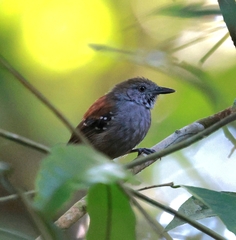

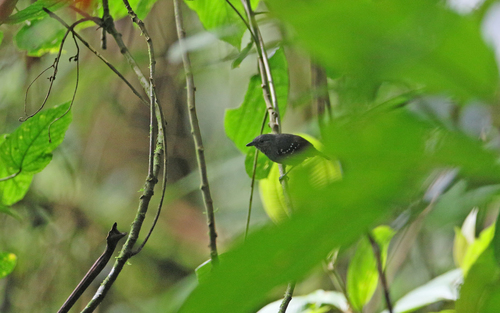
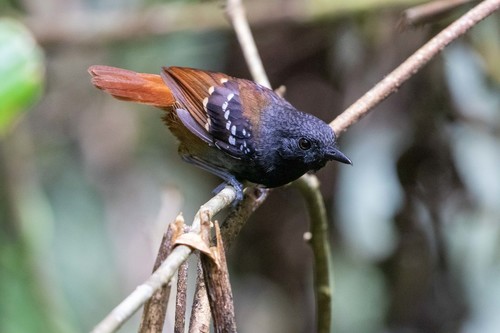
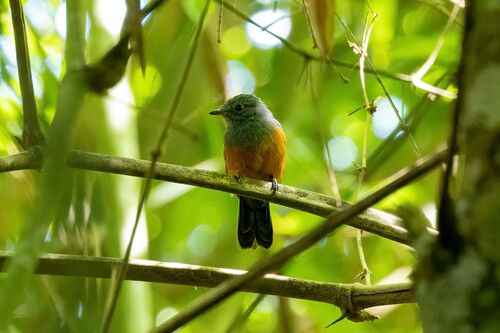
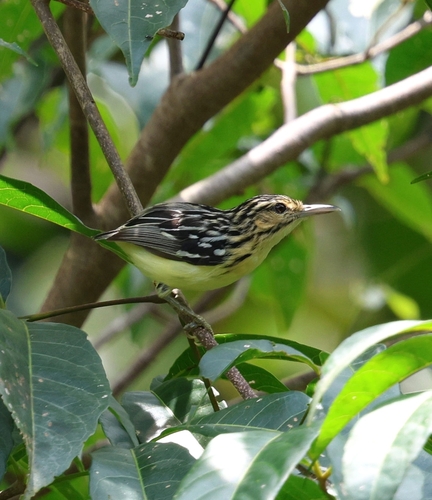
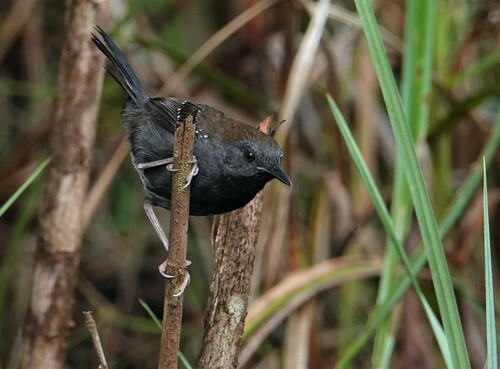
Rufous-backed Antwren

Rufous-backed Antwren

Epinecrophylla haematonota

Silhouette: Sheatherius · PhyloPic

LCLeast ConcernNTVUENCR
Daily sighting probability <5% · Rare
at Manu National Park

In 3 days <5% in a week ~10%

37 Verified sightings at Manu National Park From 2019 to 2026
91 In all 3 parks
August Best month
☀️ Diurnal When it's spotted

About the Rufous-backed Antwren

The rufous-backed stipplethroat (Epinecrophylla haematonota) is a species of bird in subfamily Thamnophilinae of family Thamnophilidae, the "typical antbirds". It is found in Brazil, Colombia, Ecuador, Peru, and Venezuela. In its complex taxonomic history, Epinecrophylla haematonota has also been called the rufous-backed antwren, stipple-throated antwren, Napo stipple-throated antwren, and western stipple-throated antwren.

The rufous-backed stipplethroat was described by the English zoologist Philip Sclater in 1857 and given the binomial name Formicivora haematonota. It was later placed in genus Myrmotherula. Based on genetic and vocal studies it and seven other members of that genus were moved to the newly created genus Epinecrophylla. All were eventually named "stipplethroats" to highlight a common feature and to set them apart from Myrmotherula antwrens.

Since 2019 taxonomists have recognized these three subspecies within Epinecrophylla haematonota: For a time previously each of... Wikipedia →

Sounds

Song0:23

Ecuador · 2019

© Jerome Fischer · XC478369 · CC BY-NC-SA 4.0

Call0:33

Brazil · 2019

© Felipe Arantes · XC474967 · CC BY-NC-SA 4.0

Song0:39

Peru · 2015

© Dan Lane · XC298880 · CC BY-NC-SA 4.0

Global Distribution

Parks Where Found

# Park Country Daily sighting probability
1 Yasuní National Park 🇪🇨 Ecuador
<5%
2 Manu National Park 🇵🇪 Peru
<5%
3 Tambopata National Reserve 🇵🇪 Peru
<5%

Before you go

What are the chances of seeing a Rufous-backed Antwren in Manu National Park?

Rare

Under 5% of wildlife watchers report a Rufous-backed Antwren sighting in Manu National Park on a given day, based on 37 verified sightings from GBIF citizen-science data from 2019 to 2026. It is the 487th most-seen of the 641 birds we can rate there. Over three days the chance rises to under 5%, and over a week to about 10%, if each day is a fresh chance.

When is the best time to see a Rufous-backed Antwren in Manu National Park?

Any time of year

In every month with enough records, under 5% of wildlife watchers report a Rufous-backed Antwren in Manu National Park on a given day, so our monthly data shows no clear season.

What time of day is best to see a Rufous-backed Antwren?

Between 9 am and noon

Across all the parks we cover, that three-hour window holds the most Rufous-backed Antwren sightings with a recorded time, and about 8 in 10 of them come between 6 am and 6 pm: it is a daytime animal.

Is Manu National Park the best place to see a Rufous-backed Antwren?

Among the best

Of the 3 parks where we can rate Rufous-backed Antwren sightings, Manu National Park ranks 2nd at under 5%, level with the leaders once rounded. The best odds are in Yasuní National Park (Ecuador, under 5%).

Where does the Rufous-backed Antwren sighting chance come from?

GBIF citizen-science records

It is estimated from how often the Rufous-backed Antwren is recorded against all the birds logged in Manu National Park (37 verified sightings from 2019 to 2026), calibrated against known sighting rates. Figures are rounded to the nearest 10% because citizen-science data supports honest approximations, not decimals, and months with records from fewer than five people show "—". How it works.

← Back to Manu National Park