Rufous-breasted Piculet

Rufous-breasted Piculet

Picumnus rufiventris

Silhouette: Pepe Reigada · PhyloPic

LCLeast ConcernNTVUENCR
Daily sighting probability <5% · Rare
at Manu National Park

In 3 days ~10% in a week ~30%

180 Verified sightings at Manu National Park From 2019 to 2026
210 In all 2 parks
May Best month
☀️ Diurnal When it's spotted

About the Rufous-breasted Piculet

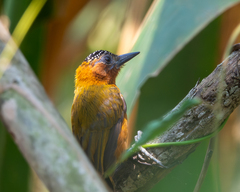
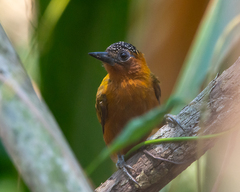
The rufous-breasted piculet (Picumnus rufiventris) is a species of bird in subfamily Picumninae of the woodpecker family Picidae. It is found in Bolivia, Brazil, Colombia, Ecuador, and Peru. The rufous-breasted piculet is 9 to 11 cm (3.5 to 4.3 in) long and weighs 12 to 21 g (0.42 to 0.74 oz). Adult males of the nominate subspecies have a black crown with wide red tips on most of the feathers and small white to buff spots on its sides and rear border. Their face, a narrow collar on their nape, and their underparts are rich orange rufous or rufous chestnut. Their upperparts are yellowish olive. Their flight feathers are dark with yellowish olive edges. Their tail is black; the innermost pair of feather have mostly white inner webs and pale buff tips, and the outer pairs have a wide buff stripe near the end. Their chin and throat feathers are pale buffish white with narrow blackish edges. Their iris is brown, the bill blackish, and the legs gray. Adult females are identical except for... Wikipedia →

Sounds

Tamborilar0:31

Brazil · 2018

© Caio Brito · XC556499 · CC BY-NC-SA 4.0

Song0:10

Brazil · 2017

© Fernando Igor de Godoy · XC537505 · CC BY-NC-SA 4.0

Drumming0:05

Brazil · 2018

© GABRIEL LEITE · XC431905 · CC BY-NC-SA 4.0

Global Distribution

Parks Where Found

# Park Country Daily sighting probability
1 Manu National Park 🇵🇪 Peru
<5%
2 Tambopata National Reserve 🇵🇪 Peru
<5%

Before you go

What are the chances of seeing a Rufous-breasted Piculet in Manu National Park?

Rare

Under 5% of wildlife watchers report a Rufous-breasted Piculet sighting in Manu National Park on a given day, based on 180 verified sightings from GBIF citizen-science data from 2019 to 2026. It is the 300th most-seen of the 641 birds we can rate there. Over three days the chance rises to about 10%, and over a week to about 30%, if each day is a fresh chance.

When is the best time to see a Rufous-breasted Piculet in Manu National Park?

April–June and December–January

In those months about 10% of wildlife watchers report a Rufous-breasted Piculet in Manu National Park on a given day, against under 5% in February–March and July–November, the lowest months.

What time of day is best to see a Rufous-breasted Piculet?

Between 7 and 10 am

Across all the parks we cover, that three-hour window holds the most Rufous-breasted Piculet sightings with a recorded time, and about 8 in 10 of them come between 6 am and 6 pm: it is a daytime animal.

Is Manu National Park the best place to see a Rufous-breasted Piculet?

Yes

Of the 2 parks where we can rate Rufous-breasted Piculet sightings, Manu National Park has the highest daily chance: under 5%. Next come Tambopata National Reserve (Peru, under 5%).

Where does the Rufous-breasted Piculet sighting chance come from?

GBIF citizen-science records

It is estimated from how often the Rufous-breasted Piculet is recorded against all the birds logged in Manu National Park (180 verified sightings from 2019 to 2026), calibrated against known sighting rates. Figures are rounded to the nearest 10% because citizen-science data supports honest approximations, not decimals, and months with records from fewer than five people show "—". How it works.

← Back to Manu National Park