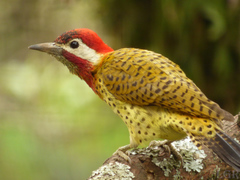
Spot-breasted Woodpecker

Spot-breasted Woodpecker

Colaptes punctigula

Silhouette: FJDegrange · PhyloPic

LCLeast ConcernNTVUENCR
Daily sighting probability ~10% · With luck
at Manu National Park

In 3 days ~30% in a week ~50%

399 Verified sightings at Manu National Park From 2019 to 2026
959 In all 7 parks
July Best month
☀️ Diurnal When it's spotted

About the Spot-breasted Woodpecker

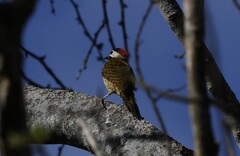
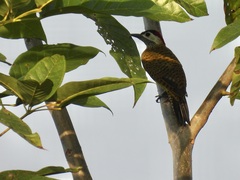
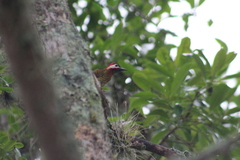
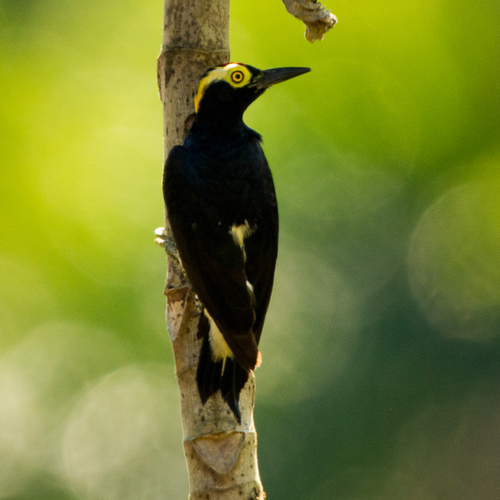
The spot-breasted woodpecker or spot-breasted flicker (Colaptes punctigula) is a species of bird in subfamily Picinae of the woodpecker family Picidae. It is found in Panama and every mainland South American country except Argentina, Chile, Paraguay, and Uruguay.

The spot-breasted woodpecker was described by the French polymath Georges-Louis Leclerc, Comte de Buffon in 1780 in his Histoire Naturelle des Oiseaux from a specimen collected in Cayenne, French Guiana. The bird was also illustrated in a hand-colored plate engraved by François-Nicolas Martinet in the Planches Enluminées D'Histoire Naturelle, which was produced under the supervision of Edme-Louis Daubenton to accompany Buffon's text. Neither the plate caption nor Buffon's description included a scientific name, but in 1783 the Dutch naturalist Pieter Boddaert coined the binomial name Picus punctigula in his catalogue of the Planches Enluminées. For many years, the spot-breasted woodpecker was placed in the genus Chrysoptilus, but it is now placed in the genus Colaptes that was introduced by the Irish zoologist Nicholas Aylward Vigors in 1825. The generic name is from the Ancient Greek kolaptēs... Wikipedia →

Sounds

Call0:22

Brazil · 2024

© JAYRSON ARAUJO DE OLIVEIRA · XC939938 · CC BY-NC-SA 4.0

Drumming0:06

French Guiana · 2023

© Geoffrey Monchaux · XC781244 · CC BY-NC-SA 4.0

Uncertain0:12

Colombia · 2021

© Luis Eduardo Vidal Salgado · XC668000 · CC BY-NC-SA 4.0

Global Distribution

Parks Where Found

# Park Country Daily sighting probability
1 Amacayacu National Natural Park 🇨🇴 Colombia
~10%
2 Manu National Park 🇵🇪 Peru
~10%
3 Yasuní National Park 🇪🇨 Ecuador
~10%
4 Anavilhanas National Park 🇧🇷 Brazil
~10%
5 Farallones de Cali National Natural Park 🇨🇴 Colombia
<5%
6 Cuyabeno Wildlife Reserve 🇪🇨 Ecuador
<5%
7 Tambopata National Reserve 🇵🇪 Peru
<5%

Cities Where Found

# City Country Daily sighting probability
1 Cali 🇨🇴 Colombia
~20%
2 Barranquilla 🇨🇴 Colombia
~10%
3 Medellín 🇨🇴 Colombia
~10%
4 Caracas 🇻🇪 Venezuela
~10%
5 Valencia 🇻🇪 Venezuela
<5%
6 Panama City 🇵🇦 Panama
<5%

Before you go

What are the chances of seeing a Spot-breasted Woodpecker in Manu National Park?

With luck

About 10% of wildlife watchers report a Spot-breasted Woodpecker sighting in Manu National Park on a given day, based on 399 verified sightings from GBIF citizen-science data from 2019 to 2026. It is the 159th most-seen of the 641 birds we can rate there. Over three days the chance rises to about 30%, and over a week to about 50%, if each day is a fresh chance.

When is the best time to see a Spot-breasted Woodpecker in Manu National Park?

March and May–January

In those months about 10% of wildlife watchers report a Spot-breasted Woodpecker in Manu National Park on a given day, against under 5% in February and April, the lowest months.

What time of day is best to see a Spot-breasted Woodpecker?

Between 6 and 9 am

Across all the parks we cover, that three-hour window holds the most Spot-breasted Woodpecker sightings with a recorded time, and about 8 in 10 of them come between 6 am and 6 pm: it is a daytime animal.

Is Manu National Park the best place to see a Spot-breasted Woodpecker?

Among the best

Of the 7 parks where we can rate Spot-breasted Woodpecker sightings, Manu National Park ranks 2nd at about 10%, level with the leaders once rounded. The best odds are in Amacayacu National Natural Park (Colombia, about 10%).

Where does the Spot-breasted Woodpecker sighting chance come from?

GBIF citizen-science records

It is estimated from how often the Spot-breasted Woodpecker is recorded against all the birds logged in Manu National Park (399 verified sightings from 2019 to 2026), calibrated against known sighting rates. Figures are rounded to the nearest 10% because citizen-science data supports honest approximations, not decimals, and months with records from fewer than five people show "—". How it works.

← Back to Manu National Park