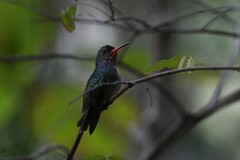
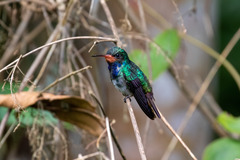
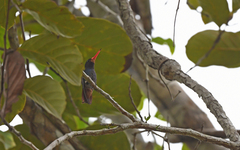
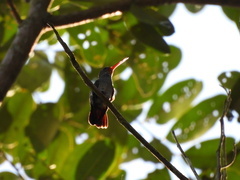

Rufous-throated Sapphire

Rufous-throated Sapphire

Hylocharis sapphirina

Silhouette: Ferran Sayol · PhyloPic

LCLeast ConcernNTVUENCR
Daily sighting probability <5% · Rare
at Manu National Park

In 3 days <5%

12 Verified sightings at Manu National Park From 2019 to 2026
47 In all 3 parks
January Best month
☀️ Diurnal When it's spotted

About the Rufous-throated Sapphire

The rufous-throated sapphire (Hylocharis sapphirina) is a species of hummingbird in the "emeralds", tribe Trochilini of subfamily Trochilinae. It is found in Bolivia, Brazil, Colombia, Ecuador, the Guianas, Peru, Venezuela and possibly Argentina and Paraguay.

The rufous-throated sapphire was formally described in 1788 by the German naturalist Johann Friedrich Gmelin in his revised and expanded edition of Carl Linnaeus's Systema Naturae. He placed it with all the other hummingbirds in the genus Trochilus and coined the binomial name Trochilus sapphirinus. He gave the type locality as Guiana. Gmelin based his description on "Le saphir" that had been described in 1779 by the French polymath Georges-Louis Leclerc, Comte de Buffon and the "Sapphir humming-bird" that had been described in 1781 by the English ornithologist John Latham. The rufous-throated sapphire is now placed by most taxonomic systems with the gilded sapphire in genus Hylocharis that was introduced in 1831 by the German naturalist Friedrich Boie. However, BirdLife International's Handbook of the Birds of the World places it in genus Amazilia with the English name rufous-throated hummingbird... Wikipedia →

Sounds

Call0:23

Brazil · 2024

© JAYRSON ARAUJO DE OLIVEIRA · XC939503 · CC BY-NC-SA 4.0

Song0:42

Colombia · 2021

© Peter Boesman · XC693612 · CC BY-NC-ND 4.0

Canto0:06

Brazil · 2017

© Caio Brito · XC427482 · CC BY-NC-SA 4.0

Global Distribution

Parks Where Found

# Park Country Daily sighting probability
1 Brownsberg Nature Park 🇸🇷 Suriname
~10%
2 Podocarpus National Park 🇪🇨 Ecuador
<5%
3 Manu National Park 🇵🇪 Peru
<5%

Before you go

What are the chances of seeing a Rufous-throated Sapphire in Manu National Park?

Rare

Under 5% of wildlife watchers report a Rufous-throated Sapphire sighting in Manu National Park on a given day, based on 12 verified sightings from GBIF citizen-science data from 2019 to 2026. It is the 575th most-seen of the 641 birds we can rate there. Over three days the chance rises to under 5%, if each day is a fresh chance.

When is the best time to see a Rufous-throated Sapphire in Manu National Park?

Any time of year

In every month with enough records, under 5% of wildlife watchers report a Rufous-throated Sapphire in Manu National Park on a given day, so our monthly data shows no clear season.

What time of day is best to see a Rufous-throated Sapphire?

Between 7 and 10 am

Across all the parks we cover, that three-hour window holds the most Rufous-throated Sapphire sightings with a recorded time, and about 9 in 10 of them come between 6 am and 6 pm: it is a daytime animal.

Is Manu National Park the best place to see a Rufous-throated Sapphire?

3rd of 3

Of the 3 parks where we can rate Rufous-throated Sapphire sightings, Manu National Park ranks 3rd at under 5%. The best odds are in Brownsberg Nature Park (Suriname, about 10%) and Podocarpus National Park (Ecuador, under 5%).

Which relatives of the Rufous-throated Sapphire live in Manu National Park?

Same family: Trochilidae

The closest relatives of the Rufous-throated Sapphire that you can see in Manu National Park (family Trochilidae, Hummingbirds) are Golden-tailed Sapphire (about 30%), White-necked Jacobin (about 30%) and Gray-breasted Sabrewing (about 30%), with each one's daily chance of a sighting.

Where does the Rufous-throated Sapphire sighting chance come from?

GBIF citizen-science records

It is estimated from how often the Rufous-throated Sapphire is recorded against all the birds logged in Manu National Park (12 verified sightings from 2019 to 2026), calibrated against known sighting rates. Figures are rounded to the nearest 10% because citizen-science data supports honest approximations, not decimals, and months with records from fewer than five people show "—". How it works.

← Back to Manu National Park