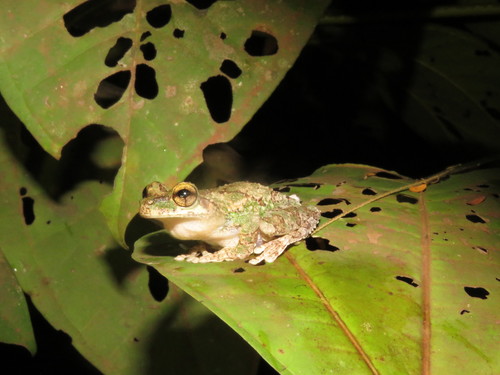

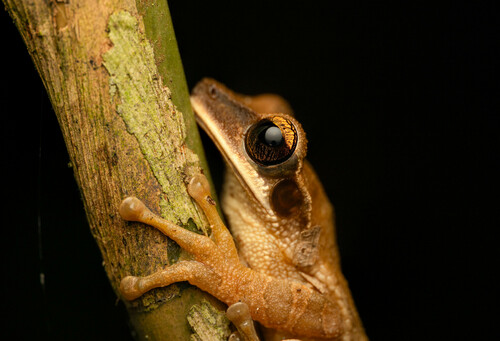
Urubamba Spiny-backed Frog

Urubamba Spiny-backed Frog

Osteocephalus helenae

Silhouette: Dmitry Bogdanov (vectorized by T. Michael Keesey) · PhyloPic

Daily sighting probability ~10% · With luck
at Manu National Park

In 3 days ~30% in a week ~60%

15 Verified sightings at Manu National Park From 2019 to 2026
15 In 1 park
November Best month
🌙 Nocturnal When it's spotted

About the Urubamba Spiny-backed Frog

Osteocephalus helenae is a species of frog in the family Hylidae. It is widely distributed in the Amazon Basin and is known from the lowlands of Bolivia, Peru, Brazil, Colombia, Venezuela, Guyana, and French Guiana. The specific name helenae honors Helen Beulah Thompson Gaige, an American herpetologist. Common name Helena's [sic] treefrog has been proposed for it.

Osteocephalus helenae was described in 1919 by Alexander Grant Ruthven as Hyla helenae based on three recently metamorphosed specimens. The relationships of this species were unclear and it was considered incertae sedis within Hyla, until Jungfer and colleagues concluded in 2013 that Ruthven's Hyla helenae is the same species as Osteocephalus germani described by Ron and colleagues in 2012 and that the correct name for this taxon is Osteocephalus helenae.

Based on the type series of Osteocephalus germani, adult males measure about 41 mm (1.6 in) and adult females about 49–51 mm (1.9–2.0 in) in snout–vent length. The snout is truncate but may sometimes be rounded in females. The tympanum is visible but partly concealed dorsally. The fingers and the toes bear large discs and are webbed, the... Wikipedia →

Global Distribution

Parks Where Found

# Park Country Daily sighting probability
1 Manu National Park 🇵🇪 Peru
~10%

More parks will be added in future updates.

Before you go

What are the chances of seeing an Urubamba Spiny-backed Frog in Manu National Park?

With luck

About 10% of wildlife watchers report an Urubamba Spiny-backed Frog sighting in Manu National Park on a given day, based on 15 verified sightings from GBIF citizen-science data from 2019 to 2026. It is the 37th most-seen of the 67 amphibians we can rate there. Over three days the chance rises to about 30%, and over a week to about 60%, if each day is a fresh chance.

When is the best time to see an Urubamba Spiny-backed Frog in Manu National Park?

November

In that month about 30% of wildlife watchers report an Urubamba Spiny-backed Frog in Manu National Park on a given day, against under 5% in March–April, August and December–January, the lowest months. That is one of Manu National Park's wettest months, with about 240 mm of rain against 60 mm in August.

What time of day is best to see an Urubamba Spiny-backed Frog?

Between 7 and 10 pm

Across all the parks we cover, that three-hour window holds the most Urubamba Spiny-backed Frog sightings with a recorded time, and about 8 in 10 of them come between 6 pm and 6 am: it is mostly seen at night.

Where else can you see an Urubamba Spiny-backed Frog?

Only Manu National Park, in our data

Manu National Park is the only park on Wallace's Line with enough records to rate Urubamba Spiny-backed Frog sightings: about 10% of wildlife watchers there report one on a given day.

Where does the Urubamba Spiny-backed Frog sighting chance come from?

GBIF citizen-science records

It is estimated from how often the Urubamba Spiny-backed Frog is recorded against all the amphibians logged in Manu National Park (15 verified sightings from 2019 to 2026), calibrated against known sighting rates. Figures are rounded to the nearest 10% because citizen-science data supports honest approximations, not decimals, and months with records from fewer than five people show "—". How it works.

← Back to Manu National Park