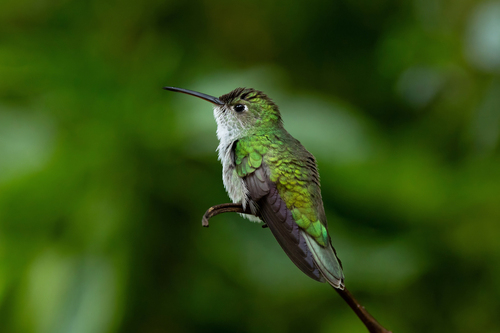
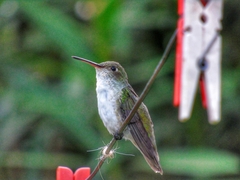

White-bellied Hummingbird

White-bellied Hummingbird

Elliotomyia chionogaster

Silhouette: Ferran Sayol · PhyloPic

LCLeast ConcernNTVUENCR
Daily sighting probability <5% · Rare
at Manu National Park

In 3 days <5%

25 Verified sightings at Manu National Park From 2019 to 2026
119 In all 2 parks
April Best month
☀️ Diurnal When it's spotted

About the White-bellied Hummingbird

The white-bellied hummingbird (Elliotomyia chionogaster) is a species of hummingbird in the "emeralds", tribe Trochilini of subfamily Trochilinae. It is found in Argentina, Bolivia, Brazil, and Peru. The white-bellied hummingbird has at various times been placed in genera Leucippus and Elliotia, and until 2014 in Amazilia. A molecular phylogenetic study published in 2014 found that Amazilia was polyphyletic. In the revised classification to create monophyletic genera, the white-bellied hummingbird was placed by most taxonomic systems in a new genus Elliotomyia.

However, BirdLife International's Handbook of the Birds of the World (HBW) retains it in Amazilia. The white-bellied hummingbird shares genus Elliotomyia with the green-and-white hummingbird (E. viridicauda). The white-bellied hummingbird is 9 to 12 cm (3.5 to 4.7 in) long. Males weigh 4.9 to 6.7 g (0.17 to 0.24 oz) and females 4.5 to 6 g (0.16 to 0.21 oz). Both sexes of both subspecies have a medium length straight bill with a blackish maxilla and a reddish mandible with a dark tip. Adult males of the... Wikipedia →

Sounds

Song1:19

Peru · 2026

© Étienne Leroy · XC1184752 · CC BY-NC-SA 4.0

Call0:27

Argentina · 2022

© Hans Matheve · XC971376 · CC BY-NC-ND 4.0

Song?0:48

Argentina · 2000

© Niels Krabbe · XC29137 · CC BY-NC-SA 3.0

Global Distribution

Parks Where Found

# Park Country Daily sighting probability
1 Amboró National Park 🇧🇴 Bolivia
~20%
2 Manu National Park 🇵🇪 Peru
<5%

Cities Where Found

# City Country Daily sighting probability
1 Cochabamba 🇧🇴 Bolivia
~10%
2 Santa Cruz de la Sierra 🇧🇴 Bolivia
~10%
3 La Paz 🇧🇴 Bolivia
<5%

Before you go

What are the chances of seeing a White-bellied Hummingbird in Manu National Park?

Rare

Under 5% of wildlife watchers report a White-bellied Hummingbird sighting in Manu National Park on a given day, based on 25 verified sightings from GBIF citizen-science data from 2019 to 2026. It is the 523rd most-seen of the 641 birds we can rate there. Over three days the chance rises to under 5%, if each day is a fresh chance.

When is the best time to see a White-bellied Hummingbird in Manu National Park?

Any time of year

In every month with enough records, under 5% of wildlife watchers report a White-bellied Hummingbird in Manu National Park on a given day, so our monthly data shows no clear season.

What time of day is best to see a White-bellied Hummingbird?

Between 9 am and noon

Across all the parks we cover, that three-hour window holds the most White-bellied Hummingbird sightings with a recorded time, and about 8 in 10 of them come between 6 am and 6 pm: it is a daytime animal.

Is Manu National Park the best place to see a White-bellied Hummingbird?

2nd of 2

Of the 2 parks where we can rate White-bellied Hummingbird sightings, Manu National Park ranks 2nd at under 5%. The best odds are in Amboró National Park (Bolivia, about 20%).

Which relatives of the White-bellied Hummingbird live in Manu National Park?

Same family: Trochilidae

The closest relatives of the White-bellied Hummingbird that you can see in Manu National Park (family Trochilidae, Hummingbirds) are Golden-tailed Sapphire (about 30%), White-necked Jacobin (about 30%) and Gray-breasted Sabrewing (about 30%), with each one's daily chance of a sighting.

Where does the White-bellied Hummingbird sighting chance come from?

GBIF citizen-science records

It is estimated from how often the White-bellied Hummingbird is recorded against all the birds logged in Manu National Park (25 verified sightings from 2019 to 2026), calibrated against known sighting rates. Figures are rounded to the nearest 10% because citizen-science data supports honest approximations, not decimals, and months with records from fewer than five people show "—". How it works.

← Back to Manu National Park