Dormilona

Dormilona

Corallus ruschenbergerii

Silhouette: T. Michael Keesey (from a photo by Maximilian Paradiz) · PhyloPic

LCLeast ConcernNTVUENCR
Daily sighting probability ~10% · With luck
at Manuel Antonio National Park

In 3 days ~20% in a week ~40%

5 Verified sightings at Manuel Antonio National Park From 2019 to 2026
148 In all 5 parks
October Best month
☀️🌙 Day & Night When it's spotted

About the Dormilona

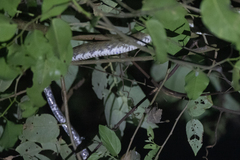
Corallus ruschenbergerii, commonly known as the Central American tree boa, common tree boa, and Trinidad tree boa, is a boa species found in lower Central America and northern South America. No subspecies are currently recognized. Like all boas, it is not venomous.

The specific name, ruschenbergerii, is in honor of William Ruschenberger, who was a United States Navy surgeon. Corallus ruschenbergerii is one of the largest members of the genus Corallus with adults reaching up to 2 metres (6 ft 7 in) in total length (including tail). The colors are typically shades of yellow, brown or gray, although populations on Trinidad and Tobago are often a patternless pure bronze.

Corallus ruschenbergerii is found in Lower Central America in southwestern Costa Rica (south of 10° N) and Panama, including Isla del Rey, Isla Contadora, Isla de Cébaco and Isla Suscantupu. In South America it occurs in Colombia east of the Andes, north of the Cordillera Central and north of the Cordillera Oriental, northern Venezuela north of the Cordillera de Mérida and in the drainage of the Río Orinoco, north and west of the Guiana Shield, east of the Orinoco... Wikipedia →

Global Distribution

Parks Where Found

# Park Country Daily sighting probability
1 Caroni Swamp 🇹🇹 Trinidad and Tobago
~80%
2 Main Ridge Forest Reserve 🇹🇹 Trinidad and Tobago
~40%
3 Tayrona National Natural Park 🇨🇴 Colombia
~30%
4 Piedras Blancas National Park 🇨🇷 Costa Rica
~20%
5 Manuel Antonio National Park 🇨🇷 Costa Rica
~10%

Zoos & Centres Where Found

# Zoo / Centre Country
1 Pairi Daiza 🇧🇪 Belgium In captivity
2 Zoo Miami 🇺🇸 United States In captivity
3 Woodland Park Zoo 🇺🇸 United States In captivity
4 Touroparc Zoo 🇫🇷 France In captivity

Before you go

What are the chances of seeing a Dormilona in Manuel Antonio National Park?

With luck

About 10% of wildlife watchers report a Dormilona sighting in Manuel Antonio National Park on a given day, based on 5 verified sightings from GBIF citizen-science data from 2019 to 2026. It is the 32nd most-seen of the 39 reptiles we can rate there. Over three days the chance rises to about 20%, and over a week to about 40%, if each day is a fresh chance.

When is the best time to see a Dormilona in Manuel Antonio National Park?

May and October

In those months about 20% of wildlife watchers report a Dormilona in Manuel Antonio National Park on a given day, against under 5% in March, June–September and November–January, the lowest months. Those are among Manuel Antonio National Park's wettest months, with about 780 mm of rain a month against 35 mm in February.

What time of day is best to see a Dormilona?

Between 7 and 10 pm

Across all the parks we cover, that three-hour window holds the most Dormilona sightings with a recorded time, and about 6 in 10 of them come between 6 am and 6 pm: it is seen both by day and at night.

Which relatives of the Dormilona live in Manuel Antonio National Park?

Same family: Boidae

The closest relatives of the Dormilona that you can see in Manuel Antonio National Park (family Boidae, Boas) are Central American Boa (about 20%) and Panamanian Dwarf Boa (about 10%), with each one's daily chance of a sighting.

Where does the Dormilona sighting chance come from?

GBIF citizen-science records

It is estimated from how often the Dormilona is recorded against all the reptiles logged in Manuel Antonio National Park (5 verified sightings from 2019 to 2026), calibrated against known sighting rates. Figures are rounded to the nearest 10% because citizen-science data supports honest approximations, not decimals, and months with records from fewer than five people show "—". How it works.

← Back to Manuel Antonio National Park