Lesser Kudu

Lesser Kudu

Tragelaphus imberbis

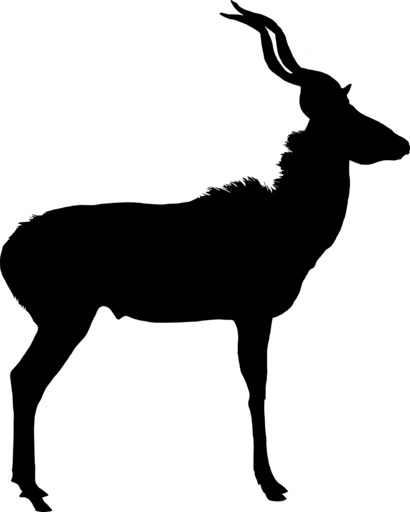
Silhouette: Kai Caspar · PhyloPic

LCNTNear ThreatenedVUENCR
Daily sighting probability ~60% · Likely
at Meru National Park

In 3 days ~90% in a week >90%

26 Verified sightings at Meru National Park From 2019 to 2026
188 In all 7 parks
June Best month
☀️ Diurnal When it's spotted

About the Lesser Kudu

The Lesser Kudu (Tragelaphus imberbis) is a medium-sized East African antelope found in East Africa. The species is not especially closely related to the Greater Kudu, though both belong the Artiodactyl tribe Tragelaphini (family Bovidae), of striped, spiral-horned African bovids, along with the Nyala, Elands, Balbok, Bushbucks, Bongo, and Sitatunga. It was first scientifically described by English zoologist Edward Blyth (1869).

The lesser kudu is a browser subsisting off of foliage from tall bushes, trees, and herbaceous perennial plants. They are not territorial, and mainly crepuscular, preferring to be active after dusk until the dawn hours, seeking shelter in dense thickets just after the sunrise. The Lesser Kudu inhabits dry bushland regions, bordering on arid grasslands, as well as scrubland and light open forest habitat.

The Lesser Kudu is native to Ethiopia, Kenya, Somalia, South Sudan, Tanzania, and Uganda, but it is possibly extirpated from Djibouti. It may have been present in Saudi Arabia and Yemen as recently as 1967, though its presence in the Arabian Peninsula is still controversial.

The total population of the Lesser Kudu is decreasing. Presently, the International Union for Conservation of Nature rates the Lesser Kudu as "near threatened". The handsome head of the male Lesser Kudu, with his elegant spiraled horns, is the symbol of the Saint Louis Zoo. Wikipedia →

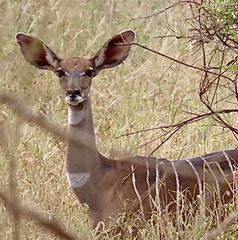
Global Distribution

Parks Where Found

# Park Country Daily sighting probability
1 Tsavo West National Park 🇰🇪 Kenya
~60%
2 Meru National Park 🇰🇪 Kenya
~60%
3 Tsavo East National Park 🇰🇪 Kenya
~50%
4 Awash National Park 🇪🇹 Ethiopia
~40%
5 Amboseli National Park 🇰🇪 Kenya
~30%
6 Mkomazi National Park 🇹🇿 Tanzania
~20%
7 Tarangire National Park 🇹🇿 Tanzania
~10%

Zoos & Centres Where Found

# Zoo / Centre Country
1 San Diego Zoo 🇺🇸 United States In captivity
2 National Zoological Park 🇺🇸 United States In captivity
3 ZooParc de Beauval 🇫🇷 France In captivity
4 Denver Zoo 🇺🇸 United States In captivity
5 Dvůr Králové Zoo 🇨🇿 Czechia In captivity
6 Haller Park 🇰🇪 Kenya In captivity
7 Bronx Zoo 🇺🇸 United States In captivity
8 Bratislava Zoo 🇸🇰 Slovakia In captivity
9 Omaha’s Henry Doorly Zoo and Aquarium 🇺🇸 United States In captivity
10 The Maryland Zoo 🇺🇸 United States In captivity
11 Saint Louis Zoo 🇺🇸 United States In captivity
12 Dickerson Park Zoo 🇺🇸 United States In captivity
13 Fort Worth Zoo 🇺🇸 United States In captivity
14 Łódź Zoo 🇵🇱 Poland In captivity
15 Little Rock Zoo 🇺🇸 United States In captivity
16 Reserva Zoológica Oasys MiniHollywood 🇪🇸 Spain In captivity
17 Newport Aquarium 🇺🇸 United States In captivity
18 Sobela Ocean Aquarium 🇺🇸 United States In captivity
19 Glen Echo Park Aquarium 🇺🇸 United States In captivity
20 Kung Fu Corals 🇺🇸 United States In captivity
21 Sea Life Aquarium Kansas City 🇺🇸 United States In captivity

Before you go

What are the chances of seeing a Lesser Kudu in Meru National Park?

Likely

About 60% of wildlife watchers report a Lesser Kudu sighting in Meru National Park on a given day, based on 26 verified sightings from GBIF citizen-science data from 2019 to 2026. It is the 10th most-seen of the 22 mammals we can rate there. Over three days the chance rises to about 90%, and over a week to over 90%, if each day is a fresh chance.

When is the best time to see a Lesser Kudu in Meru National Park?

February–March, June–July and December

In those months about 70% of wildlife watchers report a Lesser Kudu in Meru National Park on a given day, against about 20% in May and September, the lowest months. Those are among Meru National Park's driest months, with about 35 mm of rain a month against 200 mm in November.

What time of day is best to see a Lesser Kudu?

Between 5 and 8 am

Across all the parks we cover, that three-hour window holds the most Lesser Kudu sightings with a recorded time, and about 8 in 10 of them come between 6 am and 6 pm: it is a daytime animal.

Is Meru National Park the best place to see a Lesser Kudu?

Among the best

Of the 7 parks where we can rate Lesser Kudu sightings, Meru National Park ranks 2nd at about 60%, level with the leaders once rounded. The best odds are in Tsavo West National Park (Kenya, about 60%). All parks ranked.

Which relatives of the Lesser Kudu live in Meru National Park?

Same family: Bovidae

The closest relatives of the Lesser Kudu that you can see in Meru National Park (family Bovidae, Bovids) are Waterbuck (about 70%), Grant's Gazelle (about 70%) and Kirk's Dik-dik (about 60%), with each one's daily chance of a sighting.

Where does the Lesser Kudu sighting chance come from?

GBIF citizen-science records

It is estimated from how often the Lesser Kudu is recorded against all the mammals logged in Meru National Park (26 verified sightings from 2019 to 2026), calibrated against known sighting rates. Figures are rounded to the nearest 10% because citizen-science data supports honest approximations, not decimals, and months with records from fewer than five people show "—". How it works.

← Back to Meru National Park