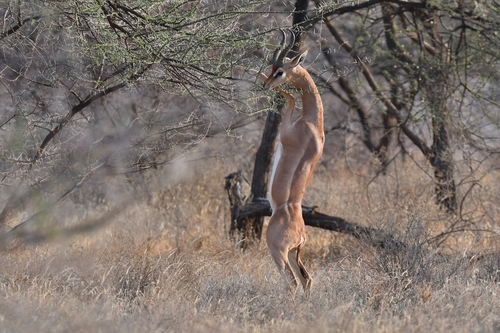
Grant's Gazelle

Grant's Gazelle

Nanger granti

Silhouette: Kai Caspar · PhyloPic

LCLeast ConcernNTVUENCR
Daily sighting probability ~70% · Very likely
at Meru National Park

In 3 days >90%

21 Verified sightings at Meru National Park From 2019 to 2026
1,157 In all 11 parks
July Best month
☀️ Diurnal When it's spotted

About the Grant's Gazelle

Grant's gazelle (Nanger granti) is a relatively large species of gazelle antelope, distributed from northern Tanzania to South Sudan and Ethiopia, and from the Kenyan coast to Lake Victoria. Its Swahili name is swala granti. It was named for a 19th-century Scottish explorer, James Grant.

Grant's gazelle is genetically related to Soemmerring's gazelle (N. soemmerringii) and Thomson's gazelle (Eudorcas thomsonii) with Soemmering's gazelle being the closer relative. Grant's gazelle shows high genetic variation among its populations, although there is no geographic isolation. The differentiation of the species may have evolved during repeated expansion and contraction of arid habitats during the late Pleistocene era in which populations were possibly isolated. Grant's gazelle was formerly considered a member of the genus Gazella within the subgenus Nanger before Nanger was elevated to genus status. In 2021, the American Society of Mammalogists granted full species status to Bright's gazelle (Nanger notatus) and the Peters's gazelle (Nanger petersii),

based (mainly) on recent genetic analysis. This article currently treats all three as a single species. �... Wikipedia →

Global Distribution

Parks Where Found

# Park Country Daily sighting probability
1 Tsavo East National Park 🇰🇪 Kenya
~80%
2 Samburu National Reserve 🇰🇪 Kenya
~80%
3 Meru National Park 🇰🇪 Kenya
~70%
4 Ngorongoro Conservation Area 🇹🇿 Tanzania
~60%
5 Amboseli National Park 🇰🇪 Kenya
~60%
6 Lake Nakuru National Park 🇰🇪 Kenya
~50%
7 Tsavo West National Park 🇰🇪 Kenya
~40%
8 Serengeti National Park 🇹🇿 Tanzania
~40%
9 Tarangire National Park 🇹🇿 Tanzania
~40%
10 Nairobi National Park 🇰🇪 Kenya
~40%
11 Masai Mara National Reserve 🇰🇪 Kenya
~30%

Zoos & Centres Where Found

# Zoo / Centre Country
1 Busch Gardens Tampa 🇺🇸 United States In captivity
2 Zoo Miami 🇺🇸 United States In captivity
3 Natural Bridge Wildlife Ranch 🇺🇸 United States In captivity
4 San Diego Zoo Safari Park 🇺🇸 United States In captivity
5 Safari West 🇺🇸 United States In captivity
6 WildFlorida Safaris 🇺🇸 United States In captivity
7 Woodland Park Zoo 🇺🇸 United States In captivity
8 Virginia Zoological Park 🇺🇸 United States In captivity

Before you go

What are the chances of seeing a Grant's Gazelle in Meru National Park?

Very likely

About 70% of wildlife watchers report a Grant's Gazelle sighting in Meru National Park on a given day, based on 21 verified sightings from GBIF citizen-science data from 2019 to 2026. It is the 3rd most-seen of the 22 mammals we can rate there. Over three days the chance rises to over 90%, if each day is a fresh chance.

When is the best time to see a Grant's Gazelle in Meru National Park?

February–March and July–August

In those months about 80% of wildlife watchers report a Grant's Gazelle in Meru National Park on a given day, against about 20% in December, the lowest month. Those are among Meru National Park's driest months, with about 25 mm of rain a month against 200 mm in November.

What time of day is best to see a Grant's Gazelle?

Between 9 am and noon

Across all the parks we cover, that three-hour window holds the most Grant's Gazelle sightings with a recorded time, and about 8 in 10 of them come between 6 am and 6 pm: it is a daytime animal.

Which relatives of the Grant's Gazelle live in Meru National Park?

Same family: Bovidae

The closest relatives of the Grant's Gazelle that you can see in Meru National Park (family Bovidae, Bovids) are Waterbuck (about 70%), Kirk's Dik-dik (about 60%) and Impala (about 60%), with each one's daily chance of a sighting.

Where does the Grant's Gazelle sighting chance come from?

GBIF citizen-science records

It is estimated from how often the Grant's Gazelle is recorded against all the mammals logged in Meru National Park (21 verified sightings from 2019 to 2026), calibrated against known sighting rates. Figures are rounded to the nearest 10% because citizen-science data supports honest approximations, not decimals, and months with records from fewer than five people show "—". How it works.

← Back to Meru National Park