



Completed


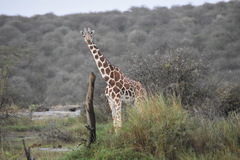


Reticulated Giraffe
Giraffa reticulata
Silhouette: David M. Brown, Rick A. Brenneman, Klaus-Peter Koepfli, John P. Pollinger, Borja Milá, Nicholas J. Georgiadis, Edward E. Louis Jr., Gregory F. Grether, David K. Jacobs & Robert K. Wayne · PhyloPic
- KingdomAnimalia (Animals)
- PhylumChordata (Chordates)
- ClassMammalia (Mammals)
- OrderArtiodactyla (Even-toed Ungulates and Cetaceans)
- FamilyGiraffidae (Giraffes and Okapi)
- GenusGiraffa (Giraffes)
- SpeciesGiraffa reticulata (Reticulated Giraffe)
In 3 days >90%
50 Verified sightings at Meru National Park From 2019 to 2026
320 In all 3 parks
June Best month
☀️ Diurnal When it's spotted



About the Reticulated Giraffe
The reticulated giraffe (Giraffa reticulata) also known as the Somali giraffe is a species of giraffe native to the Horn of Africa. It is differentiated from the other giraffe species by its coat, which consists of large, polygonal (or squared), block-like spots, which extend onto the lower legs, tail and face. These prominent liver-red spots also show much less white between them, when compared to other giraffe species. With up to 6 meters in height, the reticulated giraffe is the largest species of giraffe and the tallest land animal in general. While the reticulated giraffe may yet still be found in parts of its historic range, such as areas of Somalia and Ethiopia, its population stronghold is primarily within Kenya. There are approximately 8,500 individuals living in the wild. In both captivity and the wild, as of 2024 there are 15,785 individuals across the world.
Reticulated giraffes can interbreed with other giraffe species in captivity, or if they come into contact with other species of giraffe in the wild, such as the Masai giraffe (G. tippelskirchii). Along with the aforementioned Masai giraffe, as well as the Baringo or Rothschild's giraffe (G. c. rothschildi), the reticulated giraffe is among the most commonly seen giraffe species in animal parks and zoos. Wikipedia →
Recent sightings of Reticulated Giraffe in Meru National Park
LIVEiNaturalistGlobal Distribution
Parks Where Found
| # | Park | Country | Daily sighting probability |
|---|---|---|---|
| 1 | Meru National Park | 🇰🇪 Kenya | |
| 2 | Samburu National Reserve | 🇰🇪 Kenya | |
| 3 | Aberdare National Park | 🇰🇪 Kenya |
Zoos & Centres Where Found
Closest Relatives at Meru National Park







Before you go
What are the chances of seeing a Reticulated Giraffe in Meru National Park?
Very likely
About 80% of wildlife watchers report a Reticulated Giraffe sighting in Meru National Park on a given day, based on 50 verified sightings from GBIF citizen-science data from 2019 to 2026. It is the most-seen of the 22 mammals we can rate there. Over three days the chance rises to over 90%, if each day is a fresh chance.
When is the best time to see a Reticulated Giraffe in Meru National Park?
June, August and October
In those months about 90% of wildlife watchers report a Reticulated Giraffe in Meru National Park on a given day, against about 30% in April and September, the lowest months. Those are among Meru National Park's driest months, with about 35 mm of rain a month against 200 mm in November.
What time of day is best to see a Reticulated Giraffe?
Between 3 and 6 pm
Across all the parks we cover, that three-hour window holds the most Reticulated Giraffe sightings with a recorded time, and about 9 in 10 of them come between 6 am and 6 pm: it is a daytime animal.
Is Meru National Park the best place to see a Reticulated Giraffe?
Yes
Of the 3 parks where we can rate Reticulated Giraffe sightings, Meru National Park has the highest daily chance: about 80%. Next come Samburu National Reserve (Kenya, about 60%) and Aberdare National Park (Kenya, about 30%).
Which relatives of the Reticulated Giraffe live in Meru National Park?
Same order: Artiodactyla
The closest relatives of the Reticulated Giraffe that you can see in Meru National Park (order Artiodactyla, Even-toed Ungulates and Cetaceans) are Waterbuck (about 70%), Grant's Gazelle (about 70%) and Kirk's Dik-dik (about 60%), with each one's daily chance of a sighting.
Where does the Reticulated Giraffe sighting chance come from?
GBIF citizen-science records
It is estimated from how often the Reticulated Giraffe is recorded against all the mammals logged in Meru National Park (50 verified sightings from 2019 to 2026), calibrated against known sighting rates. Figures are rounded to the nearest 10% because citizen-science data supports honest approximations, not decimals, and months with records from fewer than five people show "—". How it works.
