Unstriped Ground Squirrel

Unstriped Ground Squirrel

Xerus rutilus

Silhouette: Joseph Smit · PhyloPic

LCLeast ConcernNTVUENCR
Daily sighting probability ~50% · Likely
at Meru National Park

In 3 days ~90% in a week >90%

9 Verified sightings at Meru National Park From 2019 to 2026
207 In all 7 parks
January Best month
☀️ Diurnal When it's spotted

About the Unstriped Ground Squirrel

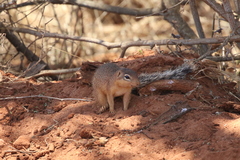
The unstriped ground squirrel (Xerus rutilus) is a species of rodent (order Rodentia) in the family Sciuridae. It is the only member of the genus Xerus. It is found in Djibouti, Eritrea, Ethiopia, Kenya, Somalia, Sudan, Tanzania, and Uganda. Its natural habitats are dry savanna and subtropical or tropical dry shrubland.

The unstriped ground squirrel is brownish or tawny in color with a lighter colored front. As the name suggests the X. rutilus differs from other species of African ground squirrel by not having dorsal-running longitudinal white stripes. The eye is ringed with white hair (all hair being coarse in observed specimens). Their small head and body measure on average 225.8 millimetres (8.89 in) long with an average tail length of 172 mm (6.8 in). This tail is flat in appearance. Body weight varies across studies and habitats and ranges from 257.7 to 420 grams (9.09 to 14.82 oz). The length of the hind foot is 35–49 mm with a braincase measuring only 24–25 mm. The length of the mandible is variable in the range of 31.0 to 33.9 mm.

Xerus rutilus is a member of the Xerini tribe, but differs from its sister group Xerus daamsi. Both are separate and distinct from... Wikipedia →

Global Distribution

Parks Where Found

# Park Country Daily sighting probability
1 Samburu National Reserve 🇰🇪 Kenya
~70%
2 Meru National Park 🇰🇪 Kenya
~50%
3 Tsavo East National Park 🇰🇪 Kenya
~50%
4 Tsavo West National Park 🇰🇪 Kenya
~40%
5 Tarangire National Park 🇹🇿 Tanzania
~40%
6 Mkomazi National Park 🇹🇿 Tanzania
~30%
7 Amboseli National Park 🇰🇪 Kenya
~20%

Before you go

What are the chances of seeing an Unstriped Ground Squirrel in Meru National Park?

Likely

About 50% of wildlife watchers report an Unstriped Ground Squirrel sighting in Meru National Park on a given day, based on 9 verified sightings from GBIF citizen-science data from 2019 to 2026. It is the 16th most-seen of the 22 mammals we can rate there. Over three days the chance rises to about 90%, and over a week to over 90%, if each day is a fresh chance.

When is the best time to see an Unstriped Ground Squirrel in Meru National Park?

January and July

In those months about 70% of wildlife watchers report an Unstriped Ground Squirrel in Meru National Park on a given day, against about 10% in February, June and October–November, the lowest months. Those are among Meru National Park's driest months, with about 15 mm of rain a month against 200 mm in November.

What time of day is best to see an Unstriped Ground Squirrel?

Between 1 and 4 pm

Across all the parks we cover, that three-hour window holds the most Unstriped Ground Squirrel sightings with a recorded time, and about 9 in 10 of them come between 6 am and 6 pm: it is a daytime animal.

Is Meru National Park the best place to see an Unstriped Ground Squirrel?

2nd of 7

Of the 7 parks where we can rate Unstriped Ground Squirrel sightings, Meru National Park ranks 2nd at about 50%. The best odds are in Samburu National Reserve (Kenya, about 70%). All parks ranked.

Where does the Unstriped Ground Squirrel sighting chance come from?

GBIF citizen-science records

It is estimated from how often the Unstriped Ground Squirrel is recorded against all the mammals logged in Meru National Park (9 verified sightings from 2019 to 2026), calibrated against known sighting rates. Figures are rounded to the nearest 10% because citizen-science data supports honest approximations, not decimals, and months with records from fewer than five people show "—". How it works.

← Back to Meru National Park