
Violet-bellied Hummingbird

Violet-bellied Hummingbird

Chlorestes julie

Silhouette: Ferran Sayol · PhyloPic

LCLeast ConcernNTVUENCR
Daily sighting probability ~10% · With luck
at Parque Natural Metropolitano

In 3 days ~20% in a week ~40%

223 Verified sightings at Parque Natural Metropolitano From 2019 to 2026
5,351 In all 6 parks
February Best month
☀️ Diurnal When it's spotted

About the Violet-bellied Hummingbird

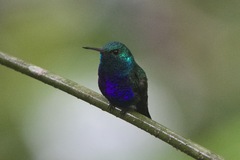
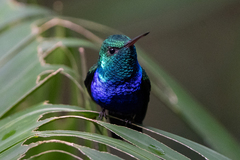
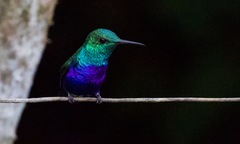
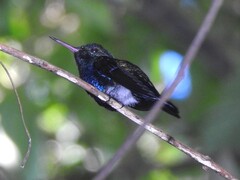
The violet-bellied hummingbird (Chlorestes julie) is a species of hummingbird characterized by the male's shimmering violet belly. The scientific name of this bird is currently Chlorestes julie, however, it was previously described as Juliamyia julie. Its genus being Chlorestes which is in the hummingbird family: Trochilidae. This family belongs to the order Apodiformes which includes hummingbirds and swifts. Within this species rank are three subspecies: panamensis, julie, and feliciana. Each are only separated by very minute features. Chlorestes julie panamensis occurs in Panama and has a head the same dull metallic green color as its back. Chlorestes julie julie and feliciana both have a brilliant green metallic back although julie has a shorter bill (14.5 mm) and a bluer belly whereas feliciana has a longer bill (15.1 mm) and a more violet belly. While julie occurs in Northern Columbia, feliciana occurs in western Ecuador and the extremely northwestern parts of Peru.

The violet-bellied hummingbird is characterized by the male's shimmering violet belly. The rest of its body is just as brilliant; its back and crown being a metallic... Wikipedia →

Sounds

Dawn song0:20

Ecuador · 2024

© Manuel Sánchez-Nivicela · XC1140225 · CC BY-NC-ND 4.0

Song1:24

Colombia · 2018

© Andrea Lopera-Salazar · XC432417 · CC BY-NC-SA 4.0

Alarm call0:14

Ecuador · 1997

© Olaf Jahn · XC261730 · CC BY-NC-SA 4.0

Global Distribution

Parks Where Found

# Park Country Daily sighting probability
1 Soberanía National Park 🇵🇦 Panama
~40%
2 San Lorenzo Protected Forest 🇵🇦 Panama
~20%
3 Chagres National Park 🇵🇦 Panama
~10%
4 Parque Natural Metropolitano 🇵🇦 Panama
~10%
5 Darién National Park 🇵🇦 Panama
~10%
6 Machalilla National Park 🇪🇨 Ecuador
~10%

Cities Where Found

# City Country Daily sighting probability
1 Panama City 🇵🇦 Panama
<5%

Before you go

What are the chances of seeing a Violet-bellied Hummingbird in Parque Natural Metropolitano?

With luck

About 10% of wildlife watchers report a Violet-bellied Hummingbird sighting in Parque Natural Metropolitano on a given day, based on 223 verified sightings from GBIF citizen-science data from 2019 to 2026. It is the 96th most-seen of the 328 birds we can rate there. Over three days the chance rises to about 20%, and over a week to about 40%, if each day is a fresh chance.

When is the best time to see a Violet-bellied Hummingbird in Parque Natural Metropolitano?

May and October–March

In those months about 10% of wildlife watchers report a Violet-bellied Hummingbird in Parque Natural Metropolitano on a given day, against under 5% in April and June–September, the lowest months.

What time of day is best to see a Violet-bellied Hummingbird?

Between 10 am and 1 pm

Across all the parks we cover, that three-hour window holds the most Violet-bellied Hummingbird sightings with a recorded time, and about 9 in 10 of them come between 6 am and 6 pm: it is a daytime animal.

Is Parque Natural Metropolitano the best place to see a Violet-bellied Hummingbird?

4th of 6

Of the 6 parks where we can rate Violet-bellied Hummingbird sightings, Parque Natural Metropolitano ranks 4th at about 10%. The best odds are in Soberanía National Park (Panama, about 40%), San Lorenzo Protected Forest (Panama, about 20%) and Chagres National Park (Panama, about 10%).

Where does the Violet-bellied Hummingbird sighting chance come from?

GBIF citizen-science records

It is estimated from how often the Violet-bellied Hummingbird is recorded against all the birds logged in Parque Natural Metropolitano (223 verified sightings from 2019 to 2026), calibrated against known sighting rates. Figures are rounded to the nearest 10% because citizen-science data supports honest approximations, not decimals, and months with records from fewer than five people show "—". How it works.

← Back to Parque Natural Metropolitano