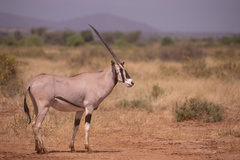
East African Oryx

East African Oryx

Oryx beisa

Silhouette: Jan A. Venter, Herbert H. T. Prins, David A. Balfour & Rob Slotow (vectorized by T. Michael Keesey) · PhyloPic

LCNTVUENEndangeredCR
Daily sighting probability ~40% · Likely
at Mkomazi National Park

In 3 days ~80% in a week >90%

8 Verified sightings at Mkomazi National Park From 2019 to 2026
385 In all 7 parks
September Best month
☀️ Diurnal When it's spotted

About the East African Oryx

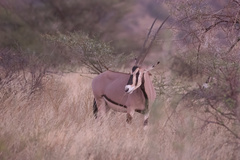
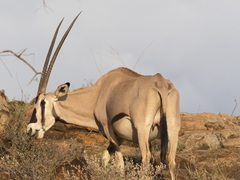
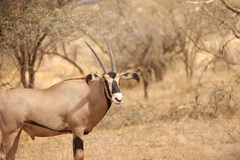
The East African oryx (Oryx beisa), also known as the beisa, is a species of medium-sized antelope from East Africa. It has two subspecies: the common beisa oryx (Oryx beisa beisa) found in steppe and semidesert throughout the Horn of Africa Somalia and north of the Tana River, and the fringe-eared oryx (Oryx beisa callotis) south of the Tana River in southern Kenya Somalia and parts of Tanzania. The species is listed as Endangered by the IUCN.

In the past, some taxonomists considered it a subspecies of the gemsbok (Oryx gazella), but they are genetically distinct; the diploid chromosome count is 56 for the beisa and 58 for the gemsbok. The East African oryx stands between 0.79 and 1.25 m (2.6 and 4.1 ft) tall at the shoulder and typically weighs between 220 and 460 lb (100 and 209 kg). It has a grey coat with a white underside, separated from the grey by a stripe of black, with black stripes where the head attaches to the neck, along the nose, and from the eye to the mouth and on the forehead. The mane is small and chestnut-coloured; the ringed horns are thin and straight. They are found on both sexes and typically measure 75–80 cm (30–31 in). Comparably, the gemsbok... Wikipedia →

Global Distribution

Parks Where Found

# Park Country Daily sighting probability
1 Awash National Park 🇪🇹 Ethiopia
~70%
2 Tsavo West National Park 🇰🇪 Kenya
~70%
3 Tsavo East National Park 🇰🇪 Kenya
~60%
4 Samburu National Reserve 🇰🇪 Kenya
~50%
5 Mkomazi National Park 🇹🇿 Tanzania
~40%
6 Meru National Park 🇰🇪 Kenya
~30%
7 Tarangire National Park 🇹🇿 Tanzania
~10%

Zoos & Centres Where Found

# Zoo / Centre Country
1 Six Flags Great Adventure 🇺🇸 United States In captivity
2 ZooParc de Beauval 🇫🇷 France In captivity
3 North Carolina Zoo 🇺🇸 United States In captivity
4 Cabarceno Natural Park 🇪🇸 Spain In captivity
5 The Wilds 🇺🇸 United States In captivity
6 San Diego Zoo Safari Park 🇺🇸 United States In captivity
7 Taipei Zoo 🇹🇼 Taiwan In captivity
8 Haller Park 🇰🇪 Kenya In captivity
9 Wildlife World Zoo 🇺🇸 United States In captivity
10 Zoo La Barben 🇫🇷 France In captivity
11 Burgers' Ocean 🇳🇱 Netherlands In captivity
12 DierenPark Amersfoort 🇳🇱 Netherlands In captivity
13 Zoológico la pastroa 🇲🇽 Mexico In captivity
14 Pittsburgh Zoo & Aquarium 🇺🇸 United States In captivity
15 Mořský svět 🇨🇿 Czechia In captivity

Before you go

What are the chances of seeing an East African Oryx in Mkomazi National Park?

Likely

About 40% of wildlife watchers report an East African Oryx sighting in Mkomazi National Park on a given day, based on 8 verified sightings from GBIF citizen-science data from 2019 to 2026. It is the 4th most-seen of the 13 mammals we can rate there. Over three days the chance rises to about 80%, and over a week to over 90%, if each day is a fresh chance.

When is the best time to see an East African Oryx in Mkomazi National Park?

September

In that month about 60% of wildlife watchers report an East African Oryx in Mkomazi National Park on a given day, against about 10% in March–April, July and December, the lowest months. That is one of Mkomazi National Park's driest months, with about 20 mm of rain against 150 mm in December. May has too few records to rate.

What time of day is best to see an East African Oryx?

Between 8 and 11 am

Across all the parks we cover, that three-hour window holds the most East African Oryx sightings with a recorded time, and about 8 in 10 of them come between 6 am and 6 pm: it is a daytime animal.

Which relatives of the East African Oryx live in Mkomazi National Park?

Same family: Bovidae

The closest relatives of the East African Oryx that you can see in Mkomazi National Park (family Bovidae, Bovids) are Hartebeest (about 50%), Common Eland (about 50%) and African Buffalo (about 40%), with each one's daily chance of a sighting.

Where does the East African Oryx sighting chance come from?

GBIF citizen-science records

It is estimated from how often the East African Oryx is recorded against all the mammals logged in Mkomazi National Park (8 verified sightings from 2019 to 2026), calibrated against known sighting rates. Figures are rounded to the nearest 10% because citizen-science data supports honest approximations, not decimals, and months with records from fewer than five people show "—". How it works.

← Back to Mkomazi National Park