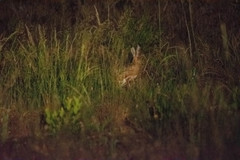
Granada Hare

Granada Hare

Lepus granatensis

Silhouette: Jan A. Venter, Herbert H. T. Prins, David A. Balfour & Rob Slotow (vectorized by T. Michael Keesey) · PhyloPic

LCLeast ConcernNTVUENCR
Daily sighting probability ~10% · With luck
at Monfragüe National Park

In 3 days ~30% in a week ~60%

6 Verified sightings at Monfragüe National Park From 2019 to 2026
19 In all 3 parks
April Best month
☀️🌙 Day & Night When it's spotted

About the Granada Hare

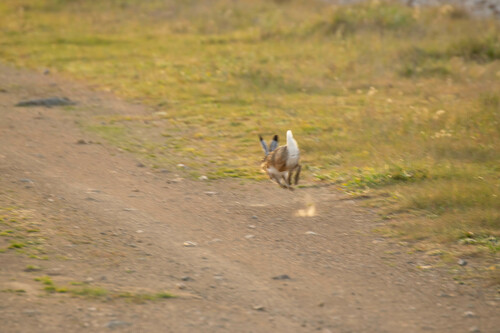
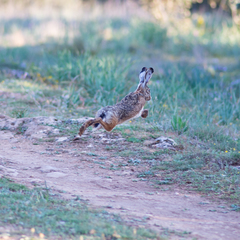
The Granada hare (Lepus granatensis), also known as the Iberian hare (Spanish: liebre Ibérica), is a species of hare that is endemic to the Iberian Peninsula and the island of Mallorca. A small species compared to other European hares, it has long been hunted as an important game species.

Three subspecies of the Granada hare are known: Lepus granatensis granatensis is the most abundant and nominate subspecies, found in Andalusia, Extremadura, Meseta Central, Valencia and the south of Aragon and Catalonia. It is the only subspecies present in Portugal.

Lepus granatensis gallaecius described by Gerrit Smith Miller Jr. in 1907 was a male adult hare collected in the Province of A Coruña. This subspecies with a darker coat occurs in the northwest of the Iberian Peninsula, in Galicia.

Lepus granatensis solisi, also called the Majorcan hare, is native to Mallorca and Ibiza in the Balearic Islands. This subspecies was described by biologists Fernando Palacios Arribas and José Fernández López in 1992, who noted its overall smaller size and differing dental morphology from the nominate subspecies. It is considered either critically endangered by some zoologists or extinct by the... Wikipedia →
Global Distribution

Parks Where Found

# Park Country Daily sighting probability
1 Monfragüe National Park 🇪🇸 Spain
~10%
2 Doñana National Park 🇪🇸 Spain
~10%
3 Sierra de Guadarrama National Park 🇪🇸 Spain
<5%

Cities Where Found

# City Country Daily sighting probability
1 Madrid 🇪🇸 Spain
~10%

Before you go

What are the chances of seeing a Granada Hare in Monfragüe National Park?

With luck

About 10% of wildlife watchers report a Granada Hare sighting in Monfragüe National Park on a given day, based on 6 verified sightings from GBIF citizen-science data from 2019 to 2026. It is the 6th most-seen of the 7 mammals we can rate there. Over three days the chance rises to about 30%, and over a week to about 60%, if each day is a fresh chance.

When is the best time to see a Granada Hare in Monfragüe National Park?

April

In that month about 20% of wildlife watchers report a Granada Hare in Monfragüe National Park on a given day, against under 5% in June to February, the lowest months. That is one of Monfragüe National Park's wettest months, with about 70 mm of rain against almost none in July.

What time of day is best to see a Granada Hare?

Between 7 and 10 pm

Across all the parks we cover, that three-hour window holds the most Granada Hare sightings with a recorded time, and about 6 in 10 of them come between 6 am and 6 pm: it is seen both by day and at night.

Is Monfragüe National Park the best place to see a Granada Hare?

Yes

Of the 3 parks where we can rate Granada Hare sightings, Monfragüe National Park has the highest daily chance: about 10%. Next come Doñana National Park (Spain, about 10%) and Sierra de Guadarrama National Park (Spain, under 5%).

Where does the Granada Hare sighting chance come from?

GBIF citizen-science records

It is estimated from how often the Granada Hare is recorded against all the mammals logged in Monfragüe National Park (6 verified sightings from 2019 to 2026), calibrated against known sighting rates. Figures are rounded to the nearest 10% because citizen-science data supports honest approximations, not decimals, and months with records from fewer than five people show "—". How it works.

← Back to Monfragüe National Park