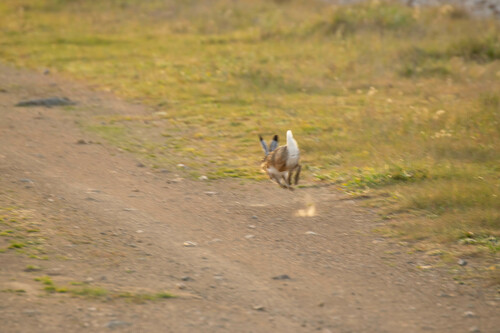
Stone Marten

Stone Marten

Martes foina

Silhouette: Ferran Sayol · PhyloPic

LCLeast ConcernNTVUENCR
Daily sighting probability ~10% · With luck
at Monfragüe National Park

In 3 days ~30% in a week ~60%

5 Verified sightings at Monfragüe National Park From 2019 to 2026
57 In all 3 parks
November Best month
☀️🌙 Day & Night When it's spotted

About the Stone Marten

The beech marten (Martes foina), also known as the stone marten, house marten or white breasted marten, is a species of marten native to much of Europe and Central Asia, though it has established a feral population in North America. It is listed as Least Concern on the IUCN Red List on account of its wide distribution, its large population, and its presence in a number of protected areas. It is superficially similar to the European pine marten, but differs from it by its smaller size and habitat preferences. While the pine marten is a forest specialist, the beech marten is a more generalist and adaptable species, occurring in a number of open and forest habitats.

Its most likely ancestor is Martes vetus, which also gave rise to the pine marten. The earliest M. vetus fossils were found in deposits dated to the Würm glaciation in Lebanon and Israel. The beech marten likely originated in the Near East or southwestern Asia, and may have arrived in Europe by the Late Pleistocene or the early Holocene. Thus, the beech marten differs from most other European mustelids of the Quaternary, as all other species (save for the European mink) appeared during the Middle Pleistocene... Wikipedia →

Sounds

Aberrant1:10

Belgium · 2026

© Astrid Cervantes · XC1175261 · CC BY-NC-SA 4.0

Call0:06

France · 2020

© Tanguy Loïs · XC1135343 · CC BY-SA 4.0

Agonistic call0:12

France · 2025

© Rodolphe Leroy · XC1039192 · CC BY-NC-SA 4.0

Global Distribution

Parks Where Found

# Park Country Daily sighting probability
1 Cévennes National Park 🇫🇷 France
~20%
2 Monfragüe National Park 🇪🇸 Spain
~10%
3 Bavarian Forest National Park 🇩🇪 Germany
~10%

Cities Where Found

# City Country Daily sighting probability
1 Hamburg 🇩🇪 Germany
~20%
2 Cologne 🇩🇪 Germany
~10%
3 Vienna 🇦🇹 Austria
~10%
4 Budapest 🇭🇺 Hungary
~10%
5 Essen 🇩🇪 Germany
~10%
6 Paris 🇫🇷 France
~10%
7 Berlin 🇩🇪 Germany
~10%
8 Brussels 🇧🇪 Belgium
~10%
9 Prague 🇨🇿 Czechia
<5%

Zoos & Centres Where Found

# Zoo / Centre Country
1 Lusen National Park Centre 🇩🇪 Germany In captivity
2 Cumberland Wildpark Grünau 🇦🇹 Austria In captivity
3 Faunia 🇪🇸 Spain In captivity
4 Minsk Zoo 🇧🇾 Belarus In captivity
5 Zoo Sibiu 🇷🇴 Romania In captivity
6 Odesa Zoo 🇺🇦 Ukraine In captivity
7 Dolphinarium in Klaipėda 🇱🇹 Lithuania In captivity
8 Cumberland Wildpark 🇦🇹 Austria In captivity
9 Hankensbüttel Otter Centre 🇩🇪 Germany In captivity
10 Ogród Zoologiczny w Katowicach 🇵🇱 Poland In captivity
11 Дэльфінарый 🇧🇾 Belarus In captivity

Before you go

What are the chances of seeing a Stone Marten in Monfragüe National Park?

With luck

About 10% of wildlife watchers report a Stone Marten sighting in Monfragüe National Park on a given day, based on 5 verified sightings from GBIF citizen-science data from 2019 to 2026. It is the 7th most-seen of the 7 mammals we can rate there. Over three days the chance rises to about 30%, and over a week to about 60%, if each day is a fresh chance.

When is the best time to see a Stone Marten in Monfragüe National Park?

August and November

In those months about 30% of wildlife watchers report a Stone Marten in Monfragüe National Park on a given day, against under 5% in May–July, September and December–February, the lowest months.

What time of day is best to see a Stone Marten?

Between 9 pm and midnight

Across all the parks we cover, that three-hour window holds the most Stone Marten sightings with a recorded time, and about half of them come between 6 pm and 6 am: it is seen both by day and at night.

Is Monfragüe National Park the best place to see a Stone Marten?

2nd of 3

Of the 3 parks where we can rate Stone Marten sightings, Monfragüe National Park ranks 2nd at about 10%. The best odds are in Cévennes National Park (France, about 20%).

Where does the Stone Marten sighting chance come from?

GBIF citizen-science records

It is estimated from how often the Stone Marten is recorded against all the mammals logged in Monfragüe National Park (5 verified sightings from 2019 to 2026), calibrated against known sighting rates. Figures are rounded to the nearest 10% because citizen-science data supports honest approximations, not decimals, and months with records from fewer than five people show "—". How it works.

← Back to Monfragüe National Park