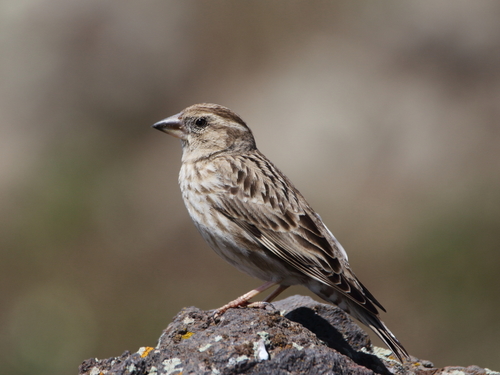
Spanish Sparrow

Spanish Sparrow

Passer hispaniolensis

Silhouette: Andrew Butko (modified) · PhyloPic

LCLeast ConcernNTVUENCR
Daily sighting probability ~20% · Possible
at Monfragüe National Park

In 3 days ~50% in a week ~80%

1,104 Verified sightings at Monfragüe National Park From 2019 to 2026
1,650 In all 4 parks
November Best month
☀️ Diurnal When it's spotted

About the Spanish Sparrow

The Spanish sparrow or willow sparrow (Passer hispaniolensis) is a passerine bird of the sparrow family Passeridae. It is found in the Mediterranean region and south-west and central Asia. It is very similar to the closely related house sparrow, and the two species show their close relation in a "biological mix-up" of hybridisation in the Mediterranean region, which complicates the taxonomy of this species.

The Spanish sparrow is a rather large sparrow, at 15–16 cm (6–6.5 in) in length, and 22–36 g (0.78–1.27 oz) in weight. It is slightly larger and heavier than house sparrows, and also has a slightly longer and stouter bill. The male is similar to the house sparrow in plumage, but differs in that its underparts are heavily streaked with black, has a chestnut rather than grey crown, and has white rather than grey cheeks. The female is effectively inseparable from the house sparrow in its basic plumage, which is grey-brown overall but more boldly marked. The female has light streaking on its sides, a pale cream supercilium, and broad cream streaks on its back.

Two subspecies of the Spanish sparrow – the western Spanish sparrow (P. h. hispaniolensis) and eastern Spanish... Wikipedia →

Sounds

Song0:29

Croatia · 2026

© Branislav Oblučar · XC1147264 · CC BY-NC-SA 4.0

Call0:08

Cyprus · 2024

© David Tattersley · XC891558 · CC BY-NC-SA 4.0

Begging call0:27

Kazakhstan · 2023

© Ding Li Yong · XC815265 · CC BY-NC-ND 4.0

Global Distribution

Parks Where Found

# Park Country Daily sighting probability
1 Monfragüe National Park 🇪🇸 Spain
~20%
2 Doñana National Park 🇪🇸 Spain
~10%
3 Sierra Nevada National Park 🇪🇸 Spain
<5%
4 Sierra de Guadarrama National Park 🇪🇸 Spain
<5%

Cities Where Found

# City Country Daily sighting probability
1 Tunis 🇹🇳 Tunisia
~80%
2 Sincan 🇹🇷 Turkey
~30%
3 Marrakesh 🇲🇦 Morocco
~20%
4 Algiers 🇩🇿 Algeria
~10%
5 Riyadh 🇸🇦 Saudi Arabia
~10%
6 Kuwait City 🇰🇼 Kuwait
~10%
7 Tel Aviv 🇮🇱 Israel
~10%
8 Mashhad 🇮🇷 Iran
~10%
9 Cairo 🇪🇬 Egypt
~10%
10 Rabat 🇲🇦 Morocco
~10%

Before you go

What are the chances of seeing a Spanish Sparrow in Monfragüe National Park?

Possible

About 20% of wildlife watchers report a Spanish Sparrow sighting in Monfragüe National Park on a given day, based on 1,104 verified sightings from GBIF citizen-science data from 2019 to 2026. It is the 55th most-seen of the 205 birds we can rate there. Over three days the chance rises to about 50%, and over a week to about 80%, if each day is a fresh chance.

When is the best time to see a Spanish Sparrow in Monfragüe National Park?

March and November–December

In those months about 30% of wildlife watchers report a Spanish Sparrow in Monfragüe National Park on a given day, against about 10% in August and September, the lowest months. Those are among Monfragüe National Park's wettest months, with about 75 mm of rain a month against almost none in July.

What time of day is best to see a Spanish Sparrow?

Between 11 am and 2 pm

Across all the parks we cover, that three-hour window holds the most Spanish Sparrow sightings with a recorded time, and about 8 in 10 of them come between 6 am and 6 pm: it is a daytime animal.

Is Monfragüe National Park the best place to see a Spanish Sparrow?

Yes

Of the 4 parks where we can rate Spanish Sparrow sightings, Monfragüe National Park has the highest daily chance: about 20%. Next come Doñana National Park (Spain, about 10%) and Sierra Nevada National Park (Spain, under 5%).

Where does the Spanish Sparrow sighting chance come from?

GBIF citizen-science records

It is estimated from how often the Spanish Sparrow is recorded against all the birds logged in Monfragüe National Park (1,104 verified sightings from 2019 to 2026), calibrated against known sighting rates. Figures are rounded to the nearest 10% because citizen-science data supports honest approximations, not decimals, and months with records from fewer than five people show "—". How it works.

← Back to Monfragüe National Park