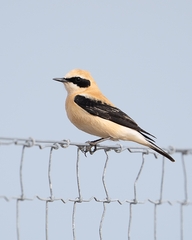
Western Black-eared Wheatear

Western Black-eared Wheatear

Oenanthe hispanica

Silhouette: Mathieu Pélissié · PhyloPic

LCLeast ConcernNTVUENCR
Daily sighting probability <5% · Rare
at Monfragüe National Park

In 3 days ~10% in a week ~30%

220 Verified sightings at Monfragüe National Park From 2019 to 2026
289 In all 4 parks
May Best month
☀️ Diurnal When it's spotted

About the Western Black-eared Wheatear

The western black-eared wheatear (Oenanthe hispanica) is a wheatear, a small migratory passerine bird that was formerly classed as a member of the thrush family Turdidae, but is now considered to be an Old World flycatcher (family Muscicapidae). It was formerly (and still is by some authorities) considered conspecific with the eastern black-eared wheatear.

The breeding male has the forehead and crown white or nearly white, the mantle buff, and the wings blacker than those of the northern wheatear. The underparts are white tinged with buff. The back, upper tail coverts and most of the tail are white. A black mask extends from the ear coverts to the bill. The throat can be either black or white.

In autumn and winter the head and mantle are distinctly buff, as are the underparts (including the throat in non-black-throated individuals), but the buff varies in intensity. Except for the central pair, the tail feathers are much whiter than in the northern wheatear, the white on the inner web often extending to the tip.

The female is a browner bird, but has the characteristic white lower back, and her seasonal changes are less marked. The male western black-eared wheatear... Wikipedia →

Sounds

Song0:39

Spain · 2023

© Bernard BOUSQUET · XC801828 · CC BY-NC-SA 4.0

Imitation0:36

Spain · 2022

© Stanislas Wroza · XC730458 · CC BY-NC-SA 4.0

Call0:15

Spain · 2020

© Marcel Gil Velasco · XC582958 · CC BY-NC-SA 4.0

Global Distribution

Parks Where Found

# Park Country Daily sighting probability
1 Monfragüe National Park 🇪🇸 Spain
<5%
2 Sierra Nevada National Park 🇪🇸 Spain
<5%
3 Sierra de Guadarrama National Park 🇪🇸 Spain
<5%
4 Doñana National Park 🇪🇸 Spain
<5%

Cities Where Found

# City Country Daily sighting probability
1 Ramallah 🇵🇸 Palestine
~10%
2 Ankara 🇹🇷 Turkey
<5%
3 Tel Aviv 🇮🇱 Israel
<5%
4 Izmir 🇹🇷 Turkey
<5%
5 Kuwait City 🇰🇼 Kuwait
<5%
6 Beirut 🇱🇧 Lebanon
<5%
7 Jerusalem 🇮🇱 Israel
<5%
8 Athens 🇬🇷 Greece
<5%

Before you go

What are the chances of seeing a Western Black-eared Wheatear in Monfragüe National Park?

Rare

Under 5% of wildlife watchers report a Western Black-eared Wheatear sighting in Monfragüe National Park on a given day, based on 220 verified sightings from GBIF citizen-science data from 2019 to 2026. It is the 119th most-seen of the 205 birds we can rate there. Over three days the chance rises to about 10%, and over a week to about 30%, if each day is a fresh chance.

When is the best time to see a Western Black-eared Wheatear in Monfragüe National Park?

April to June

In those months about 10% of wildlife watchers report a Western Black-eared Wheatear in Monfragüe National Park on a given day, against under 5% in July to March, the lowest months.

What time of day is best to see a Western Black-eared Wheatear?

Between 9 am and noon

Across all the parks we cover, that three-hour window holds the most Western Black-eared Wheatear sightings with a recorded time, and about 8 in 10 of them come between 6 am and 6 pm: it is a daytime animal.

Is Monfragüe National Park the best place to see a Western Black-eared Wheatear?

Yes

Of the 4 parks where we can rate Western Black-eared Wheatear sightings, Monfragüe National Park has the highest daily chance: under 5%. Next come Sierra Nevada National Park (Spain, under 5%) and Sierra de Guadarrama National Park (Spain, under 5%).

Where does the Western Black-eared Wheatear sighting chance come from?

GBIF citizen-science records

It is estimated from how often the Western Black-eared Wheatear is recorded against all the birds logged in Monfragüe National Park (220 verified sightings from 2019 to 2026), calibrated against known sighting rates. Figures are rounded to the nearest 10% because citizen-science data supports honest approximations, not decimals, and months with records from fewer than five people show "—". How it works.

← Back to Monfragüe National Park