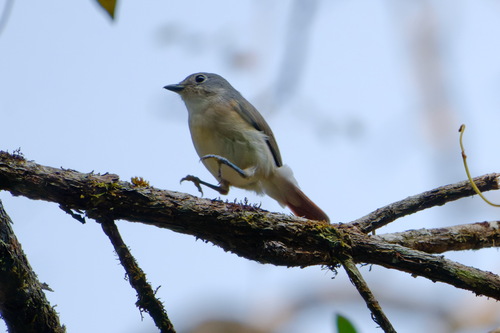
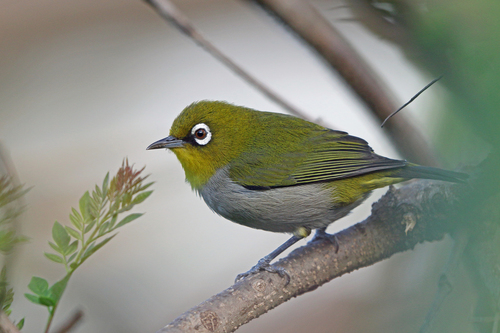
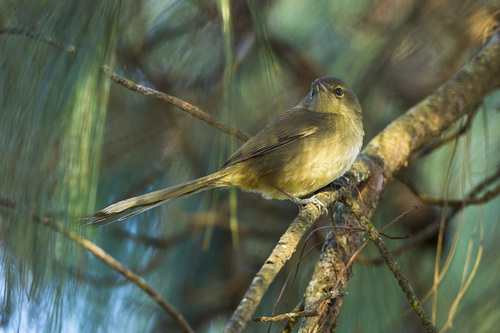
Hook-billed Vanga

Hook-billed Vanga

Vanga curvirostris

Silhouette: Sheatherius · PhyloPic

LCLeast ConcernNTVUENCR Endemic
Daily sighting probability ~20% · Possible
at Montagne d'Ambre National Park

In 3 days ~50% in a week ~80%

8 Verified sightings at Montagne d'Ambre National Park From 2019 to 2026
510 In all 6 parks
October Best month
☀️ Diurnal When it's spotted

About the Hook-billed Vanga

The hook-billed vanga (Vanga curvirostris) is a species of bird in the family Vangidae. It is endemic to Madagascar. Its natural habitats are subtropical or tropical dry forest, subtropical or tropical moist lowland forest, and subtropical or tropical moist montane forest.

In 1760 the French zoologist Mathurin Jacques Brisson included a description of the hook-billed vanga in his Ornithologie based on a specimen collected on the island of Madagascar. He used the French name L'écorcheur de Madagascar and the Latin Collurio Madagascariensis. Although Brisson coined Latin names, these do not conform to the binomial system and are not recognised by the International Commission on Zoological Nomenclature. When in 1766 the Swedish naturalist Carl Linnaeus updated his Systema Naturae for the twelfth edition, he added 240 species that had been previously described by Brisson. One of these was the hook-billed vanga. Linnaeus included a brief description, coined the binomial name Lanius curvirostris and cited Brisson's work. It is now the only species placed in the genus Vanga that was introduced by the French ornithologist Louis Pierre Vieillot in 1816.

The genus name Vanga is the Malagasy name for the species. The specific epithet curvirostris is from Latin curvus "curved" and -rostrum "billed". Two subspecies are recognised: A 2018 study on avian skull evolution has concluded that the ancestral neornithe had a beak most similar to this species. This suggests a similar ancestral ecological niche for modern birds.

Wikipedia →

Sounds

Song0:32

Madagascar · 2021

© Ken Behrens · XC697809 · CC BY-NC-SA 4.0

Call1:10

Madagascar · 2015

© Bernard BOUSQUET · XC295318 · CC BY-NC-SA 4.0

Song0:12

Madagascar · 2019

© Dries Van de Loock · XC536956 · CC BY-NC-SA 4.0

Global Distribution

Parks Where Found

# Park Country Daily sighting probability
1 Berenty Reserve 🇲🇬 Madagascar
~50%
2 Ankarafantsika National Park 🇲🇬 Madagascar
~30%
3 Ranomafana National Park 🇲🇬 Madagascar
~20%
4 Montagne d'Ambre National Park 🇲🇬 Madagascar
~20%
5 Ankarana National Park 🇲🇬 Madagascar
~20%
6 Mantadia National Park 🇲🇬 Madagascar
~10%

Before you go

What are the chances of seeing a Hook-billed Vanga in Montagne d'Ambre National Park?

Possible

About 20% of wildlife watchers report a Hook-billed Vanga sighting in Montagne d'Ambre National Park on a given day, based on 8 verified sightings from GBIF citizen-science data from 2019 to 2026. It is the 20th most-seen of the 30 birds we can rate there. Over three days the chance rises to about 50%, and over a week to about 80%, if each day is a fresh chance.

What time of day is best to see a Hook-billed Vanga?

Between 7 and 10 am

Across all the parks we cover, that three-hour window holds the most Hook-billed Vanga sightings with a recorded time, and about 7 in 10 of them come between 6 am and 6 pm: it is a daytime animal.

Which relatives of the Hook-billed Vanga live in Montagne d'Ambre National Park?

Same family: Vangidae

The closest relatives of the Hook-billed Vanga that you can see in Montagne d'Ambre National Park (family Vangidae, Vangas, Helmetshrikes, and Allies) are Common Newtonia (about 30%), Dark Newtonia (about 30%) and Red-tailed Vanga (about 20%), with each one's daily chance of a sighting.

Where does the Hook-billed Vanga sighting chance come from?

GBIF citizen-science records

It is estimated from how often the Hook-billed Vanga is recorded against all the birds logged in Montagne d'Ambre National Park (8 verified sightings from 2019 to 2026), calibrated against known sighting rates. Figures are rounded to the nearest 10% because citizen-science data supports honest approximations, not decimals, and months with records from fewer than five people show "—". How it works.

← Back to Montagne d'Ambre National Park