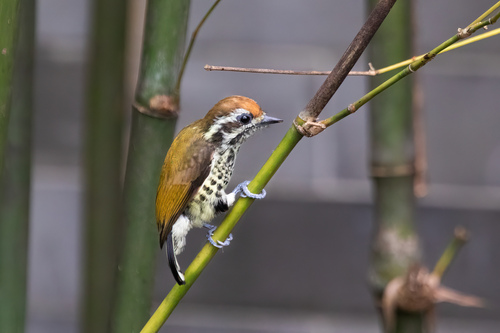
Malabar Barbet

Malabar Barbet

Psilopogon malabaricus

Silhouette: Vijay Cavale (photo), John E. McCormack, Michael G. Harvey, Brant C. Faircloth, Nicholas G. Crawford, Travis C. Glenn, Robb T. Brumfield & T. Michael Keesey · PhyloPic

LCLeast ConcernNTVUENCR Endemic
Daily sighting probability <5% · Rare
at Mudumalai National Park

In 3 days <5% in a week ~10%

15 Verified sightings at Mudumalai National Park From 2019 to 2026
4,065 In all 5 parks
May Best month
🌅 Crepuscular When it's spotted

About the Malabar Barbet

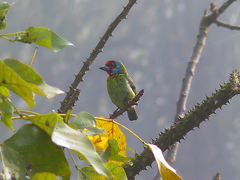
The Malabar barbet (Psilopogon malabaricus) is an Asian barbet native to the Western Ghats in India. It was formerly treated as a race of the crimson-fronted barbet (Psilopogon rubricapillus). It overlaps in some places with the range of the coppersmith barbet (Psilopogon haemacephala) and has a similar but more rapid call.

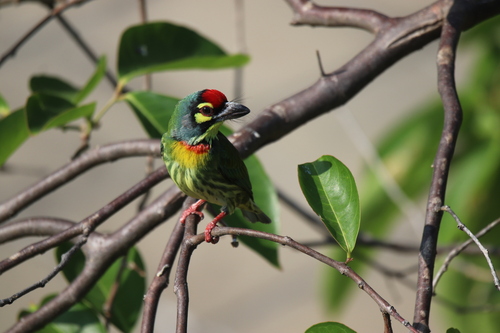
This species can be told apart from the coppersmith barbet by the crimson face and throat. The call notes are more rapidly delivered than in the other species. This species is found in the Western Ghats from around Goa south to southern Kerala in moist evergreen forest mainly below 1200 m elevation. They are also found in coffee estates. They often visit fruiting Ficus species, joining flocks of green pigeon and mynas.

These birds are usually seen in pairs during the breeding season but are gregarious in the non-breeding season. In flight, their straight and rapid flight can resemble that of lorikeets. The breeding season is mainly February–March prior to the rains. The nest hole is excavated on the underside of thin branches. It takes about 18 days to excavate the nest. These nest holes... Wikipedia →

Sounds

Song0:27

India · 2017

© Peter Boesman · XC369306 · CC BY-NC-ND 4.0

Call0:33

India · 2015

© Sudipto Roy · XC220733 · CC BY-NC-SA 4.0

Call0:18

India · 2009

© Pankaj Lad · XC215859 · CC BY-NC-SA 4.0

Global Distribution

Parks Where Found

# Park Country Daily sighting probability
1 Periyar National Park 🇮🇳 India
~50%
2 Nagarhole National Park 🇮🇳 India
~20%
3 Bandipur National Park 🇮🇳 India
~10%
4 Eravikulam National Park 🇮🇳 India
<5%
5 Mudumalai National Park 🇮🇳 India
<5%

Before you go

What are the chances of seeing a Malabar Barbet in Mudumalai National Park?

Rare

Under 5% of wildlife watchers report a Malabar Barbet sighting in Mudumalai National Park on a given day, based on 15 verified sightings from GBIF citizen-science data from 2019 to 2026. It is the 208th most-seen of the 233 birds we can rate there. Over three days the chance rises to under 5%, and over a week to about 10%, if each day is a fresh chance.

When is the best time to see a Malabar Barbet in Mudumalai National Park?

April and May

In those months about 10% of wildlife watchers report a Malabar Barbet in Mudumalai National Park on a given day, against under 5% in June to March, the lowest months.

What time of day is best to see a Malabar Barbet?

Between 3 and 6 am

Across all the parks we cover, that three-hour window holds the most Malabar Barbet sightings with a recorded time, and about half of them come between 6 am and 6 pm: it is most active around dawn and dusk.

Is Mudumalai National Park the best place to see a Malabar Barbet?

5th of 5

Of the 5 parks where we can rate Malabar Barbet sightings, Mudumalai National Park ranks 5th at under 5%. The best odds are in Periyar National Park (India, about 50%), Nagarhole National Park (India, about 20%) and Bandipur National Park (India, about 10%).

Which relatives of the Malabar Barbet live in Mudumalai National Park?

Same genus: Psilopogon

The closest relatives of the Malabar Barbet that you can see in Mudumalai National Park (genus Psilopogon, Typical Asian Barbets) are White-cheeked Barbet (about 60%) and Coppersmith Barbet (about 50%), with each one's daily chance of a sighting.

Where does the Malabar Barbet sighting chance come from?

GBIF citizen-science records

It is estimated from how often the Malabar Barbet is recorded against all the birds logged in Mudumalai National Park (15 verified sightings from 2019 to 2026), calibrated against known sighting rates. Figures are rounded to the nearest 10% because citizen-science data supports honest approximations, not decimals, and months with records from fewer than five people show "—". How it works.

← Back to Mudumalai National Park