Lesser Yellownape

Lesser Yellownape

Picus chlorolophus

Silhouette: Martin Bulla, based on John Cox's illustration · PhyloPic

LCLeast ConcernNTVUENCR
Daily sighting probability ~10% · With luck
at Mudumalai National Park

In 3 days ~30% in a week ~50%

104 Verified sightings at Mudumalai National Park From 2019 to 2026
3,032 In all 21 parks
January Best month
🌅 Crepuscular When it's spotted

About the Lesser Yellownape

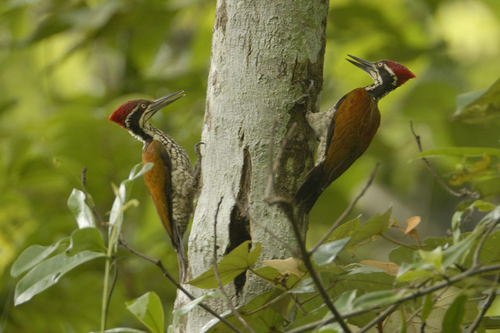
The lesser yellownape (Picus chlorolophus) is a type of woodpecker which is a widespread and often common breeder in tropical and sub-tropical Asia, primarily the Indian subcontinent and Southeast Asia. It ranges from India, Bhutan, Nepal, Bangladesh and Sri Lanka eastwards to Thailand, Burma, Cambodia, Laos, Indonesia, Malaysia and Vietnam. Much of the scientific knowledge gathered about this species is sourced from formal studies in various parts of India.

This is a jungle species which nests in a tree cavity, laying two to four white eggs. Like other woodpecking birds, this species has a straight pointed bill, a stiff tail to provide support against tree trunks, and zygodactyl or "yoked" feet, with two toes pointing forward, and two backward. The long tongue can be darted forward to capture insects.

The lesser yellownape is a largish species at 27 cm in length. It has a typical woodpecker shape. The upperparts are green apart from the bright yellow tufted nape. The neck and breast are green and the belly is whitish, finely barred with green. The rump and tail are blackish.

The adult male lesser yellownape has a green head with a white throat. He has... Wikipedia →

Sounds

Call0:14

Vietnam · 2026

© Ding Li Yong · XC1106735 · CC BY-NC-ND 4.0

Begging call0:27

Sri Lanka · 2020

© KASUN CHATHURANGA · XC551744 · CC BY-NC-ND 4.0

Song0:43

Thailand · 2017

© Marc Anderson · XC396735 · CC BY-NC-ND 4.0

Global Distribution

Parks Where Found

# Park Country Daily sighting probability
1 Sinharaja Forest Reserve 🇱🇰 Sri Lanka
~30%
2 Royal Manas National Park 🇧🇹 Bhutan
~30%
3 Cat Tien National Park 🇻🇳 Vietnam
~20%
4 Jim Corbett National Park 🇮🇳 India
~20%
5 Manas National Park 🇮🇳 India
~20%
6 Namdapha National Park 🇮🇳 India
~20%
7 Chitwan National Park 🇳🇵 Nepal
~20%
8 Periyar National Park 🇮🇳 India
~10%
9 Mudumalai National Park 🇮🇳 India
~10%
10 Kerinci Seblat National Park 🇮🇩 Indonesia
~10%
11 Sundarbans National Park 🇮🇳 India
~10%
12 Nagarhole National Park 🇮🇳 India
<5%
13 Royal Bardia National Park 🇳🇵 Nepal
<5%
14 Kaziranga National Park 🇮🇳 India
<5%
15 Khao Yai National Park 🇹🇭 Thailand
<5%
16 Doi Inthanon National Park 🇹🇭 Thailand
<5%
17 Bandipur National Park 🇮🇳 India
<5%
18 Horton Plains National Park 🇱🇰 Sri Lanka
<5%
19 Satpura National Park 🇮🇳 India
<5%
20 Kanha National Park 🇮🇳 India
<5%
21 Kaeng Krachan National Park 🇹🇭 Thailand
<5%

Cities Where Found

# City Country Daily sighting probability
1 Dehradun 🇮🇳 India
~10%
2 Thrissur 🇮🇳 India
<5%
3 Kozhikode 🇮🇳 India
<5%
4 Kathmandu 🇳🇵 Nepal
<5%
5 Colombo [Sri Jayawardenepura Kotte] 🇱🇰 Sri Lanka
<5%

Before you go

What are the chances of seeing a Lesser Yellownape in Mudumalai National Park?

With luck

About 10% of wildlife watchers report a Lesser Yellownape sighting in Mudumalai National Park on a given day, based on 104 verified sightings from GBIF citizen-science data from 2019 to 2026. It is the 116th most-seen of the 233 birds we can rate there. Over three days the chance rises to about 30%, and over a week to about 50%, if each day is a fresh chance.

When is the best time to see a Lesser Yellownape in Mudumalai National Park?

January and July

In those months about 20% of wildlife watchers report a Lesser Yellownape in Mudumalai National Park on a given day, against under 5% in March, the lowest month.

What time of day is best to see a Lesser Yellownape?

Between 3 and 6 am

Across all the parks we cover, that three-hour window holds the most Lesser Yellownape sightings with a recorded time, and about half of them come between 6 am and 6 pm: it is most active around dawn and dusk.

Where does the Lesser Yellownape sighting chance come from?

GBIF citizen-science records

It is estimated from how often the Lesser Yellownape is recorded against all the birds logged in Mudumalai National Park (104 verified sightings from 2019 to 2026), calibrated against known sighting rates. Figures are rounded to the nearest 10% because citizen-science data supports honest approximations, not decimals, and months with records from fewer than five people show "—". How it works.

← Back to Mudumalai National Park