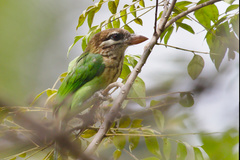
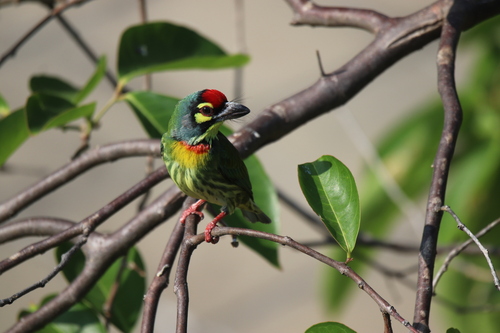
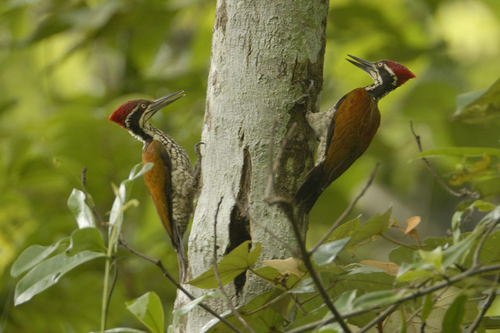
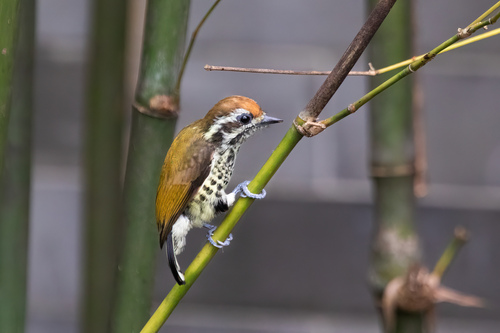
White-cheeked Barbet

White-cheeked Barbet

Psilopogon viridis

Silhouette: Rohit N · PhyloPic

LCLeast ConcernNTVUENCR Endemic
Daily sighting probability ~60% · Likely
at Mudumalai National Park

In 3 days ~90% in a week >90%

756 Verified sightings at Mudumalai National Park From 2019 to 2026
10,967 In all 5 parks
January Best month
🌅 Crepuscular When it's spotted

About the White-cheeked Barbet

The white-cheeked barbet or small green barbet (Psilopogon viridis) is a species of Asian barbet found in southern India. It is very similar to the more widespread brown-headed barbet (or large green barbet, Psilopogon zeylanicus), but this species has a distinctive supercilium and a broad white cheek stripe below the eye and is found in the forest areas of the Western Ghats, parts of the Eastern Ghats and adjoining hills. The brown-headed barbet has an orange eye-ring but the calls are very similar and the two species occur together in some of the drier forests to the east of the Western Ghats. Like all other Asian barbets, they are mainly frugivorous (although they may sometimes eat insects), and use their bills to excavate nest cavities in trees.

Bucco viridis was the scientific name proposed by Pieter Boddaert in 1783 for a green barbet that had been described by Georges-Louis Leclerc, Comte de Buffon in 1780 based on a specimen collected in India. It was illustrated by François-Nicolas Martinet in a hand-coloured plate. It was placed in the genus Megalaima proposed by George Robert Gray in 1842 who suggested to use this name instead of Bucco.

Its type locality is... Wikipedia →

Sounds

Song0:39

India · 2024

© Jairam Vijayan · XC872785 · CC BY-SA 4.0

Call0:08

India · 2023

© Tushar Bhagwat · XC788186 · CC BY-NC-SA 4.0

Call0:14

India · 2023

© Sathyan Meppayur · XC786596 · CC BY-NC-SA 4.0

Global Distribution

Parks Where Found

# Park Country Daily sighting probability
1 Periyar National Park 🇮🇳 India
~80%
2 Mudumalai National Park 🇮🇳 India
~60%
3 Nagarhole National Park 🇮🇳 India
~60%
4 Bandipur National Park 🇮🇳 India
~50%
5 Eravikulam National Park 🇮🇳 India
~40%

Cities Where Found

# City Country Daily sighting probability
1 Bengaluru 🇮🇳 India
~80%
2 Thrissur 🇮🇳 India
~80%
3 Thiruvananthapuram 🇮🇳 India
~80%
4 Kollam 🇮🇳 India
~70%
5 Kochi 🇮🇳 India
~60%
6 Ponnani 🇮🇳 India
~60%
7 Mysuru 🇮🇳 India
~60%
8 Kozhikode 🇮🇳 India
~50%
9 Colachel 🇮🇳 India
~10%
10 Coimbatore 🇮🇳 India
<5%

Before you go

What are the chances of seeing a White-cheeked Barbet in Mudumalai National Park?

Likely

About 60% of wildlife watchers report a White-cheeked Barbet sighting in Mudumalai National Park on a given day, based on 756 verified sightings from GBIF citizen-science data from 2019 to 2026. It is the 5th most-seen of the 233 birds we can rate there. Over three days the chance rises to about 90%, and over a week to over 90%, if each day is a fresh chance.

When is the best time to see a White-cheeked Barbet in Mudumalai National Park?

January–February and April

In those months about 70% of wildlife watchers report a White-cheeked Barbet in Mudumalai National Park on a given day, against about 30% in September, the lowest month. Those are among Mudumalai National Park's driest months, with about 30 mm of rain a month against 230 mm in July.

What time of day is best to see a White-cheeked Barbet?

Between 3 and 6 am

Across all the parks we cover, that three-hour window holds the most White-cheeked Barbet sightings with a recorded time, and about half of them come between 6 pm and 6 am: it is most active around dawn and dusk.

Is Mudumalai National Park the best place to see a White-cheeked Barbet?

2nd of 5

Of the 5 parks where we can rate White-cheeked Barbet sightings, Mudumalai National Park ranks 2nd at about 60%. The best odds are in Periyar National Park (India, about 80%). All parks ranked.

Where does the White-cheeked Barbet sighting chance come from?

GBIF citizen-science records

It is estimated from how often the White-cheeked Barbet is recorded against all the birds logged in Mudumalai National Park (756 verified sightings from 2019 to 2026), calibrated against known sighting rates. Figures are rounded to the nearest 10% because citizen-science data supports honest approximations, not decimals, and months with records from fewer than five people show "—". How it works.

← Back to Mudumalai National Park