Malabar Lark

Malabar Lark

Galerida malabarica

Silhouette: Gossipguy and T. Michael Keesey · PhyloPic

LCLeast ConcernNTVUENCR Endemic
Daily sighting probability ~20% · Possible
at Mudumalai National Park

In 3 days ~50% in a week ~80%

196 Verified sightings at Mudumalai National Park From 2019 to 2026
290 In all 3 parks
January Best month
☀️ Diurnal When it's spotted

About the Malabar Lark

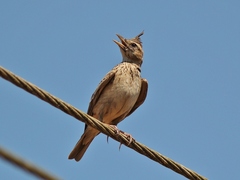
The Malabar lark, or Malabar crested lark (Galerida malabarica) is a species of lark in the family Alaudidae found in western India. Originally, the Malabar lark was classified in the genus Alauda before being moved to its present genus. Also, some authorities have considered the Thekla lark to be a subspecies of the Malabar lark.

This is a smallish lark, slightly smaller than the Eurasian skylark. It has a long spiky erectile crest. It is greyer than the skylark, and lacks the white wing and tail edges of that species, which is a winter visitor to India.

It is very similar to the crested lark, which breeds in northern India. The Malabar lark is smaller and dark-streaked reddish brown in plumage, whereas the crested lark is grey. The belly is white. The sexes are similar.

Sykes's lark is another Indian relative that also has reddish-brown plumage, but is smaller, shorter-billed, with a stiff upright crest and has plain rufous underparts. The Malabar lark is found in western India. It is a common bird of open country, cultivation and scrub, often at some altitude. The Malabar lark... Wikipedia →

Sounds

Song0:25

India · 2011

© Rajgopal Patil · XC578188 · CC BY-NC-SA 4.0

Call1:28

India · 2009

© Pankaj Lad · XC214131 · CC BY-NC-SA 4.0

Call0:39

India · 2013

© Sushant more · XC200959 · CC BY-NC-SA 4.0

Global Distribution

Parks Where Found

# Park Country Daily sighting probability
1 Mudumalai National Park 🇮🇳 India
~20%
2 Bandipur National Park 🇮🇳 India
<5%
3 Nagarhole National Park 🇮🇳 India
<5%

Cities Where Found

# City Country Daily sighting probability
1 Nashik 🇮🇳 India
<5%
2 Kollam 🇮🇳 India
<5%
3 Kochi 🇮🇳 India
<5%
4 Pune 🇮🇳 India
<5%

Before you go

What are the chances of seeing a Malabar Lark in Mudumalai National Park?

Possible

About 20% of wildlife watchers report a Malabar Lark sighting in Mudumalai National Park on a given day, based on 196 verified sightings from GBIF citizen-science data from 2019 to 2026. It is the 62nd most-seen of the 233 birds we can rate there. Over three days the chance rises to about 50%, and over a week to about 80%, if each day is a fresh chance.

When is the best time to see a Malabar Lark in Mudumalai National Park?

January–February and November

In those months about 30% of wildlife watchers report a Malabar Lark in Mudumalai National Park on a given day, against about 10% in July and September, the lowest months. Those are among Mudumalai National Park's driest months, with about 55 mm of rain a month against 230 mm in July.

What time of day is best to see a Malabar Lark?

Between 7 and 10 am

Across all the parks we cover, that three-hour window holds the most Malabar Lark sightings with a recorded time, and about 9 in 10 of them come between 6 am and 6 pm: it is a daytime animal.

Is Mudumalai National Park the best place to see a Malabar Lark?

Yes

Of the 3 parks where we can rate Malabar Lark sightings, Mudumalai National Park has the highest daily chance: about 20%. Next come Bandipur National Park (India, under 5%) and Nagarhole National Park (India, under 5%).

Where does the Malabar Lark sighting chance come from?

GBIF citizen-science records

It is estimated from how often the Malabar Lark is recorded against all the birds logged in Mudumalai National Park (196 verified sightings from 2019 to 2026), calibrated against known sighting rates. Figures are rounded to the nearest 10% because citizen-science data supports honest approximations, not decimals, and months with records from fewer than five people show "—". How it works.

← Back to Mudumalai National Park