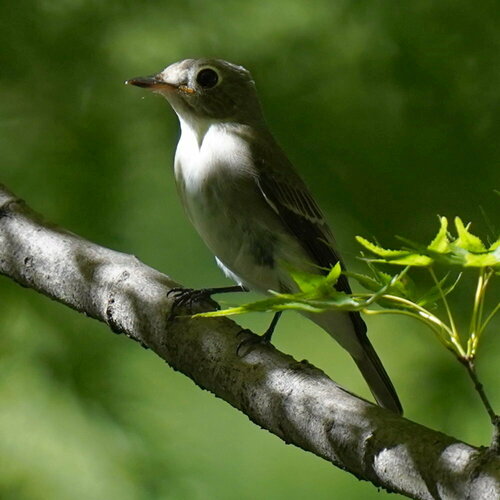
Rusty-tailed Flycatcher

Rusty-tailed Flycatcher

Muscicapa ruficauda

Silhouette: Ekytza · PhyloPic

Daily sighting probability <5% · Rare
at Mudumalai National Park

In 3 days ~10%

19 Verified sightings at Mudumalai National Park From 2019 to 2026
402 In all 3 parks
March Best month
🌅 Crepuscular When it's spotted

About the Rusty-tailed Flycatcher

The rusty-tailed flycatcher (Ficedula ruficauda) is a small passerine bird in the flycatcher family Muscicapidae. It is found mainly in the northern regions of the Indian subcontinent and some parts of southwest India, as well as pockets of Central Asia including Uzbekistan and Tajikistan. The species is partially migratory, with the Central Asian populations migrating to India, as far as the southwest Indian coast along the Arabian Sea, to Karnataka and Kerala.

Other populations, especially those across the lower Himalayas, remain in their native regions year-round and breed there. The species is also an occasional vagrant to other areas in India. The rusty-tailed flycatcher is 14 cm (5.5 in) in length and weighs 11–16 g (0.39–0.56 oz). The sexes have similar plumage.

In a molecular phylogenetic study of species in Muscicapa and related genera (tribe Muscicapini) published in 2016, Gary Voelker and colleagues found that the rusty-tailed flycatcher was basal to the other Muscicapini species and proposed that it be placed in its own monotypic genus Ripleyia. This name was found to be preoccupied and was replaced by Ripleyornis. A subsequent phylogenetic analysis that included species from both Ficedula and Muscicapa found that the rusty-tailed flycatcher formed part of a clade containing members of Ficedula. Wikipedia →

Global Distribution

Parks Where Found

# Park Country Daily sighting probability
1 Periyar National Park 🇮🇳 India
~10%
2 Mudumalai National Park 🇮🇳 India
<5%
3 Nagarhole National Park 🇮🇳 India
<5%

Cities Where Found

# City Country Daily sighting probability
1 Srinagar 🇮🇳 India
<5%
2 Kolkata 🇮🇳 India
<5%
3 Jabalpur 🇮🇳 India
<5%
4 Kathmandu 🇳🇵 Nepal
<5%
5 Bengaluru 🇮🇳 India
<5%
6 Pune 🇮🇳 India
<5%

Before you go

What are the chances of seeing a Rusty-tailed Flycatcher in Mudumalai National Park?

Rare

Under 5% of wildlife watchers report a Rusty-tailed Flycatcher sighting in Mudumalai National Park on a given day, based on 19 verified sightings from GBIF citizen-science data from 2019 to 2026. It is the 201st most-seen of the 233 birds we can rate there. Over three days the chance rises to about 10%, if each day is a fresh chance.

When is the best time to see a Rusty-tailed Flycatcher in Mudumalai National Park?

March

In that month about 10% of wildlife watchers report a Rusty-tailed Flycatcher in Mudumalai National Park on a given day, against under 5% in April to February, the lowest months. That is one of Mudumalai National Park's driest months, with about 35 mm of rain against 230 mm in July.

What time of day is best to see a Rusty-tailed Flycatcher?

Between 4 and 7 am

Across all the parks we cover, that three-hour window holds the most Rusty-tailed Flycatcher sightings with a recorded time, and about 6 in 10 of them come between 6 am and 6 pm: it is most active around dawn and dusk.

Is Mudumalai National Park the best place to see a Rusty-tailed Flycatcher?

2nd of 3

Of the 3 parks where we can rate Rusty-tailed Flycatcher sightings, Mudumalai National Park ranks 2nd at under 5%. The best odds are in Periyar National Park (India, about 10%).

Where does the Rusty-tailed Flycatcher sighting chance come from?

GBIF citizen-science records

It is estimated from how often the Rusty-tailed Flycatcher is recorded against all the birds logged in Mudumalai National Park (19 verified sightings from 2019 to 2026), calibrated against known sighting rates. Figures are rounded to the nearest 10% because citizen-science data supports honest approximations, not decimals, and months with records from fewer than five people show "—". How it works.

← Back to Mudumalai National Park