Red-tailed Shrike

Red-tailed Shrike

Lanius phoenicuroides

Silhouette: Andy Wilson · PhyloPic

LCLeast ConcernNTVUENCR
Daily sighting probability <5% · Rare
at Murchison Falls National Park

In 3 days ~10%

22 Verified sightings at Murchison Falls National Park From 2019 to 2026
616 In all 15 parks
January Best month
☀️ Diurnal When it's spotted

About the Red-tailed Shrike

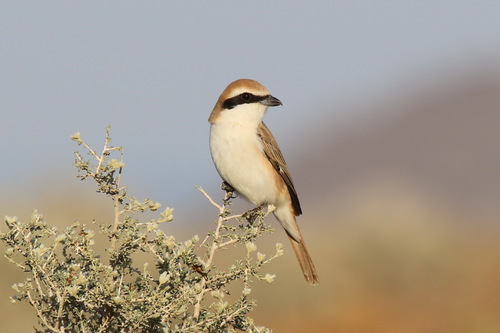
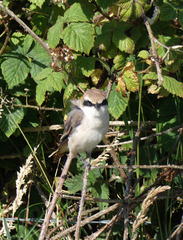
The red-tailed shrike or Turkestan shrike (Lanius phoenicuroides) is a member of the shrike family (Laniidae). It was formerly considered conspecific with the isabelline shrike and the red-backed shrike. The plumage is a sandy colour. It has a red tail.

The red-tailed shrike breeds in south Siberia and Central Asia. This migratory medium-sized passerine eats large insects, small birds, rodents and lizards. Like other shrikes it hunts from prominent perches, and impales corpses on thorns or barbed wire as a larder. It breeds in open cultivated country, preferably with thorn bushes.

Oiseaux Pictures Wikipedia →

Sounds

Song0:45

Oman · 2024

© Maarten Sluijter · XC984093 · CC BY-NC-SA 4.0

Song and call0:28

Kazakhstan · 2023

© Peter Boesman · XC813454 · CC BY-NC-ND 4.0

Call0:08

Oman · 2018

© James Lidster · XC529928 · CC BY-NC-SA 4.0

Global Distribution

Parks Where Found

# Park Country Daily sighting probability
1 Tsavo West National Park 🇰🇪 Kenya
~10%
2 Awash National Park 🇪🇹 Ethiopia
~10%
3 Tsavo East National Park 🇰🇪 Kenya
~10%
4 Samburu National Reserve 🇰🇪 Kenya
~10%
5 Mkomazi National Park 🇹🇿 Tanzania
~10%
6 Lake Manyara National Park 🇹🇿 Tanzania
~10%
7 Arusha National Park 🇹🇿 Tanzania
~10%
8 Nairobi National Park 🇰🇪 Kenya
<5%
9 Amboseli National Park 🇰🇪 Kenya
<5%
10 Murchison Falls National Park 🇺🇬 Uganda
<5%
11 Serengeti National Park 🇹🇿 Tanzania
<5%
12 Lake Nakuru National Park 🇰🇪 Kenya
<5%
13 Ngorongoro Conservation Area 🇹🇿 Tanzania
<5%
14 Masai Mara National Reserve 🇰🇪 Kenya
<5%
15 Tarangire National Park 🇹🇿 Tanzania
<5%

Cities Where Found

# City Country Daily sighting probability
1 Abu Dhabi 🇦🇪 United Arab Emirates
~10%
2 Dammam 🇸🇦 Saudi Arabia
~10%
3 Riyadh 🇸🇦 Saudi Arabia
~10%
4 Kuwait City 🇰🇼 Kuwait
<5%
5 Doha 🇶🇦 Qatar
<5%
6 Dubai 🇦🇪 United Arab Emirates
<5%

Before you go

What are the chances of seeing a Red-tailed Shrike in Murchison Falls National Park?

Rare

Under 5% of wildlife watchers report a Red-tailed Shrike sighting in Murchison Falls National Park on a given day, based on 22 verified sightings from GBIF citizen-science data from 2019 to 2026. It is the 293rd most-seen of the 424 birds we can rate there. Over three days the chance rises to about 10%, if each day is a fresh chance.

When is the best time to see a Red-tailed Shrike in Murchison Falls National Park?

January

In that month about 20% of wildlife watchers report a Red-tailed Shrike in Murchison Falls National Park on a given day, against under 5% in February to December, the lowest months. That is one of Murchison Falls National Park's driest months, with about 15 mm of rain against 190 mm in October.

What time of day is best to see a Red-tailed Shrike?

Between 7 and 10 am

Across all the parks we cover, that three-hour window holds the most Red-tailed Shrike sightings with a recorded time, and about 8 in 10 of them come between 6 am and 6 pm: it is a daytime animal.

Is Murchison Falls National Park the best place to see a Red-tailed Shrike?

10th of 15

Of the 15 parks where we can rate Red-tailed Shrike sightings, Murchison Falls National Park ranks 10th at under 5%. The best odds are in Tsavo West National Park (Kenya, about 10%), Awash National Park (Ethiopia, about 10%) and Tsavo East National Park (Kenya, about 10%).

Where does the Red-tailed Shrike sighting chance come from?

GBIF citizen-science records

It is estimated from how often the Red-tailed Shrike is recorded against all the birds logged in Murchison Falls National Park (22 verified sightings from 2019 to 2026), calibrated against known sighting rates. Figures are rounded to the nearest 10% because citizen-science data supports honest approximations, not decimals, and months with records from fewer than five people show "—". How it works.

← Back to Murchison Falls National Park