
Red-tailed Comet

Red-tailed Comet

Sappho sparganurus

Silhouette: Ferran Sayol · PhyloPic

LCLeast ConcernNTVUENCR
Daily sighting probability <5% · Rare
at Nahuel Huapi National Park

In 3 days <5% in a week ~10%

25 Verified sightings at Nahuel Huapi National Park From 2019 to 2026
25 In 1 park
June Best month
☀️ Diurnal When it's spotted

About the Red-tailed Comet

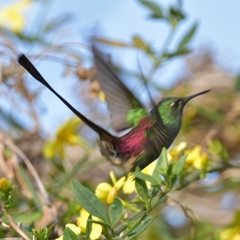
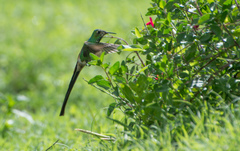
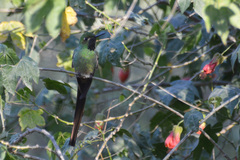
The red-tailed comet (Sappho sparganurus) is a medium-sized hummingbird belonging to tribe Lesbiini of subfamily Lesbiinae, the "coquettes". It is found in Argentina and Bolivia and possibly Chile and Peru. The red-tailed comet was formally described in 1812 by the English naturalist George Shaw under the binomial name Trochilus sparganurus. The type locality is Bolivia. Some early twentieth century authors placed it in genus Lesbia. The red-tailed comet is now the only species in genus Sappho that was introduced in 1849 by the German naturalist Ludwig Reichenbach. The genus name refers to Sappho, an ancient Greek poet of Lesbos. The specific epithet sparganurus combines the Ancient Greek σπαργανόω/spargaō meaning 'to wrap' and ουρά/oura meaning 'tail'.

In the early twentieth century at least one author treated the two as individual species. In at least part of its range it is known in the local Quechua language as Q'ori Kenti (lit. 'golden hummingbird'). It is called the picaflor cometa in Argentina.

Male red-tailed... Wikipedia →

Sounds

Song0:07

Argentina · 2013

© Peter Boesman · XC273062 · CC BY-NC-ND 4.0

Call0:31

Bolivia · 2014

© Dan Lane · XC263264 · CC BY-NC-SA 4.0

Song0:22

Argentina · 2009

© Bernabe Lopez-Lanus · XC48792 · CC BY-NC-SA 3.0

Global Distribution

Parks Where Found

# Park Country Daily sighting probability
1 Nahuel Huapi National Park 🇦🇷 Argentina
<5%

More parks will be added in future updates.

Cities Where Found

# City Country Daily sighting probability
1 Mendoza 🇦🇷 Argentina
~50%
2 La Paz 🇧🇴 Bolivia
~40%
3 Cordoba 🇦🇷 Argentina
~20%
4 Cochabamba 🇧🇴 Bolivia
<5%

Before you go

What are the chances of seeing a Red-tailed Comet in Nahuel Huapi National Park?

Rare

Under 5% of wildlife watchers report a Red-tailed Comet sighting in Nahuel Huapi National Park on a given day, based on 25 verified sightings from GBIF citizen-science data from 2019 to 2026. It is the 96th most-seen of the 111 birds we can rate there. Over three days the chance rises to under 5%, and over a week to about 10%, if each day is a fresh chance.

When is the best time to see a Red-tailed Comet in Nahuel Huapi National Park?

June and July

In those months about 10% of wildlife watchers report a Red-tailed Comet in Nahuel Huapi National Park on a given day, against under 5% in August to May, the lowest months. Those are among Nahuel Huapi National Park's wettest months, with about 290 mm of rain a month against 55 mm in February.

What time of day is best to see a Red-tailed Comet?

Between 9 am and noon

Across all the parks we cover, that three-hour window holds the most Red-tailed Comet sightings with a recorded time, and about 9 in 10 of them come between 6 am and 6 pm: it is a daytime animal.

Where else can you see a Red-tailed Comet?

Only Nahuel Huapi National Park, in our data

Nahuel Huapi National Park is the only park on Wallace's Line with enough records to rate Red-tailed Comet sightings: under 5% of wildlife watchers there report one on a given day.

Where does the Red-tailed Comet sighting chance come from?

GBIF citizen-science records

It is estimated from how often the Red-tailed Comet is recorded against all the birds logged in Nahuel Huapi National Park (25 verified sightings from 2019 to 2026), calibrated against known sighting rates. Figures are rounded to the nearest 10% because citizen-science data supports honest approximations, not decimals, and months with records from fewer than five people show "—". How it works.

← Back to Nahuel Huapi National Park