African Skimmer

African Skimmer

Rynchops flavirostris

Silhouette: Daniel Nuñez-Leon · PhyloPic

LCLeast ConcernNTVUENCR
Daily sighting probability <5% · Rare
at Nairobi National Park

In 3 days <5%

8 Verified sightings at Nairobi National Park From 2019 to 2026
1,650 In all 18 parks
December Best month
☀️ Diurnal When it's spotted

About the African Skimmer

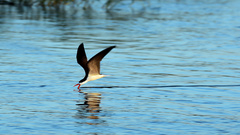
The African skimmer (Rynchops flavirostris) is a species of bird belonging to the skimmer genus Rynchops in the family Laridae. It is found along rivers, lakes and lagoons in Sub-Saharan Africa. African skimmers have long wings, with a black back, hindneck, and crown. The forehead and rest of the body is white, with a bright, long, orange beak that ends with a yellow tip (black tip when immature), hence the specific name flavirostris, "yellow-beak". Their short forked tail is white, and their legs are bright red. The average size is about 38 cm (15 in) long. Their voice is a sharp "kip-kip". Their bill structure is unique; the lower mandible is much longer than the upper mandible, and is flattened sideways like scissor blades.

The African skimmer is found from Senegal to northern Congo River and southern Nile Valley, southern Tanzania to the Zambezi Valley, and then to KwaZulu-Natal Province (South Africa) and Angola. They live at large tropical rivers with sandbanks for nesting and roosting, lake shores, and coastal lagoons. The African skimmer is generally uncommon and the total populations is estimated at 15,000–25,000 individuals... Wikipedia →

Sounds

Flight call0:12

Uganda · 2018

© Phil Gregory · XC608119 · CC BY-NC-SA 4.0

Call0:46

Uganda · 2018

© Andrew Spencer · XC430459 · CC BY-NC-ND 4.0

Begging call1:04

Zambia · 2018

© Toby Esplin · XC442871 · CC BY-NC-ND 4.0

Global Distribution

Parks Where Found

# Park Country Daily sighting probability
1 Gonarezhou National Park 🇿🇼 Zimbabwe
~30%
2 South Luangwa National Park 🇿🇲 Zambia
~20%
3 Chobe National Park 🇧🇼 Botswana
~20%
4 Murchison Falls National Park 🇺🇬 Uganda
~20%
5 Liwonde National Park 🇲🇼 Malawi
~10%
6 Queen Elizabeth National Park 🇺🇬 Uganda
~10%
7 Lower Zambezi National Park 🇿🇲 Zambia
~10%
8 Gorongosa National Park 🇲🇿 Mozambique
~10%
9 Mana Pools National Park 🇿🇼 Zimbabwe
~10%
10 Lake Nakuru National Park 🇰🇪 Kenya
~10%
11 Ruaha National Park 🇹🇿 Tanzania
~10%
12 Moremi Game Reserve 🇧🇼 Botswana
<5%
13 Kafue National Park 🇿🇲 Zambia
<5%
14 Hwange National Park 🇿🇼 Zimbabwe
<5%
15 Tsavo West National Park 🇰🇪 Kenya
<5%
16 iSimangaliso Wetland Park 🇿🇦 South Africa
<5%
17 Kruger National Park 🇿🇦 South Africa
<5%
18 Nairobi National Park 🇰🇪 Kenya
<5%

Cities Where Found

# City Country Daily sighting probability
1 Kampala 🇺🇬 Uganda
<5%

Before you go

What are the chances of seeing an African Skimmer in Nairobi National Park?

Rare

Under 5% of wildlife watchers report an African Skimmer sighting in Nairobi National Park on a given day, based on 8 verified sightings from GBIF citizen-science data from 2019 to 2026. It is the 361st most-seen of the 371 birds we can rate there. Over three days the chance rises to under 5%, if each day is a fresh chance.

When is the best time to see an African Skimmer in Nairobi National Park?

Any time of year

In every month with enough records, under 5% of wildlife watchers report an African Skimmer in Nairobi National Park on a given day, so our monthly data shows no clear season.

What time of day is best to see an African Skimmer?

Between 3 and 6 pm

Across all the parks we cover, that three-hour window holds the most African Skimmer sightings with a recorded time, and about 9 in 10 of them come between 6 am and 6 pm: it is a daytime animal.

Where does the African Skimmer sighting chance come from?

GBIF citizen-science records

It is estimated from how often the African Skimmer is recorded against all the birds logged in Nairobi National Park (8 verified sightings from 2019 to 2026), calibrated against known sighting rates. Figures are rounded to the nearest 10% because citizen-science data supports honest approximations, not decimals, and months with records from fewer than five people show "—". How it works.

← Back to Nairobi National Park