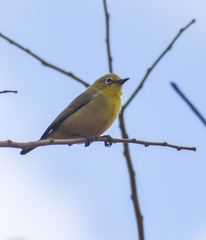
Pale White-eye

Pale White-eye

Zosterops flavilateralis

Silhouette: Ferran Sayol · PhyloPic

LCLeast ConcernNTVUENCR
Daily sighting probability ~20% · Possible
at Nairobi National Park

In 3 days ~40% in a week ~70%

272 Verified sightings at Nairobi National Park From 2019 to 2026
666 In all 10 parks
August Best month
☀️ Diurnal When it's spotted

About the Pale White-eye

The pale white-eye also known as Kenya white-eye (Zosterops flavilateralis) is a bird species in the family Zosteropidae. It is found in Kenya, eastern Tanzania, southern Ethiopia and southern Somalia. The pale white-eye was formally described in 1892 by the German ornithologist Anton Reichenow under the current binomial name Zosterops flavilateralis. The specific epithet flavilateralis combines Latin flavus meaning "yellow" with lateralis meaning "of the sides". The pale white-eye was formerly treated as a subspecies of the Abyssinian white-eye (Zosterops abyssinicus) but is now treated as a separate species.

Two subspecies are recognised: Wikipedia →

Sounds

Call0:20

Kenya · 2021

© isaac kilusu · XC681391 · CC BY-NC-SA 4.0

Song0:40

Tanzania · 2019

© Peter Boesman · XC510478 · CC BY-NC-ND 4.0

Call0:42

Ethiopia · 2015

© Andrew Spencer · XC268776 · CC BY-NC-ND 4.0

Global Distribution

Parks Where Found

# Park Country Daily sighting probability
1 Mkomazi National Park 🇹🇿 Tanzania
~30%
2 Tsavo West National Park 🇰🇪 Kenya
~20%
3 Nairobi National Park 🇰🇪 Kenya
~20%
4 Arusha National Park 🇹🇿 Tanzania
~10%
5 Meru National Park 🇰🇪 Kenya
~10%
6 Lake Manyara National Park 🇹🇿 Tanzania
<5%
7 Tsavo East National Park 🇰🇪 Kenya
<5%
8 Ngorongoro Conservation Area 🇹🇿 Tanzania
<5%
9 Tarangire National Park 🇹🇿 Tanzania
<5%
10 Amboseli National Park 🇰🇪 Kenya
<5%

Cities Where Found

# City Country Daily sighting probability
1 Nairobi 🇰🇪 Kenya
<5%

Before you go

What are the chances of seeing a Pale White-eye in Nairobi National Park?

Possible

About 20% of wildlife watchers report a Pale White-eye sighting in Nairobi National Park on a given day, based on 272 verified sightings from GBIF citizen-science data from 2019 to 2026. It is the 142nd most-seen of the 371 birds we can rate there. Over three days the chance rises to about 40%, and over a week to about 70%, if each day is a fresh chance.

When is the best time to see a Pale White-eye in Nairobi National Park?

February, April–June, August and October–December

In those months about 20% of wildlife watchers report a Pale White-eye in Nairobi National Park on a given day, against about 10% in January, March, July and September, the lowest months.

What time of day is best to see a Pale White-eye?

Between 6 and 9 am

Across all the parks we cover, that three-hour window holds the most Pale White-eye sightings with a recorded time, and about 9 in 10 of them come between 6 am and 6 pm: it is a daytime animal.

Is Nairobi National Park the best place to see a Pale White-eye?

3rd of 10

Of the 10 parks where we can rate Pale White-eye sightings, Nairobi National Park ranks 3rd at about 20%. The best odds are in Mkomazi National Park (Tanzania, about 30%) and Tsavo West National Park (Kenya, about 20%).

Where does the Pale White-eye sighting chance come from?

GBIF citizen-science records

It is estimated from how often the Pale White-eye is recorded against all the birds logged in Nairobi National Park (272 verified sightings from 2019 to 2026), calibrated against known sighting rates. Figures are rounded to the nearest 10% because citizen-science data supports honest approximations, not decimals, and months with records from fewer than five people show "—". How it works.

← Back to Nairobi National Park