Beautiful Nuthatch

Beautiful Nuthatch

Sitta formosa

Silhouette: Alan and Elaine Wilson (Modified) · PhyloPic

LCNTVUVulnerableENCR
Daily sighting probability <5% · Rare
at Namdapha National Park

In 3 days ~10% in a week ~20%

53 Verified sightings at Namdapha National Park From 2019 to 2026
82 In all 2 parks
April Best month
☀️ Diurnal When it's spotted

About the Beautiful Nuthatch

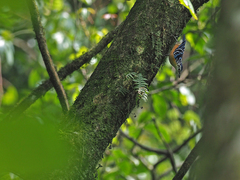
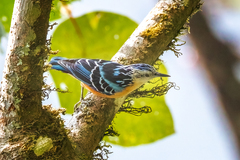
The beautiful nuthatch (Sitta formosa) is a bird species in the family Sittidae, collectively known as nuthatches. It is a large nuthatch, measuring 16.5 cm (6.5 in) in length, that is not sexually dimorphic. Its colour and markings are dramatic, the upper parts being black and azure, streaked with white and pale blue on the head and lined with the same colours on the wing feathers. The underparts are orange, and the eyebrow and throat are ochre. An irregular, dark eyestripe highlights its eye. Its ecology is not fully described, but it is known to feed on small insects and larvae found on the trunks and epiphyte-covered branches of trees in its range. Reproduction takes place from April to May; the nest is placed in the hole of an oak, rhododendron, or other large tree. The nest is made of plant material and fur in which the bird typically lays four to six eggs.

Although the species is found in most of the countries making up the mainland of Southeast Asia, it appears to be rare throughout its range, its population being highly local where it is found. The bird nests predominantly in montane forest at an altitudinal range from 950 m (3,120 ft) up to nearly 2,300 m (7,500 ft), with some seasonal height adjustment, down to around 300 m (980 ft) in winter. Its localised occurrence within its range makes rigorous estimates of its population difficult, but its habitat is threatened by deforestation and the species appears to be in decline. It has been classified as vulnerable by the International Union for Conservation of Nature. Wikipedia →

Sounds

Uncertain0:05

Bhutan · 2026

© Sonam Dorji, Bhutan Bird · XC1099363 · CC BY-NC-SA 4.0

Call0:46

China · 2023

© He Wenjin/文进 · XC843049 · CC BY-NC-SA 4.0

Song1:24

Bhutan · 2019

© Rolf A. de By · XC508009 · CC BY-NC-SA 4.0

Global Distribution

Parks Where Found

# Park Country Daily sighting probability
1 Namdapha National Park 🇮🇳 India
<5%
2 Royal Manas National Park 🇧🇹 Bhutan
<5%

Before you go

What are the chances of seeing a Beautiful Nuthatch in Namdapha National Park?

Rare

Under 5% of wildlife watchers report a Beautiful Nuthatch sighting in Namdapha National Park on a given day, based on 53 verified sightings from GBIF citizen-science data from 2019 to 2026. It is the 185th most-seen of the 298 birds we can rate there. Over three days the chance rises to about 10%, and over a week to about 20%, if each day is a fresh chance.

When is the best time to see a Beautiful Nuthatch in Namdapha National Park?

February to April

In those months about 10% of wildlife watchers report a Beautiful Nuthatch in Namdapha National Park on a given day, against under 5% in May and October–January, the lowest months. June to September have too few records to rate.

What time of day is best to see a Beautiful Nuthatch?

Between 7 and 10 am

Across all the parks we cover, that three-hour window holds the most Beautiful Nuthatch sightings with a recorded time, and about 8 in 10 of them come between 6 am and 6 pm: it is a daytime animal.

Is Namdapha National Park the best place to see a Beautiful Nuthatch?

Yes

Of the 2 parks where we can rate Beautiful Nuthatch sightings, Namdapha National Park has the highest daily chance: under 5%. Next come Royal Manas National Park (Bhutan, under 5%).

Where does the Beautiful Nuthatch sighting chance come from?

GBIF citizen-science records

It is estimated from how often the Beautiful Nuthatch is recorded against all the birds logged in Namdapha National Park (53 verified sightings from 2019 to 2026), calibrated against known sighting rates. Figures are rounded to the nearest 10% because citizen-science data supports honest approximations, not decimals, and months with records from fewer than five people show "—". How it works.

← Back to Namdapha National Park