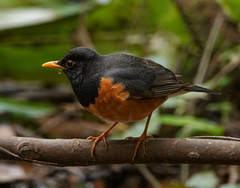
Black-breasted Thrush

Black-breasted Thrush

Turdus dissimilis

Silhouette: Sharon Wegner-Larsen · PhyloPic

LCLeast ConcernNTVUENCR
Daily sighting probability <5% · Rare
at Namdapha National Park

In 3 days ~10%

24 Verified sightings at Namdapha National Park From 2019 to 2026
147 In all 3 parks
January Best month
🌅 Crepuscular When it's spotted

About the Black-breasted Thrush

The black-breasted thrush (Turdus dissimilis) is a species of bird in the family Turdidae. It is found from north-eastern India to northern Vietnam. Although both male and female birds have the same colour on their lower parts, the upper section of males is mostly black in colour, while females are mostly grey-brown. Thus, the bird's common name refers to the colour of the male bird's breast. They tend to live in forests located at high altitude.

The black-breasted thrush belongs to the order Passeriformes and the family Turdidae. The species is a monotypic taxon – it has been hypothesized that it forms part of a larger superspecies, classified together with Tickell's thrush (T. unicolor) and the grey-backed thrush (T. hortulorum). It was previously thought to have conspecificity with the latter species of thrush. The black-breasted thrush was first described by Edward Blyth in 1847 and was found in the lower Bengal region.

The black-breasted thrush is 22 centimetres (8.7 in) to 23.5 centimetres (9.3 in) long in total, including its tail. Whereas the lower parts are the same colour for both sexes, the upper and middle parts are where they differ. For... Wikipedia →

Sounds

Call1:05

China · 2024

© Bo Shunqi薄顺奇 · XC892003 · CC BY-NC-SA 4.0

Imitation0:25

China · 2022

© Dave Guo · XC769334 · CC BY-NC-SA 4.0

Song0:28

Thailand · 2022

© Ding Li Yong · XC715076 · CC BY-NC-ND 4.0

Global Distribution

Parks Where Found

# Park Country Daily sighting probability
1 Cuc Phuong National Park 🇻🇳 Vietnam
~40%
2 Namdapha National Park 🇮🇳 India
<5%
3 Manas National Park 🇮🇳 India
<5%

Cities Where Found

# City Country Daily sighting probability
1 Guiyang 🇨🇳 China
~50%
2 Kunming 🇨🇳 China
~10%
3 Hanoi 🇻🇳 Vietnam
<5%

Zoos & Centres Where Found

# Zoo / Centre Country
1 Prague Zoo 🇨🇿 Czechia In captivity
2 Tierpark Berlin 🇩🇪 Germany In captivity
3 Zürich Zoo 🇨🇭 Switzerland In captivity
4 Rákosův pavilon 🇨🇿 Czechia In captivity
5 Velemlokárium 🇨🇿 Czechia In captivity

Before you go

What are the chances of seeing a Black-breasted Thrush in Namdapha National Park?

Rare

Under 5% of wildlife watchers report a Black-breasted Thrush sighting in Namdapha National Park on a given day, based on 24 verified sightings from GBIF citizen-science data from 2019 to 2026. It is the 219th most-seen of the 298 birds we can rate there. Over three days the chance rises to about 10%, if each day is a fresh chance.

When is the best time to see a Black-breasted Thrush in Namdapha National Park?

January

In that month about 10% of wildlife watchers report a Black-breasted Thrush in Namdapha National Park on a given day, against under 5% in February–May and October–December, the lowest months. That is one of Namdapha National Park's driest months, with about 50 mm of rain against 660 mm in July. June to September have too few records to rate.

What time of day is best to see a Black-breasted Thrush?

Between 1 and 4 am

Across all the parks we cover, that three-hour window holds the most Black-breasted Thrush sightings with a recorded time, and about half of them come between 6 pm and 6 am: it is most active around dawn and dusk.

Is Namdapha National Park the best place to see a Black-breasted Thrush?

2nd of 3

Of the 3 parks where we can rate Black-breasted Thrush sightings, Namdapha National Park ranks 2nd at under 5%. The best odds are in Cuc Phuong National Park (Vietnam, about 40%).

Where does the Black-breasted Thrush sighting chance come from?

GBIF citizen-science records

It is estimated from how often the Black-breasted Thrush is recorded against all the birds logged in Namdapha National Park (24 verified sightings from 2019 to 2026), calibrated against known sighting rates. Figures are rounded to the nearest 10% because citizen-science data supports honest approximations, not decimals, and months with records from fewer than five people show "—". How it works.

← Back to Namdapha National Park