Common Buttonquail

Common Buttonquail

Turnix sylvaticus

Silhouette: PhyloPic

LCLeast ConcernNTVUENCR
Daily sighting probability <5% · Rare
at Ngorongoro Conservation Area

In 3 days <5% in a week ~10%

16 Verified sightings at Ngorongoro Conservation Area From 2019 to 2026
602 In all 18 parks
April Best month
☀️ Diurnal When it's spotted

About the Common Buttonquail

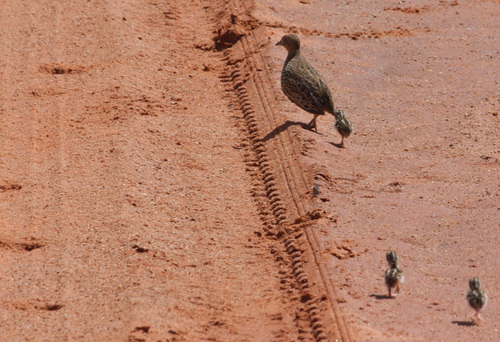
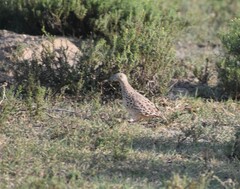
The common buttonquail (Turnix sylvaticus), also called Kurrichane buttonquail and Andalusian hemipode, is a buttonquail, one of a small family of birds that resemble but are not closely related to the true quails. The common buttonquail was formally described and illustrated in 1789 by the French botanist René Louiche Desfontaines under the binomial name Tetrao sylvaticus. The specific epithet sylvaticus is Latin meaning "of the woods". It is now placed in the genus Turnix that was named in 1840 by Pierre Joseph Bonnaterre.

Nine subspecies are recognised: Wikipedia →

Sounds

Call0:10

Saudi Arabia · 2023

© Gregory Askew · XC815345 · CC BY-NC-SA 4.0

Song0:32

South Africa · 2017

© Faansie Peacock · XC382899 · CC BY-NC-SA 4.0

Soft purring0:05

South Africa · 2013

© Peter Boesman · XC280798 · CC BY-NC-ND 4.0

Global Distribution

Parks Where Found

# Park Country Daily sighting probability
1 Kidepo Valley National Park 🇺🇬 Uganda
~10%
2 Queen Elizabeth National Park 🇺🇬 Uganda
~10%
3 Mkomazi National Park 🇹🇿 Tanzania
~10%
4 Ruaha National Park 🇹🇿 Tanzania
~10%
5 Hwange National Park 🇿🇼 Zimbabwe
~10%
6 Tsavo East National Park 🇰🇪 Kenya
<5%
7 Kafue National Park 🇿🇲 Zambia
<5%
8 Tsavo West National Park 🇰🇪 Kenya
<5%
9 Masai Mara National Reserve 🇰🇪 Kenya
<5%
10 Samburu National Reserve 🇰🇪 Kenya
<5%
11 Kruger National Park 🇿🇦 South Africa
<5%
12 Moremi Game Reserve 🇧🇼 Botswana
<5%
13 Nairobi National Park 🇰🇪 Kenya
<5%
14 Serengeti National Park 🇹🇿 Tanzania
<5%
15 Bali Barat National Park 🇮🇩 Indonesia
<5%
16 Ngorongoro Conservation Area 🇹🇿 Tanzania
<5%
17 Tarangire National Park 🇹🇿 Tanzania
<5%
18 Chobe National Park 🇧🇼 Botswana
<5%

Cities Where Found

# City Country Daily sighting probability
1 Phnom Penh 🇰🇭 Cambodia
<5%

Before you go

What are the chances of seeing a Common Buttonquail in Ngorongoro Conservation Area?

Rare

Under 5% of wildlife watchers report a Common Buttonquail sighting in Ngorongoro Conservation Area on a given day, based on 16 verified sightings from GBIF citizen-science data from 2019 to 2026. It is the 439th most-seen of the 519 birds we can rate there. Over three days the chance rises to under 5%, and over a week to about 10%, if each day is a fresh chance.

When is the best time to see a Common Buttonquail in Ngorongoro Conservation Area?

April

In that month about 10% of wildlife watchers report a Common Buttonquail in Ngorongoro Conservation Area on a given day, against under 5% in May to March, the lowest months. That is one of Ngorongoro Conservation Area's wettest months, with about 190 mm of rain against almost none in July.

What time of day is best to see a Common Buttonquail?

Between 6 and 9 am

Across all the parks we cover, that three-hour window holds the most Common Buttonquail sightings with a recorded time, and about 7 in 10 of them come between 6 am and 6 pm: it is a daytime animal.

Which relatives of the Common Buttonquail live in Ngorongoro Conservation Area?

Same order: Charadriiformes

The closest relatives of the Common Buttonquail that you can see in Ngorongoro Conservation Area (order Charadriiformes, Shorebirds and Allies) are Blacksmith Lapwing (about 60%), Crowned Lapwing (about 50%) and Black-winged Stilt (about 50%), with each one's daily chance of a sighting.

Where does the Common Buttonquail sighting chance come from?

GBIF citizen-science records

It is estimated from how often the Common Buttonquail is recorded against all the birds logged in Ngorongoro Conservation Area (16 verified sightings from 2019 to 2026), calibrated against known sighting rates. Figures are rounded to the nearest 10% because citizen-science data supports honest approximations, not decimals, and months with records from fewer than five people show "—". How it works.

← Back to Ngorongoro Conservation Area