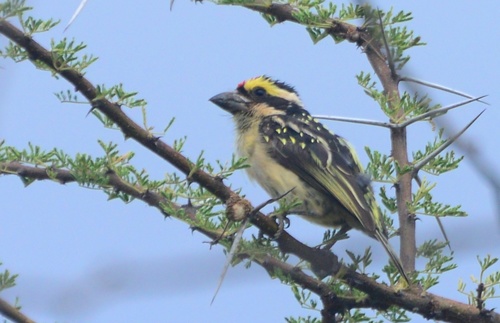
Green-backed Honeyguide

Green-backed Honeyguide

Prodotiscus zambesiae

Silhouette: Sheatherius · PhyloPic

LCLeast ConcernNTVUENCR
Daily sighting probability <5% · Rare
at Ngorongoro Conservation Area

In 3 days <5% in a week ~10%

23 Verified sightings at Ngorongoro Conservation Area From 2019 to 2026
147 In all 3 parks
May Best month
☀️ Diurnal When it's spotted

About the Green-backed Honeyguide

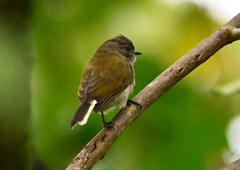
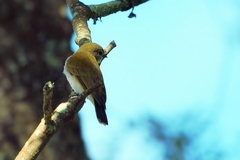
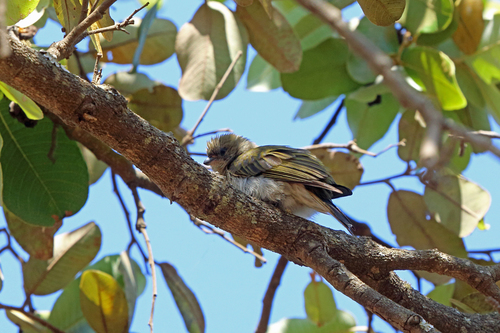
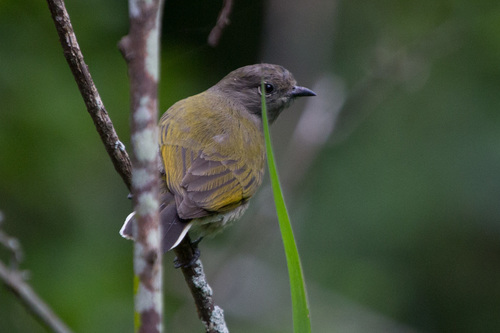
The green-backed honeybird (Prodotiscus zambesiae), also known as the eastern green-backed honeyguide, green-backed honeyguide and slender-billed honeyguide, is a species of bird in the family Indicatoridae. It is a nest parasite of three white-eye species. It is an insectivore that sometimes eats the waxy shed of scaly insects.

The adult green-backed honeybird of both sexes has ashy-gray, sometimes white, underparts, which is considered an adaptation to its environment. Its upperparts are gray-green, and its outer tail feathers, including the tips, are white. Between the back and the side, it has a white patch that can be raised upright. Its beak and legs are black. In Angola, this species is greener, less golden, and overall darker than in other areas. In Central Ethiopia, it is also darker. The juvenile is duller than the adult. It is greyer, paler, yellower above and yellowish-brown below. Younglings have an orangish mouth opening.

Its upperparts are more greyish compared to the greener Cassin’s honeybird. This closely related species is darker, olive or greenish on its underparts while the green-backed honeybird is paler, especially on its belly. Otherwise, the... Wikipedia →
Sounds

Call0:23

Zambia · 2016

© Carl Beel · XC441139 · CC BY-NC-SA 4.0

Flight call0:05

Ethiopia · 2015

© Hans Matheve · XC306016 · CC BY-NC-ND 4.0

Call0:18

Zimbabwe · 2018

© Derek Solomon · XC429468 · CC BY-NC-SA 4.0

Global Distribution

Parks Where Found

# Park Country Daily sighting probability
1 Nairobi National Park 🇰🇪 Kenya
~10%
2 Arusha National Park 🇹🇿 Tanzania
<5%
3 Ngorongoro Conservation Area 🇹🇿 Tanzania
<5%

Cities Where Found

# City Country Daily sighting probability
1 Nairobi 🇰🇪 Kenya
~10%

Before you go

What are the chances of seeing a Green-backed Honeyguide in Ngorongoro Conservation Area?

Rare

Under 5% of wildlife watchers report a Green-backed Honeyguide sighting in Ngorongoro Conservation Area on a given day, based on 23 verified sightings from GBIF citizen-science data from 2019 to 2026. It is the 409th most-seen of the 519 birds we can rate there. Over three days the chance rises to under 5%, and over a week to about 10%, if each day is a fresh chance.

When is the best time to see a Green-backed Honeyguide in Ngorongoro Conservation Area?

Any time of year

In every month with enough records, under 5% of wildlife watchers report a Green-backed Honeyguide in Ngorongoro Conservation Area on a given day, so our monthly data shows no clear season.

What time of day is best to see a Green-backed Honeyguide?

Between 7 and 10 am

Across all the parks we cover, that three-hour window holds the most Green-backed Honeyguide sightings with a recorded time, and about 7 in 10 of them come between 6 am and 6 pm: it is a daytime animal.

Is Ngorongoro Conservation Area the best place to see a Green-backed Honeyguide?

3rd of 3

Of the 3 parks where we can rate Green-backed Honeyguide sightings, Ngorongoro Conservation Area ranks 3rd at under 5%. The best odds are in Nairobi National Park (Kenya, about 10%) and Arusha National Park (Tanzania, under 5%).

Where does the Green-backed Honeyguide sighting chance come from?

GBIF citizen-science records

It is estimated from how often the Green-backed Honeyguide is recorded against all the birds logged in Ngorongoro Conservation Area (23 verified sightings from 2019 to 2026), calibrated against known sighting rates. Figures are rounded to the nearest 10% because citizen-science data supports honest approximations, not decimals, and months with records from fewer than five people show "—". How it works.

← Back to Ngorongoro Conservation Area