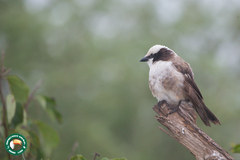
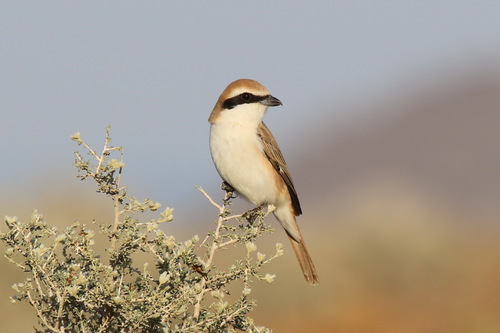
Northern White-crowned Shrike

Northern White-crowned Shrike

Eurocephalus ruppelli

Silhouette: PhyloPic

LCLeast ConcernNTVUENCR
Daily sighting probability ~20% · Possible
at Ngorongoro Conservation Area

In 3 days ~50% in a week ~80%

660 Verified sightings at Ngorongoro Conservation Area From 2019 to 2026
7,466 In all 16 parks
April Best month
☀️ Diurnal When it's spotted

About the Northern White-crowned Shrike

The northern white-crowned shrike or white-rumped shrike (Eurocephalus ruppelli), is a shrike found in dry thornbush, semi-desert, and open acacia woodland in east Africa from south eastern South Sudan and southern Ethiopia to Tanzania. Its binomial name commemorates the German naturalist and explorer Eduard Rüppell.

The northern white-crowned shrike is a large and fluffy passerine, measuring 19–23-cm long and weigh 42–58 gram. The adult has a white crown and rump, black eyestripe, brown back and wings and black tail. The throat, breast and belly are white, and the flanks are brown. The sexes are similar, but juveniles have a brown crown, white head sides, and grey breast. The flight is parrot-like.

Several subspecies have been described, but there is extensive individual variation in plumage. Although birds in the north of the range are larger than in the south, the difference is clinal and the northern white-crowned shrike may be monotypic.

The calls are high-pitched squawks, squeaks and chatters, including kek-kek and chee-chee. The northern white-crowned shrike is gregarious, occurring in groups of up 12 birds. It hunts from an exposed perch, feeding... Wikipedia →

Sounds

Call0:22

Tanzania · 2022

© isaac kilusu · XC767574 · CC BY-NC-SA 4.0

Call0:49

Tanzania · 2017

© Frank Lambert · XC429649 · CC BY-NC-ND 4.0

Call0:29

Ethiopia · 2015

© Peter Boesman · XC300295 · CC BY-NC-ND 4.0

Global Distribution

Parks Where Found

# Park Country Daily sighting probability
1 Tarangire National Park 🇹🇿 Tanzania
~70%
2 Meru National Park 🇰🇪 Kenya
~60%
3 Tsavo East National Park 🇰🇪 Kenya
~60%
4 Serengeti National Park 🇹🇿 Tanzania
~60%
5 Tsavo West National Park 🇰🇪 Kenya
~60%
6 Mkomazi National Park 🇹🇿 Tanzania
~50%
7 Lake Manyara National Park 🇹🇿 Tanzania
~40%
8 Samburu National Reserve 🇰🇪 Kenya
~40%
9 Ruaha National Park 🇹🇿 Tanzania
~40%
10 Kidepo Valley National Park 🇺🇬 Uganda
~40%
11 Awash National Park 🇪🇹 Ethiopia
~40%
12 Ngorongoro Conservation Area 🇹🇿 Tanzania
~20%
13 Masai Mara National Reserve 🇰🇪 Kenya
~20%
14 Amboseli National Park 🇰🇪 Kenya
~10%
15 Lake Nakuru National Park 🇰🇪 Kenya
<5%
16 Nairobi National Park 🇰🇪 Kenya
<5%

Before you go

What are the chances of seeing a Northern White-crowned Shrike in Ngorongoro Conservation Area?

Possible

About 20% of wildlife watchers report a Northern White-crowned Shrike sighting in Ngorongoro Conservation Area on a given day, based on 660 verified sightings from GBIF citizen-science data from 2019 to 2026. It is the 62nd most-seen of the 519 birds we can rate there. Over three days the chance rises to about 50%, and over a week to about 80%, if each day is a fresh chance.

When is the best time to see a Northern White-crowned Shrike in Ngorongoro Conservation Area?

April

In that month about 40% of wildlife watchers report a Northern White-crowned Shrike in Ngorongoro Conservation Area on a given day, against about 10% in June–August and October, the lowest months. That is one of Ngorongoro Conservation Area's wettest months, with about 190 mm of rain against almost none in July.

What time of day is best to see a Northern White-crowned Shrike?

Between 10 am and 1 pm

Across all the parks we cover, that three-hour window holds the most Northern White-crowned Shrike sightings with a recorded time, and about 9 in 10 of them come between 6 am and 6 pm: it is a daytime animal.

Which relatives of the Northern White-crowned Shrike live in Ngorongoro Conservation Area?

Same family: Laniidae

The closest relatives of the Northern White-crowned Shrike that you can see in Ngorongoro Conservation Area (family Laniidae, Shrikes) are Northern Fiscal (about 40%), Teita Fiscal (about 10%) and Grey-backed Fiscal (about 10%), with each one's daily chance of a sighting.

Where does the Northern White-crowned Shrike sighting chance come from?

GBIF citizen-science records

It is estimated from how often the Northern White-crowned Shrike is recorded against all the birds logged in Ngorongoro Conservation Area (660 verified sightings from 2019 to 2026), calibrated against known sighting rates. Figures are rounded to the nearest 10% because citizen-science data supports honest approximations, not decimals, and months with records from fewer than five people show "—". How it works.

← Back to Ngorongoro Conservation Area