Rüppell's Robin-Chat

Rüppell's Robin-Chat

Cossypha semirufa

Silhouette: Martin Bulla, based on François Desbordes' illustration · PhyloPic

LCLeast ConcernNTVUENCR
Daily sighting probability ~10% · With luck
at Ngorongoro Conservation Area

In 3 days ~20% in a week ~30%

123 Verified sightings at Ngorongoro Conservation Area From 2019 to 2026
1,139 In all 7 parks
March Best month
☀️ Diurnal When it's spotted

About the Rüppell's Robin-Chat

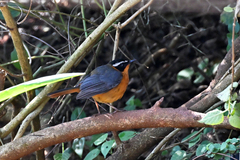
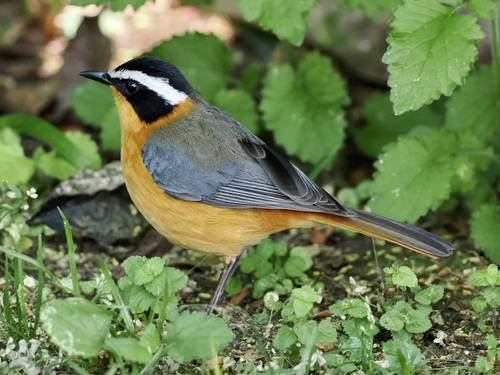
Rüppell's robin-chat (Cossypha semirufa) is a species of bird in the family Muscicapidae, that is native to the Afrotropics. It is named for the German naturalist Eduard Rüppell. It is a smaller version of the White-browed robin-chat, measuring 18 cm rather than 20 cm, with darker, blackish central tail feathers, and in some races a more constricted supercilium behind the eye.

It is native to Eritrea, Ethiopia, Kenya, South Sudan and Tanzania. It is found in subtropical or tropical moist montane forests, including Juniper and Podocarpus forest, and in subtropical or tropical moist shrubland and gardens.

There are three races: Cossypha semirufa semirufa Range: Eritrea, Ethiopia, south-eastern South Sudan and northern Kenya Cossypha semirufa donaldsoni Sharpe, 1895 Description: Rufous collar almost complete, upperparts darker than nominate

Range: south-eastern Ethiopia and adjacent Somalia Cossypha semirufa intercedens (Cabanis, 1878) Range: central to south-eastern Kenya and northern Tanzania Wikipedia →
Sounds

Subsong0:13

Kenya · 2026

© Ding Li Yong · XC1180358 · CC BY-NC-ND 4.0

Call1:01

Kenya · 2024

© Peter Boesman · XC951419 · CC BY-NC-ND 4.0

Song0:30

Kenya · 2023

© isaac kilusu · XC774767 · CC BY-NC-SA 4.0

Global Distribution

Parks Where Found

# Park Country Daily sighting probability
1 Arusha National Park 🇹🇿 Tanzania
~40%
2 Nairobi National Park 🇰🇪 Kenya
~30%
3 Aberdare National Park 🇰🇪 Kenya
~30%
4 Bale Mountains National Park 🇪🇹 Ethiopia
~20%
5 Mkomazi National Park 🇹🇿 Tanzania
~10%
6 Ngorongoro Conservation Area 🇹🇿 Tanzania
~10%
7 Lake Manyara National Park 🇹🇿 Tanzania
<5%

Cities Where Found

# City Country Daily sighting probability
1 Addis Ababa 🇪🇹 Ethiopia
~50%
2 Nairobi 🇰🇪 Kenya
~40%

Before you go

What are the chances of seeing a Rüppell's Robin-Chat in Ngorongoro Conservation Area?

With luck

About 10% of wildlife watchers report a Rüppell's Robin-Chat sighting in Ngorongoro Conservation Area on a given day, based on 123 verified sightings from GBIF citizen-science data from 2019 to 2026. It is the 242nd most-seen of the 519 birds we can rate there. Over three days the chance rises to about 20%, and over a week to about 30%, if each day is a fresh chance.

When is the best time to see a Rüppell's Robin-Chat in Ngorongoro Conservation Area?

January, March–April, June and September

In those months about 10% of wildlife watchers report a Rüppell's Robin-Chat in Ngorongoro Conservation Area on a given day, against under 5% in February, May, July–August and October–December, the lowest months.

What time of day is best to see a Rüppell's Robin-Chat?

Between 9 am and noon

Across all the parks we cover, that three-hour window holds the most Rüppell's Robin-Chat sightings with a recorded time, and about 8 in 10 of them come between 6 am and 6 pm: it is a daytime animal.

Is Ngorongoro Conservation Area the best place to see a Rüppell's Robin-Chat?

6th of 7

Of the 7 parks where we can rate Rüppell's Robin-Chat sightings, Ngorongoro Conservation Area ranks 6th at about 10%. The best odds are in Arusha National Park (Tanzania, about 40%), Nairobi National Park (Kenya, about 30%) and Aberdare National Park (Kenya, about 30%).

Which relatives of the Rüppell's Robin-Chat live in Ngorongoro Conservation Area?

Same genus: Cossypha

The closest relatives of the Rüppell's Robin-Chat that you can see in Ngorongoro Conservation Area (genus Cossypha, Typical Robin-Chats) are White-browed Robin-Chat (about 20%) and Cape Robin-Chat (about 20%), with each one's daily chance of a sighting.

Where does the Rüppell's Robin-Chat sighting chance come from?

GBIF citizen-science records

It is estimated from how often the Rüppell's Robin-Chat is recorded against all the birds logged in Ngorongoro Conservation Area (123 verified sightings from 2019 to 2026), calibrated against known sighting rates. Figures are rounded to the nearest 10% because citizen-science data supports honest approximations, not decimals, and months with records from fewer than five people show "—". How it works.

← Back to Ngorongoro Conservation Area