Beach Thick-knee

Beach Thick-knee

Esacus magnirostris

Silhouette: Auckland Museum · PhyloPic

LCNTNear ThreatenedVUENCR
Daily sighting probability <5% · Rare
at Ningaloo Marine Park

In 3 days ~10% in a week ~20%

13 Verified sightings at Ningaloo Marine Park From 2019 to 2026
256 In all 6 parks
June Best month
☀️ Diurnal When it's spotted

About the Beach Thick-knee

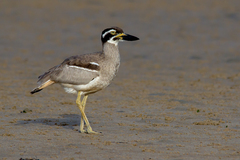
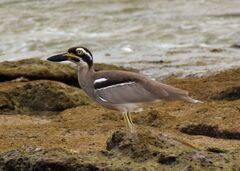
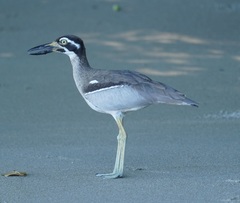
The beach stone-curlew (Esacus magnirostris) or beach thick-knee is a large, ground-dwelling bird that occurs in Australasia, the islands of South-east Asia. At 55 cm (22 in) and 1 kg (2.2 lb), it is one of the world's largest shorebirds.

It is less strictly nocturnal than most stone-curlews, and can sometimes be seen foraging by daylight, moving slowly and deliberately, with occasional short runs. It tends to be wary and fly off into the distance ahead of the observer, employing slow, rather stiff wingbeats..

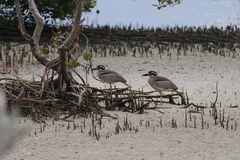
The beach stone-curlew is classified as Near Threatened on the IUCN Red List of Threatened Species. In New South Wales, it is listed as critically endangered. The beach stone-curlew is a resident of undisturbed open beaches, exposed reefs, mangroves, and tidal sand or mudflats over a large range, including coastal eastern Australia as far south as far eastern Victoria, the northern Australian coast and nearby islands, New Guinea, New Caledonia, Indonesia, Malaysia, and the Philippines. It is uncommon over most of its range, and rare south of Cairns.

The beach stone-curlew is 54-56 cm (21-22 in) long. At a mean of 1,032 g (2.275 lb) in males... Wikipedia →

Sounds

Call0:21

Australia · 2022

© Marc Anderson · XC816342 · CC BY-NC-ND 4.0

Alarm call0:23

Australia · 2023

© James Lambert · XC780135 · CC BY-NC-ND 4.0

Uncertain0:16

Australia · 2021

© nick talbot · XC639488 · CC BY-NC-SA 4.0

Global Distribution

Parks Where Found

# Park Country Daily sighting probability
1 Komodo National Park 🇮🇩 Indonesia
~10%
2 Bali Barat National Park 🇮🇩 Indonesia
<5%
3 Noosa National Park 🇦🇺 Australia
<5%
4 Ningaloo Marine Park 🇦🇺 Australia
<5%
5 Daintree National Park 🇦🇺 Australia
<5%
6 Raja Ampat 🇮🇩 Indonesia
<5%

Zoos & Centres Where Found

# Zoo / Centre Country
1 Australian Reptile Park 🇦🇺 Australia In captivity
2 Featherdale Sydney Wildlife Park 🇦🇺 Australia In captivity

Before you go

What are the chances of seeing a Beach Thick-knee in Ningaloo Marine Park?

Rare

Under 5% of wildlife watchers report a Beach Thick-knee sighting in Ningaloo Marine Park on a given day, based on 13 verified sightings from GBIF citizen-science data from 2019 to 2026. It is the 88th most-seen of the 102 birds we can rate there. Over three days the chance rises to about 10%, and over a week to about 20%, if each day is a fresh chance.

When is the best time to see a Beach Thick-knee in Ningaloo Marine Park?

June and October–November

In those months about 10% of wildlife watchers report a Beach Thick-knee in Ningaloo Marine Park on a given day, against under 5% in July–September and December–May, the lowest months.

What time of day is best to see a Beach Thick-knee?

Between 8 and 11 am

Across all the parks we cover, that three-hour window holds the most Beach Thick-knee sightings with a recorded time, and about 9 in 10 of them come between 6 am and 6 pm: it is a daytime animal.

Is Ningaloo Marine Park the best place to see a Beach Thick-knee?

4th of 6

Of the 6 parks where we can rate Beach Thick-knee sightings, Ningaloo Marine Park ranks 4th at under 5%. The best odds are in Komodo National Park (Indonesia, about 10%), Bali Barat National Park (Indonesia, under 5%) and Noosa National Park (Australia, under 5%).

Which relatives of the Beach Thick-knee live in Ningaloo Marine Park?

Same order: Charadriiformes

The closest relatives of the Beach Thick-knee that you can see in Ningaloo Marine Park (order Charadriiformes, Shorebirds and Allies) are Silver Gull (about 80%), Crested Tern (about 50%) and Pied Oystercatcher (about 50%), with each one's daily chance of a sighting.

Where does the Beach Thick-knee sighting chance come from?

GBIF citizen-science records

It is estimated from how often the Beach Thick-knee is recorded against all the birds logged in Ningaloo Marine Park (13 verified sightings from 2019 to 2026), calibrated against known sighting rates. Figures are rounded to the nearest 10% because citizen-science data supports honest approximations, not decimals, and months with records from fewer than five people show "—". How it works.

← Back to Ningaloo Marine Park