Children's Python

Children's Python

Antaresia childreni

Silhouette: SeismicShrimp · PhyloPic

LCLeast ConcernNTVUENCR Endemic
Daily sighting probability ~30% · Possible
at Ningaloo Marine Park

In 3 days ~70% in a week ~90%

25 Verified sightings at Ningaloo Marine Park From 2019 to 2026
106 In all 4 parks
January Best month
🌙 Nocturnal When it's spotted

About the Children's Python

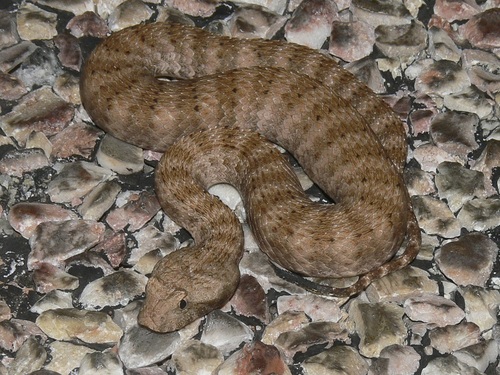
Children's python (Antaresia childreni) is a species of nonvenomous snake in the family Pythonidae. The species is named after John George Children. It is a nocturnal species occurring in the northern half of Australia and generally found on the ground, although it often climbs trees. Usually growing to about 1.0 m (3 ft) in length or more depending on the polymorphic variant, it is typically a reddish-brown colour, darker on the upper surface, and with many darker blotches, especially on younger specimens. The Stimson's python variant has much stronger and more variable colours; often being adorned with reddish-brown to chocolate blotches against lighter tan. It feeds mostly on small mammals and birds, and as with other pythons, it constricts its prey before swallowing it whole. It is a popular pet among reptile enthusiasts.

Antaresia childreni is one of four species in the genus Antaresia, a genus in the family Pythonidae. The genus is named after the star Antares. John Edward Gray published the original description of the species in 1842, naming it Liasis childreni. Both the common name and the specific epithet, childreni, are in honour of Gray's mentor... Wikipedia →

Global Distribution

Parks Where Found

# Park Country Daily sighting probability
1 Cape Range 🇦🇺 Australia
~40%
2 Litchfield National Park 🇦🇺 Australia
~40%
3 Kakadu National Park 🇦🇺 Australia
~30%
4 Ningaloo Marine Park 🇦🇺 Australia
~30%

Zoos & Centres Where Found

# Zoo / Centre Country
1 Columbus Zoo and Aquarium 🇺🇸 United States In captivity
2 Berlin Zoological Garden 🇩🇪 Germany In captivity
3 Dickerson Park Zoo 🇺🇸 United States In captivity
4 Memphis Zoo 🇺🇸 United States In captivity
5 Taronga Zoo 🇦🇺 Australia In captivity
6 Cologne Zoological Garden 🇩🇪 Germany In captivity
7 Sydney Zoo 🇦🇺 Australia In captivity
8 Reptile Gardens 🇺🇸 United States In captivity
9 Aquarium Berlin 🇩🇪 Germany In captivity
10 Australian Wildlife Park, Albany 🇦🇺 Australia In captivity
11 Cologne Zoo Aquarium 🇩🇪 Germany In captivity
12 Ranger Red’s Zoo & Conservation Park 🇦🇺 Australia In captivity

Before you go

What are the chances of seeing a Children's Python in Ningaloo Marine Park?

Possible

About 30% of wildlife watchers report a Children's Python sighting in Ningaloo Marine Park on a given day, based on 25 verified sightings from GBIF citizen-science data from 2019 to 2026. It is the 4th most-seen of the 29 reptiles we can rate there. Over three days the chance rises to about 70%, and over a week to about 90%, if each day is a fresh chance.

When is the best time to see a Children's Python in Ningaloo Marine Park?

January and February

In those months about 60% of wildlife watchers report a Children's Python in Ningaloo Marine Park on a given day, against under 5% in June–August and November, the lowest months.

What time of day is best to see a Children's Python?

Between 7 and 10 pm

Across all the parks we cover, that three-hour window holds the most Children's Python sightings with a recorded time, and about 8 in 10 of them come between 6 pm and 6 am: it is mostly seen at night.

Is Ningaloo Marine Park the best place to see a Children's Python?

4th of 4

Of the 4 parks where we can rate Children's Python sightings, Ningaloo Marine Park ranks 4th at about 30%. The best odds are in Cape Range (Australia, about 40%), Litchfield National Park (Australia, about 40%) and Kakadu National Park (Australia, about 30%).

Where does the Children's Python sighting chance come from?

GBIF citizen-science records

It is estimated from how often the Children's Python is recorded against all the reptiles logged in Ningaloo Marine Park (25 verified sightings from 2019 to 2026), calibrated against known sighting rates. Figures are rounded to the nearest 10% because citizen-science data supports honest approximations, not decimals, and months with records from fewer than five people show "—". How it works.

← Back to Ningaloo Marine Park