Spinifex Hopping Mouse

Spinifex Hopping Mouse

Notomys alexis

Silhouette: Rachel T Mason · PhyloPic

LCLeast ConcernNTVUENCR Endemic
Daily sighting probability ~20% · Possible
at Ningaloo Marine Park

In 3 days ~40% in a week ~70%

10 Verified sightings at Ningaloo Marine Park From 2019 to 2026
15 In all 2 parks
November Best month
🌅 Crepuscular When it's spotted

About the Spinifex Hopping Mouse

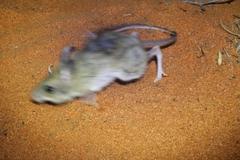
The spinifex hopping mouse (Notomys alexis), also known as the tarkawara or tarrkawarra, occurs throughout the central and western Australian arid zones, occupying both spinifex-covered sand flats and stabilised sand dunes, and loamy mulga and melaleuca flats.

The population fluctuates greatly: in normal years it is sparsely distributed and probably confined to sandy country; after rain the population explodes and spreads to other types of habitat for a time. They are mostly seen at night, bounding across open ground on their large hind feet, with tails extended and the body almost horizontal.

As semi-fossorial, burrowing surface foragers, the tiny hopping mice spend a great deal of energy not just foraging for food, but also transporting it back to their burrows. In fact, it was found that the total energy spent on transporting food in relation to energy investment on burrows far outweighed any other similar type of species.

The appearance is very similar to the northern hopping mouse: slightly larger than a common house mouse at 95 to 115 mm (3.7 to 4.5 in) head-body length and an average weight of 35 g (1.2 oz). As with all hopping mice, the hind legs are greatly... Wikipedia →

Global Distribution

Parks Where Found

# Park Country Daily sighting probability
1 Ningaloo Marine Park 🇦🇺 Australia
~20%
2 Uluru-Kata Tjuta National Park 🇦🇺 Australia
~20%

Zoos & Centres Where Found

# Zoo / Centre Country
1 Werribee Open Range Zoo 🇦🇺 Australia In captivity
2 Alice Springs Desert Park 🇦🇺 Australia In captivity
3 Taronga Zoo 🇦🇺 Australia In captivity
4 Cleland Wildlife Park 🇦🇺 Australia In captivity
5 Perth Zoo 🇦🇺 Australia In captivity
6 Sydney Zoo 🇦🇺 Australia In captivity
7 Adelaide Zoo 🇦🇺 Australia In captivity
8 Koala Park Sanctuary 🇦🇺 Australia In captivity
9 Sea Life Sydney Aquarium 🇦🇺 Australia In captivity
10 Wild Life Sydney 🇦🇺 Australia In captivity
11 African Safari World 🇦🇺 Australia In captivity

Before you go

What are the chances of seeing a Spinifex Hopping Mouse in Ningaloo Marine Park?

Possible

About 20% of wildlife watchers report a Spinifex Hopping Mouse sighting in Ningaloo Marine Park on a given day, based on 10 verified sightings from GBIF citizen-science data from 2019 to 2026. It is the 7th most-seen of the 8 mammals we can rate there. Over three days the chance rises to about 40%, and over a week to about 70%, if each day is a fresh chance.

When is the best time to see a Spinifex Hopping Mouse in Ningaloo Marine Park?

November

In that month about 40% of wildlife watchers report a Spinifex Hopping Mouse in Ningaloo Marine Park on a given day, against under 5% in March, May, September and December–January, the lowest months. That is one of Ningaloo Marine Park's driest months, with almost no rain against 50 mm in June.

What time of day is best to see a Spinifex Hopping Mouse?

Between noon and 3 pm

Across all the parks we cover, that three-hour window holds the most Spinifex Hopping Mouse sightings with a recorded time, and about 7 in 10 of them come between 6 am and 6 pm: it is most active around dawn and dusk.

Is Ningaloo Marine Park the best place to see a Spinifex Hopping Mouse?

Yes

Of the 2 parks where we can rate Spinifex Hopping Mouse sightings, Ningaloo Marine Park has the highest daily chance: about 20%. Next come Uluru-Kata Tjuta National Park (Australia, about 20%).

Where does the Spinifex Hopping Mouse sighting chance come from?

GBIF citizen-science records

It is estimated from how often the Spinifex Hopping Mouse is recorded against all the mammals logged in Ningaloo Marine Park (10 verified sightings from 2019 to 2026), calibrated against known sighting rates. Figures are rounded to the nearest 10% because citizen-science data supports honest approximations, not decimals, and months with records from fewer than five people show "—". How it works.

← Back to Ningaloo Marine Park