Green Monkey

Green Monkey

Chlorocebus sabaeus

Silhouette: PhyloPic

LCLeast ConcernNTVUENCR
Daily sighting probability ~80% · Very likely
at Niokolo-Koba National Park

In 3 days >90%

82 Verified sightings at Niokolo-Koba National Park From 2019 to 2026
82 In 1 park
December Best month
🌅 Crepuscular When it's spotted

About the Green Monkey

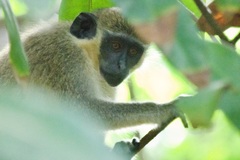
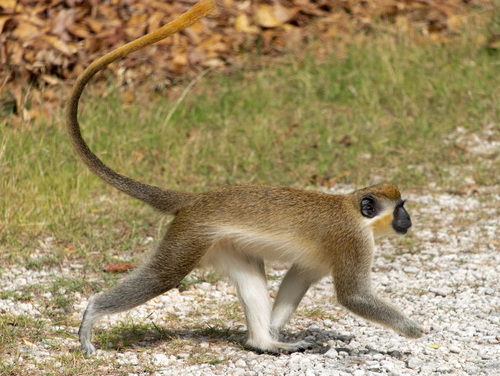
The green monkey (Chlorocebus sabaeus), also known as the sabaeus monkey, is an Old World monkey with golden-green fur and pale hands and feet. The tip of the tail is golden yellow as are the backs of the thighs and cheek whiskers. It does not have a distinguishing band of fur on the brow, like other Chlorocebus species, and males have a pale blue scrotum. Some authorities consider this and all of the members of the genus Chlorocebus to be a single widespread species, C. aethiops.

The green monkey is a sexually dimorphic species, with males typically being slightly larger than females. Wild adult males weigh between 3.9 and 8.0 kg (8.6 and 17.6 lb) and measure between 420 and 600 mm (1.38 and 1.97 ft), while the females usually weigh between 3.4 and 5.3 kg (7.5 and 11.7 lb) and measure between 300 and 495 mm (0.984 and 1.624 ft).

The green monkey can be found in a wide range of wooded habitats, ranging from very dry Sahel woodland to the edge of rainforests. It is also commonly seen in coastal regions, where known to feed on seashore foods such as crabs. It also takes a wide variety of other foods, including fruits and invertebrates... Wikipedia →
Sounds

Alarm call0:58

Gambia · 2025

© Romuald Mikusek · XC1017041 · CC BY-NC-SA 4.0

Global Distribution

Parks Where Found

# Park Country Daily sighting probability
1 Niokolo-Koba National Park 🇸🇳 Senegal
~80%

More parks will be added in future updates.

Cities Where Found

# City Country Daily sighting probability
1 Serrekunda 🇬🇲 Gambia
~60%
2 Miami 🇺🇸 United States
<5%

Zoos & Centres Where Found

# Zoo / Centre Country
1 Ecological Center of Sonora 🇲🇽 Mexico In captivity
2 Safari World 🇹🇭 Thailand In captivity
3 Selwo Aventura 🇪🇸 Spain In captivity
4 Guangzhou Zoo 🇨🇳 China In captivity
5 Zoo La Barben 🇫🇷 France In captivity
6 无锡动物园 🇨🇳 China In captivity
7 Parque Zoobotânico Arruda Câmara (BICA) 🇧🇷 Brazil In captivity
8 Зоопарк ХІІ Місяців 🇺🇦 Ukraine In captivity
9 Parc zoologique de Fréjus 🇫🇷 France In captivity
10 African Village 🇦🇪 United Arab Emirates In captivity
11 Rivne Zoo 🇺🇦 Ukraine In captivity
12 Odesa Zoo 🇺🇦 Ukraine In captivity
13 Corax Fauna 🇪🇸 Spain In captivity
14 Lutsk Zoo 🇺🇦 Ukraine In captivity
15 Barbados Wildlife Reserve 🇧🇧 Barbados In captivity
16 Natura Parc 🇪🇸 Spain In captivity
17 Zoo de Martinique 🇫🇷 France In captivity
18 Міні-зоопарк 🇺🇦 Ukraine In captivity
19 Tula Exotarium 🇷🇺 Russia In captivity

Before you go

What are the chances of seeing a Green Monkey in Niokolo-Koba National Park?

Very likely

About 80% of wildlife watchers report a Green Monkey sighting in Niokolo-Koba National Park on a given day, based on 82 verified sightings from GBIF citizen-science data from 2019 to 2026. It is the most-seen of the 15 mammals we can rate there. Over three days the chance rises to over 90%, if each day is a fresh chance.

When is the best time to see a Green Monkey in Niokolo-Koba National Park?

December and January

In those months about 90% of wildlife watchers report a Green Monkey in Niokolo-Koba National Park on a given day, against about 70% in March, the lowest month. Those are among Niokolo-Koba National Park's driest months, with almost no rain against 300 mm in August. July to October have too few records to rate.

What time of day is best to see a Green Monkey?

Between 1 and 4 pm

Across all the parks we cover, that three-hour window holds the most Green Monkey sightings with a recorded time, and about 6 in 10 of them come between 6 am and 6 pm: it is most active around dawn and dusk.

Where else can you see a Green Monkey?

Only Niokolo-Koba National Park, in our data

Niokolo-Koba National Park is the only park on Wallace's Line with enough records to rate Green Monkey sightings: about 80% of wildlife watchers there report one on a given day.

Which relatives of the Green Monkey live in Niokolo-Koba National Park?

Same family: Cercopithecidae

The closest relatives of the Green Monkey that you can see in Niokolo-Koba National Park (family Cercopithecidae, Old World Monkeys) are Guinea Baboon (about 80%) and Western Red Colobus (about 60%), with each one's daily chance of a sighting.

Where does the Green Monkey sighting chance come from?

GBIF citizen-science records

It is estimated from how often the Green Monkey is recorded against all the mammals logged in Niokolo-Koba National Park (82 verified sightings from 2019 to 2026), calibrated against known sighting rates. Figures are rounded to the nearest 10% because citizen-science data supports honest approximations, not decimals, and months with records from fewer than five people show "—". How it works.

← Back to Niokolo-Koba National Park