Guinea Baboon

Guinea Baboon

Papio papio

Silhouette: Kai Caspar · PhyloPic

LCNTNear ThreatenedVUENCR
Daily sighting probability ~80% · Very likely
at Niokolo-Koba National Park

In 3 days >90%

71 Verified sightings at Niokolo-Koba National Park From 2019 to 2026
71 In 1 park
March Best month
☀️ Diurnal When it's spotted

About the Guinea Baboon

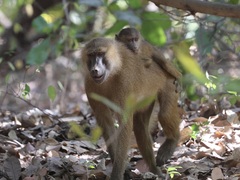
The Guinea baboon (Papio papio) is a baboon from the Old World monkey family. Some (older) classifications list only two species in the genus Papio, this one and the hamadryas baboon. In those classifications, all other Papio species are considered subspecies of P. papio and the species is called the savanna baboon.

The Guinea baboon inhabits a small area in western Africa. Its range includes Guinea, Senegal, Gambia, southern Mauritania and western Mali. Its habitat includes dry forests, gallery forests, and adjoining bush savannas or steppes. It has reddish-brown hair, a hairless, dark-violet or black face with the typical dog-like muzzle, which is surrounded by a small mane, and a tail carried in a round arc. It also has limb modifications that allow it to walk long distances on the ground. The Guinea baboon is one of the smallest baboon species, weighing between 13 and 26 kg (28.6–57 lbs). Their life spans are generally between 20 and 50 years.

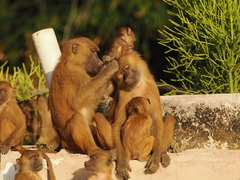
It is a diurnal and terrestrial animal, but sleeps in trees or high rocks at night, away from predators. The number of suitable sleeping trees limits the group size and the range. It lives in troops of up to 200 individuals, each with a set place in a hierarchy. Group living provides protection from predators such as the lion and various hyena species. Like all baboons, it is an omnivorous highly opportunistic feeder, eating fruits, buds, roots, bark, grasses, greens, seeds, tubers, leaves, nuts, cereals, insects, worms, birds and small mammals. Because it will eat practically anything available, the Guinea baboon is able to occupy areas with limited resources or harsh conditions. Its presence may help improve habitats because it digs for water and spreads seeds in its waste, encouraging plant growth.

The Guinea baboon is a highly communicative animal. It communicates by using a variety of vocalizations and physical interactions. In addition to vocalizations to each other, this animal has vocal communications apparently intended to be received and interpreted by predators.

Due to its small range and the loss of its habitat, the Guinea baboon is classified as "near threatened" by the IUCN. Wikipedia →

Global Distribution

Parks Where Found

# Park Country Daily sighting probability
1 Niokolo-Koba National Park 🇸🇳 Senegal
~80%

More parks will be added in future updates.

Zoos & Centres Where Found

# Zoo / Centre Country
1 Cabarceno Natural Park 🇪🇸 Spain In captivity
2 Paris Zoological Park 🇫🇷 France In captivity
3 Brookfield Zoo 🇺🇸 United States In captivity
4 Guadalajara Zoo 🇲🇽 Mexico In captivity
5 Joya Grande 🇭🇳 Honduras In captivity
6 Friguia Park 🇹🇳 Tunisia In captivity
7 Indianapolis Zoo 🇺🇸 United States In captivity
8 Wamerú zoo 🇲🇽 Mexico In captivity
9 Tiergarten Am Tiergarten 6 in Nürnberg 🇩🇪 Germany In captivity
10 La Aurora Zoo 🇬🇹 Guatemala In captivity
11 Sea Life Aquarium Kansas City 🇺🇸 United States In captivity

Before you go

What are the chances of seeing a Guinea Baboon in Niokolo-Koba National Park?

Very likely

About 80% of wildlife watchers report a Guinea Baboon sighting in Niokolo-Koba National Park on a given day, based on 71 verified sightings from GBIF citizen-science data from 2019 to 2026. It is the 2nd most-seen of the 15 mammals we can rate there. Over three days the chance rises to over 90%, if each day is a fresh chance.

When is the best time to see a Guinea Baboon in Niokolo-Koba National Park?

March, May–June and November–January

In those months about 80% of wildlife watchers report a Guinea Baboon in Niokolo-Koba National Park on a given day, against about 60% in April, the lowest month. Those are among Niokolo-Koba National Park's driest months, with about 10 mm of rain a month against 300 mm in August. July to October have too few records to rate.

What time of day is best to see a Guinea Baboon?

Between 10 am and 1 pm

Across all the parks we cover, that three-hour window holds the most Guinea Baboon sightings with a recorded time, and nearly all of them come between 6 am and 6 pm: it is a daytime animal.

Where else can you see a Guinea Baboon?

Only Niokolo-Koba National Park, in our data

Niokolo-Koba National Park is the only park on Wallace's Line with enough records to rate Guinea Baboon sightings: about 80% of wildlife watchers there report one on a given day.

Which relatives of the Guinea Baboon live in Niokolo-Koba National Park?

Same family: Cercopithecidae

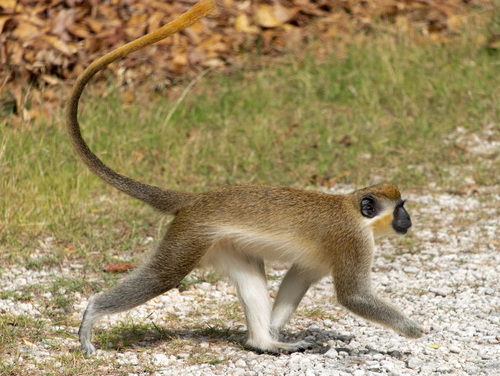
The closest relatives of the Guinea Baboon that you can see in Niokolo-Koba National Park (family Cercopithecidae, Old World Monkeys) are Green Monkey (about 80%) and Western Red Colobus (about 60%), with each one's daily chance of a sighting.

Where does the Guinea Baboon sighting chance come from?

GBIF citizen-science records

It is estimated from how often the Guinea Baboon is recorded against all the mammals logged in Niokolo-Koba National Park (71 verified sightings from 2019 to 2026), calibrated against known sighting rates. Figures are rounded to the nearest 10% because citizen-science data supports honest approximations, not decimals, and months with records from fewer than five people show "—". How it works.

← Back to Niokolo-Koba National Park