Roan Antelope

Roan Antelope

Hippotragus equinus

Silhouette: Mathew Stewart · PhyloPic

LCLeast ConcernNTVUENCR
Daily sighting probability ~60% · Likely
at Niokolo-Koba National Park

In 3 days ~90% in a week >90%

23 Verified sightings at Niokolo-Koba National Park From 2019 to 2026
158 In all 7 parks
March Best month
☀️ Diurnal When it's spotted

About the Roan Antelope

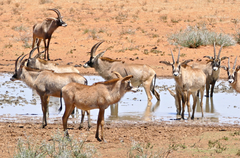
The roan antelope (Hippotragus equinus) is a large, savanna-dwelling antelope found in Western, Southern, and parts of Central and Eastern Africa. Named for its roan colour (a slightly reddish, sandy-brown), it has a lighter-toned underbelly and a (mostly) white face and snout, but with a black "mask" around the eyes and on the bridge of the snout, being somewhat lighter in females. Additionally, a pair of formidable, recurved horns (made of keratin-covered bone) are present on the heads of both males and females, albeit larger on the males, growing up to 100 cm (39 in) long. Males and females have short, erect, mohawk-like manes running down their back and very light, shaggy neckbeards, both of which are more pronounced in males. Both mane and neckbeard are tinted with darker tips, which run the length of the animal's back and belly, ending in a dark-coloured tail. The ears are long, erect, and donkey-like.

The roan is among the world's largest antelopes, after the elands (Taurotragus sp.) and the nilgai (Boselaphus tragocamelus), measuring 190–240 cm (75–94 in) from the head to the base of the tail, with a 37–48 cm (15–19 in)-long tail. Males weigh upwards of 242–300 kg (534–661 lb) and females 223–280 kg (492–617 lb), with a shoulder height of around 130–140 cm (51–55 in). Wikipedia →

Sounds

Recording0:15

Tanzania · 2014

© ChimpAndSee · iNaturalist · CC BY-NC 4.0

Global Distribution

Parks Where Found

# Park Country Daily sighting probability
1 Niokolo-Koba National Park 🇸🇳 Senegal
~60%
2 Kafue National Park 🇿🇲 Zambia
~50%
3 Hwange National Park 🇿🇼 Zimbabwe
~40%
4 Chobe National Park 🇧🇼 Botswana
~30%
5 Akagera National Park 🇷🇼 Rwanda
~30%
6 Moremi Game Reserve 🇧🇼 Botswana
~20%
7 Kruger National Park 🇿🇦 South Africa
~10%

Zoos & Centres Where Found

# Zoo / Centre Country
1 Disney's Animal Kingdom 🇺🇸 United States In captivity
2 Zlín-Lešná Zoo 🇨🇿 Czechia In captivity
3 Dvůr Králové Zoo 🇨🇿 Czechia In captivity
4 Paris Zoological Park 🇫🇷 France In captivity
5 Réserve africaine de Sigean 🇫🇷 France In captivity
6 Aquarium du palais de la Porte Dorée 🇫🇷 France In captivity
7 San Diego Zoo Safari Park 🇺🇸 United States In captivity
8 Safari West 🇺🇸 United States In captivity
9 Port Lympne Wild Animal Park 🇬🇧 United Kingdom In captivity
10 Watatunga Wildlife Reserve 🇬🇧 United Kingdom In captivity
11 Bronx Zoo 🇺🇸 United States In captivity
12 Longleat Safari and Adventure Park 🇬🇧 United Kingdom In captivity
13 Chester Zoo 🇬🇧 United Kingdom In captivity
14 Parco Natura Viva 🇮🇹 Italy In captivity
15 Burgers' Ocean 🇳🇱 Netherlands In captivity
16 Royal Burgers' Zoo 🇳🇱 Netherlands In captivity
17 Lisbon Zoo 🇵🇹 Portugal In captivity
18 Hanover Zoo 🇩🇪 Germany In captivity
19 Havana Zoo 🇨🇺 Cuba In captivity
20 Krakow Zoo 🇵🇱 Poland In captivity
21 Buffalo Zoo 🇺🇸 United States In captivity
22 Reserva Zoológica Oasys MiniHollywood 🇪🇸 Spain In captivity
23 Fossil Rim Wildlife Center 🇺🇸 United States In captivity

Before you go

What are the chances of seeing a Roan Antelope in Niokolo-Koba National Park?

Likely

About 60% of wildlife watchers report a Roan Antelope sighting in Niokolo-Koba National Park on a given day, based on 23 verified sightings from GBIF citizen-science data from 2019 to 2026. It is the 7th most-seen of the 15 mammals we can rate there. Over three days the chance rises to about 90%, and over a week to over 90%, if each day is a fresh chance.

When is the best time to see a Roan Antelope in Niokolo-Koba National Park?

February and March

In those months about 70% of wildlife watchers report a Roan Antelope in Niokolo-Koba National Park on a given day, against about 20% in May and November–December, the lowest months. Those are among Niokolo-Koba National Park's driest months, with almost no rain against 300 mm in August. July to October have too few records to rate.

What time of day is best to see a Roan Antelope?

Between 9 am and noon

Across all the parks we cover, that three-hour window holds the most Roan Antelope sightings with a recorded time, and about 9 in 10 of them come between 6 am and 6 pm: it is a daytime animal.

Is Niokolo-Koba National Park the best place to see a Roan Antelope?

Yes

Of the 7 parks where we can rate Roan Antelope sightings, Niokolo-Koba National Park has the highest daily chance: about 60%. Next come Kafue National Park (Zambia, about 50%) and Hwange National Park (Zimbabwe, about 40%). All parks ranked.

Which relatives of the Roan Antelope live in Niokolo-Koba National Park?

Same family: Bovidae

The closest relatives of the Roan Antelope that you can see in Niokolo-Koba National Park (family Bovidae, Bovids) are Northern Bushbuck (about 70%), Waterbuck (about 70%) and Kob (about 70%), with each one's daily chance of a sighting.

Where does the Roan Antelope sighting chance come from?

GBIF citizen-science records

It is estimated from how often the Roan Antelope is recorded against all the mammals logged in Niokolo-Koba National Park (23 verified sightings from 2019 to 2026), calibrated against known sighting rates. Figures are rounded to the nearest 10% because citizen-science data supports honest approximations, not decimals, and months with records from fewer than five people show "—". How it works.

← Back to Niokolo-Koba National Park