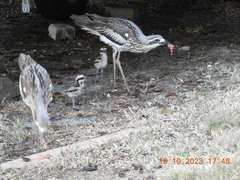
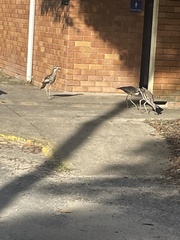
Bush Stone-curlew

Bush Stone-curlew

Burhinus grallarius

Silhouette: Auckland Museum · PhyloPic

LCLeast ConcernNTVUENCR Endemic
Daily sighting probability ~10% · With luck
at Nitmiluk National Park

In 3 days ~20% in a week ~40%

35 Verified sightings at Nitmiluk National Park From 2019 to 2026
972 In all 5 parks
April Best month
☀️ Diurnal When it's spotted

About the Bush Stone-curlew

The bush stone-curlew or bush thick-knee (Burhinus grallarius, obsolete name Burhinus magnirostris) is a large, ground-dwelling bird endemic to Australia. Its favoured habitat is open plains and woodlands, where it stalks slowly at night in search of invertebrates such as insects. Its grey-brown coloration is distinguished by dark streaks, its eyes are large and legs are long. It is capable of flight, but relies on the camouflage of its plumage to evade detection during the day; the bush curlew adopts a rigid posture when it becomes aware of an observer. Both sexes care for two eggs laid on the bare ground, usually sited near bush in a shaded position or next to a fallen branch.

The bush stone-curlew was first described by English ornithologist John Latham in 1801 under the binomial name Charadrius grallarius. Latham published three names simultaneously; however, the seniority of C. grallarius follows the publication of the names in John Gould's Birds of Australia in 1845.

Until a revision determining the priority of names assigned to this species, ornithologists cited the description under the epithet B. magnirostris. Descriptions of subspecies were published by Gregory... Wikipedia →

Sounds

Duet0:21

Australia · 2025

© Étienne Leroy · XC1074100 · CC BY-NC-SA 4.0

Call0:34

Australia · 2024

© Andrew McCafferty · XC1038616 · CC BY-NC-SA 4.0

Recording0:12

Australia · 2024

© Drew Davison · XC895590 · CC BY-NC-ND 4.0

Global Distribution

Parks Where Found

# Park Country Daily sighting probability
1 Daintree National Park 🇦🇺 Australia
~10%
2 Kakadu National Park 🇦🇺 Australia
~10%
3 Lamington National Park 🇦🇺 Australia
~10%
4 Nitmiluk National Park 🇦🇺 Australia
~10%
5 Litchfield National Park 🇦🇺 Australia
~10%

Cities Where Found

# City Country Daily sighting probability
1 Brisbane 🇦🇺 Australia
~10%

Zoos & Centres Where Found

# Zoo / Centre Country
1 Prague Zoo 🇨🇿 Czechia In captivity
2 Australia Zoo 🇦🇺 Australia In captivity
3 Ostrava Zoo 🇨🇿 Czechia In captivity
4 Zoo Pilsen 🇨🇿 Czechia In captivity
5 Territory Wildlife Park 🇦🇺 Australia In captivity
6 Busch Gardens Williamsburg 🇺🇸 United States In captivity
7 Kyabram Fauna Park 🇦🇺 Australia In captivity
8 Alice Springs Desert Park 🇦🇺 Australia In captivity
9 Jacksonville Zoo and Gardens 🇺🇸 United States In captivity
10 Healesville Sanctuary 🇦🇺 Australia In captivity
11 Woodland Park Zoo 🇺🇸 United States In captivity
12 Paignton Zoo 🇬🇧 United Kingdom In captivity
13 Koala Conservation Reserve 🇦🇺 Australia In captivity
14 Hobart Zoo and Aquarium 🇦🇺 Australia In captivity
15 National Zoo & Aquarium 🇦🇺 Australia In captivity
16 Taronga Zoo 🇦🇺 Australia In captivity
17 Wilhelma 🇩🇪 Germany In captivity
18 Cleland Wildlife Park 🇦🇺 Australia In captivity
19 Blank Park Zoo 🇺🇸 United States In captivity
20 Currumbin Wildlife Sanctuary 🇦🇺 Australia In captivity
21 Melbourne Zoo 🇦🇺 Australia In captivity
22 Lone Pine Koala Sanctuary 🇦🇺 Australia In captivity
23 Parndana Wildlife Park 🇦🇺 Australia In captivity
24 Perth Zoo 🇦🇺 Australia In captivity
25 Cologne Zoological Garden 🇩🇪 Germany In captivity
26 Phillip Island Wildlife Park 🇦🇺 Australia In captivity
27 Hartley’s Crocodile Adventures 🇦🇺 Australia In captivity
28 Moonlit Sanctuary Wildlife Conservation Park 🇦🇺 Australia In captivity
29 Vogelpark Avifauna 🇳🇱 Netherlands In captivity
30 Ballarat Wildlife Park 🇦🇺 Australia In captivity
31 Discovery Cove 🇺🇸 United States In captivity
32 Adelaide Zoo 🇦🇺 Australia In captivity
33 Australian Reptile Park 🇦🇺 Australia In captivity
34 Gorge Wildlife Park 🇦🇺 Australia In captivity
35 Symbio Wildlife Park 🇦🇺 Australia In captivity
36 Featherdale Sydney Wildlife Park 🇦🇺 Australia In captivity
37 Ipswich Nature Centre 🇦🇺 Australia In captivity
38 Wildlife Trail 🇦🇺 Australia In captivity
39 Sea Life Sydney Aquarium 🇦🇺 Australia In captivity
40 Wild Life Sydney 🇦🇺 Australia In captivity
41 Birdworld Kuranda 🇦🇺 Australia In captivity
42 Kuranda Koala Gardens 🇦🇺 Australia In captivity
43 Rákosův pavilon 🇨🇿 Czechia In captivity
44 Velemlokárium 🇨🇿 Czechia In captivity
45 Australian Wildlife Park, Albany 🇦🇺 Australia In captivity
46 Cairns Zoom and Wildlife Dome 🇦🇺 Australia In captivity
47 Campbelltown Forest of Wild Birds 🇯🇵 Japan In captivity
48 Caversham Wildlife Park 🇦🇺 Australia In captivity
49 Cologne Zoo Aquarium 🇩🇪 Germany In captivity
50 Kangaroo Island Wildlife Park 🇦🇺 Australia In captivity

Before you go

What are the chances of seeing a Bush Stone-curlew in Nitmiluk National Park?

With luck

About 10% of wildlife watchers report a Bush Stone-curlew sighting in Nitmiluk National Park on a given day, based on 35 verified sightings from GBIF citizen-science data from 2019 to 2026. It is the 59th most-seen of the 103 birds we can rate there. Over three days the chance rises to about 20%, and over a week to about 40%, if each day is a fresh chance.

When is the best time to see a Bush Stone-curlew in Nitmiluk National Park?

April

In that month about 20% of wildlife watchers report a Bush Stone-curlew in Nitmiluk National Park on a given day, against under 5% in February–March, July and October–December, the lowest months. That is one of Nitmiluk National Park's driest months, with about 45 mm of rain against 270 mm in January.

What time of day is best to see a Bush Stone-curlew?

Between 3 and 6 pm

Across all the parks we cover, that three-hour window holds the most Bush Stone-curlew sightings with a recorded time, and about 7 in 10 of them come between 6 am and 6 pm: it is a daytime animal.

Is Nitmiluk National Park the best place to see a Bush Stone-curlew?

Among the best

Of the 5 parks where we can rate Bush Stone-curlew sightings, Nitmiluk National Park ranks 4th at about 10%, level with the leaders once rounded. The best odds are in Daintree National Park (Australia, about 10%), Kakadu National Park (Australia, about 10%) and Lamington National Park (Australia, about 10%).

Where does the Bush Stone-curlew sighting chance come from?

GBIF citizen-science records

It is estimated from how often the Bush Stone-curlew is recorded against all the birds logged in Nitmiluk National Park (35 verified sightings from 2019 to 2026), calibrated against known sighting rates. Figures are rounded to the nearest 10% because citizen-science data supports honest approximations, not decimals, and months with records from fewer than five people show "—". How it works.

← Back to Nitmiluk National Park